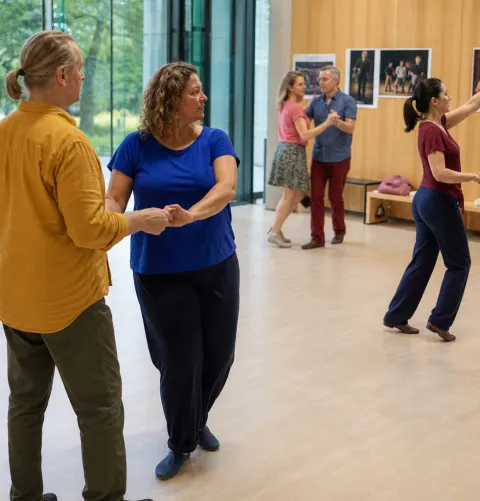
Two observation rounds make details easier to see
The top-ranked points concern information that determines whether a movement can flow into the next one at all. The lower-ranked ones tend to change the visible progression or make the task unnecessarily complicated. This gives you a practical order for observing: First take in the sequence, then follow one missing detail. You don't need to break down an entire sequence into individual frames.
When someone demonstrates a movement repeatedly, use two observation rounds. For the first, stand still briefly and watch the whole person: Where does the action begin, where does the body move, and how does it end? For the second, follow only the part that was unclear on the first try, such as how much weight is placed on one foot. If you want to learn dance steps by watching, this limited task is more helpful than trying to take in every visible detail at once.
The difference between foot position and actual weight placement is especially clear in the Rock Step with a weight change. In the side step in the Waltz, you can instead look at the path from start to finish. These examples show different observation tasks, not interchangeable technique rules: a Waltz movement is not a pattern for Sabar or Kathak. What matters is the specific movement explained in your class.