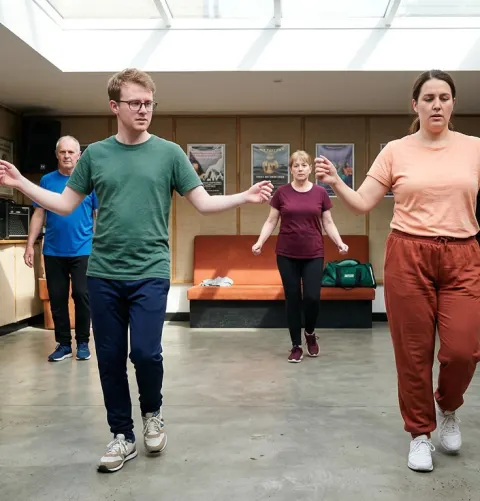
Practice independently5 minutes

Dance steps without a demo: 5 exercises to recall them on your own

By Mary De LucaUpdated

In short
  • Start with a familiar short sequence and a spoken starting cue, while no one dances it in front of you at the same time.
  • Then call out transitions and individual sections without having the beginning shown to you again.
  • Dance the whole sequence after an interruption, and finally to music without a visible model.
  • If you get stuck, use a brief prompt first instead of a full demonstration.

As long as someone is dancing up front, a sequence can feel safe. Only in the brief silence before you start yourself does it become clear which movement you can already choose on your own.

This is how the five exercises are arranged

  • Only sequences already taught

    All exercises assume that you already know the steps used and can perform them with guidance.

  • Less and Less External Help

    The best introductory exercise comes first; after that, the demands increase from a guided start to a complete run-through on your own.

  • No live demonstration

    During each recall attempt, neither the instructor nor anyone else dances for you to imitate.

  • No paid placements

    No one paid to be included; the editorial selection is current as of October 31, 2026.

An open practice space helps you focus on the routine instead of constantly having to dodge around.

Five recall exercises with increasing independence

  1. 01

    Start on your own with a cue

    A familiar sequence, a spoken start cue

    • Getting started
    • starting position
    • brief help

    Take your familiar starting position and ask another person to call out only the start, for example, “basic step,” while they remain still: You begin on your own and dance until the previously agreed end of the short section, without looking for someone to demonstrate the movement. If you miss the very first step, use a single verbal cue from class and start again; it helps if the other person does not demonstrate any direction with their hands or feet.

  2. 02

    Recall the transition after a pause

    Two familiar sections, a pause at the transition

    • Connection
    • decision
    • transition

    Dance a familiar section without a demonstration, stop at the end, and name the following figure before continuing: this lets you work on exactly the point where you would otherwise wait for the instructor's next move. On your next attempt, connect both sections without stopping. If you can't make the transition, you get at most the name of the next section as a cue, then try the transition again instead of having the entire sequence demonstrated once more.

  3. 03

    Start a section directly

    Three familiar sections, changing starting points

    • Direct start
    • sequence section
    • starting position

    Choose three sections from your course sequence and start each one directly, in turn, with the middle, the last, and the first, each from the appropriate starting position: this way, the preceding movement sequence is not available as automatic preparation. Before each start, set your posture, weight distribution, and partner position if needed; if you can only find the entry by dancing the previous figure, go back to its transition and then try starting directly again.

  4. 04

    Starting Again After an Interruption

    One complete sequence, a short interruption

    • Restart
    • full sequence
    • no repetition

    Dance the familiar sequence once without a visible model, then interrupt it briefly, for example by going to the edge and coming back, and then begin again without watching immediately beforehand or running through the movements as a rehearsal. The interruption does not need to last a set amount of time; what matters is starting again from a standstill, finding the starting position and first step yourself, rather than simply using the momentum from the run you just finished.

  5. 05

    Run the entire sequence with music

    A complete sequence, music, no figure calls

    • Independent sequence
    • music
    • keep going

    Dance your familiar course sequence to suitable music, without someone dancing along in front of you and without announcing the next figure; spoken counting may remain, because here you are practicing recalling the movements, not dancing without counting along. If you get stuck, use a familiar basic movement or a safe hold and rejoin at the agreed section, with both partners responding together and without forcing an uncertain turn; continuing counts as part of the attempt just as much as the start.

Target a retrieval gap

The sequence shows you where you still need help: at the start, between two figures, or after an interruption. You don't have to complete all five exercises in one go. Stay with the first point where you can't continue without a model. A confident start doesn't make a missing connection available.

If you get stuck, first stay calm and try to name the next part. If you only can't remember its name, the familiar starting position can help you get going. But if you no longer know how to perform the movement, you need another explanation or demonstration. After that, the demonstration ends again before your own attempt begins. Guessing is no substitute for understanding a step.

Connections between figures are especially revealing: with Foxtrott figures without an extra step and Rumba figures with a direct connection, the ending position is already the start of the next figure. So practise the connection instead of recalling both figures only in isolation.

In a couple, leading and following remain in place. The following partner shouldn't anticipate a set figure just to prove their independence. The leading partner recalls the sequence and gives the usual signals; the following partner responds to them without looking at the teacher. Both maintain a comfortable connection and enough space.

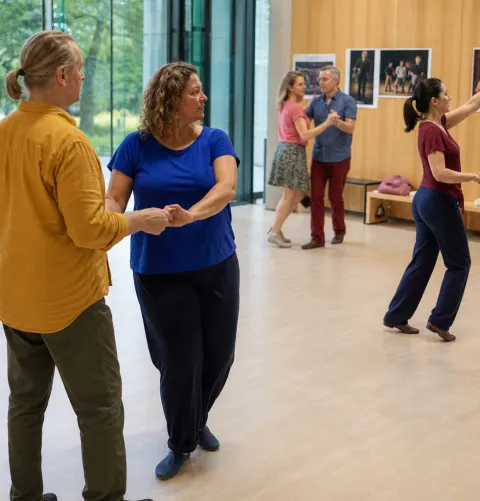
The practice structure at a glance

Exercises with less external assistance
5
Segments for transition retrieval
2
Segments for alternating starts
3

Frequently Asked Questions

  1. You don't need to cover the mirror as long as you don't use another person in it as a movement model. For an extra attempt, you can stand sideways to the mirror. Your own reflection isn't a teacher demonstrating the dance, but it can draw your attention to how you look when you're trying to recall the sequence.

Take the next step yourself, start

On udansa, you can find dance partners for familiar course routines that you take turns starting without a demo. This lets you focus on your transitions as you practice together.

Take the next step yourself, start