Practice on your own6 minutes

Dance without counting: How to replace the instructor's cues

By Bernhard De LucaUpdated

In short
  • Practice a step sequence you already know with music whose start you can confidently recognize.
  • Reduce the cues from full counts to individual start signals and brief reminders.
  • First, let a familiar section play without a voice, then gradually extend the silent sections.
  • If needed, briefly use counting again as a guide instead of continuing to dance silently through an uncertain sequence.

When the instructor's voice falls silent, a familiar sequence can suddenly feel unfamiliar. That's a good reason to scale back the support, rather than put extra pressure on yourself with a strict ban on counting.

What you'll need for the exercise

  • A short, familiar sequence of steps
  • A familiar piece of music with a clear starting point
  • Enough open space for the chosen sequence
  • Comfortable clothing and shoes suitable for the floor
  • Music played without spoken class instructions over it

One cue takes on several tasks at once

The instructor’s voice often provides three pieces of information at once: when to start, which movement comes next, and how long it lasts. If it stops, you may only be missing a reminder of the next section. That doesn’t automatically mean you can’t hear the beat. This guide assumes you can already start confidently with the music you’ve chosen. Finding the beat for the first time and general timing mistakes are different practice tasks.

Change only the verbal guidance, not the music, tempo, and sequence of steps all at once. Choose a manageable sequence with a clear ending. If you’ve already learned them, the connected Foxtrot figures or one of the short Cha-Cha figure combinations are good options. You won’t learn an additional figure for this exercise.

Also distinguish between numbers and movement words. If you only get stuck at “turn,” that transition temporarily needs a cue, not a number for every step. If you can complete the sequence but only your mouth keeps counting, the support has already decreased. Complete silence is not a measure of dancing quality; what matters is that you can keep going without someone else constantly calling out the steps.
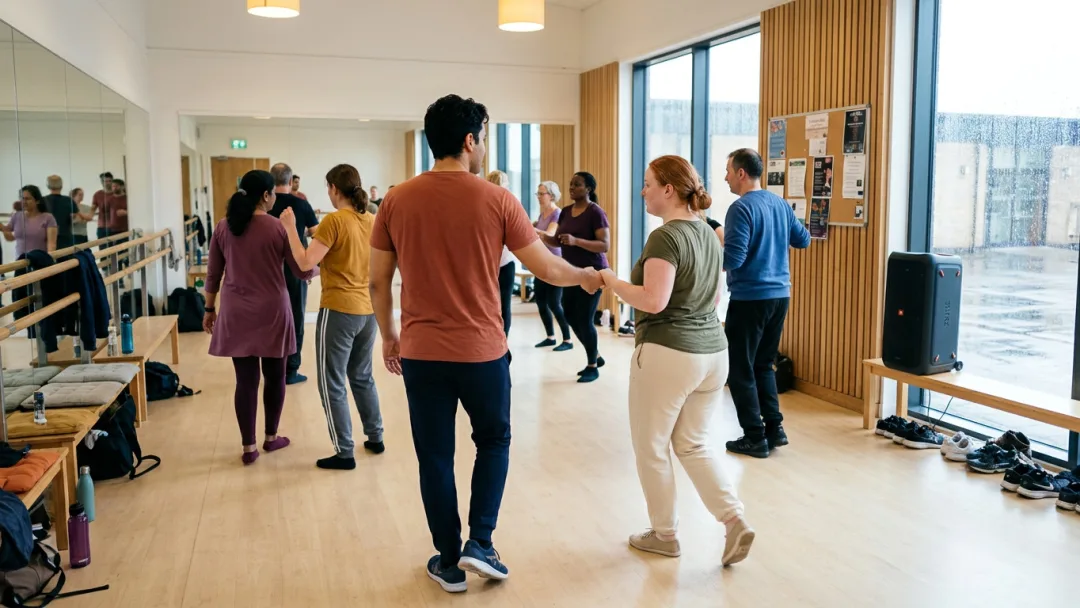
A separate music source lets you get rid of the announcement without having to switch from the familiar track at the same time.

Reclaim your voice in seven steps

  1. Dance a baseline round with verbal cues

    Dance the familiar sequence to familiar music and count as you do in class. Notice whether you verbally cue mainly the start, a transition, or every single step; this round serves as a comparison for the following attempts.

  2. Take over the cueing yourself

    Leave out the instructor's voice and say the familiar counts or movement words yourself. Stick to the same sequence and music; if the flow works, you can create the cues yourself instead of waiting for the instructor.

  3. Say only the cues you need

    Cross out words at points that are already running smoothly, and initially keep the start and difficult transitions. Your feet keep moving between these cues; if they don’t, deliberately add the cue before the sticking point.

  4. Leave one section completely silent

    Choose the safest section and don't say any numbers there either. Give your start signal beforehand, and don't give another cue until the next transition. The round is successful if there is neither a pause nor an extra step.

  5. Extend the Silent Stretch

    On the next run-through, let the next familiar section play without a cue as well. You can keep counting internally; once the transition works without an audible cue, your current level of support is enough for a longer stretch.

  6. Briefly mark only the beginning

    Now use just a brief starting cue and dance through to the familiar ending without any further cues. Focus your attention on the music and the movement sequence; if you feel unsure, add a single cue there again on your next attempt.

  7. Dance a final round without speaking

    Start from your familiar musical starting point and leave out the opening word too. Compare it with the original round: if the order, transitions and ending stay the same, you’ve replaced the instructor’s cue for this sequence, even if numbers still occasionally come to mind.

How to keep the practice meaningful

Do this

  • Add cues only at the points where they are actually needed
  • If the flow stalls, use the last safe level of assistance
  • Pause briefly between repetitions and start again

Not like this

  • Loudly comment on every step again out of habit
  • Insist on continuing to dance silently despite losing the sequence
  • Frantically start over from the beginning during a repetition

Your result after each practice phase

Before scaling back

Starting point

After the quiet sections

Progress update

After the final round

Result

Frequently asked questions

  1. No, counting silently is a valid aid, not a mistake. You can know a sequence without someone else calling it out and still think numbers at times. It only becomes an issue when counting takes up so much of your attention that you barely notice the music, the space, or your connection as a couple.

Dance familiar routines on your own

On udansa, you can find dance partners to practice the material you know from class without constant prompting. Just describe a sequence you already know and your preference for relaxed practice sessions.

Dance familiar routines on your own