Movie dances5 minutes

Learn Dirty Dancing: What Makes the Movie Scene Recognizable

By Bernhard De LucaUpdated

In short
  • The Dirty Dancing scene remains recognizable through partner interplay, rhythmic weight changes, and distinctive arm gestures, even without the lift.
  • Mambo defines the film, but the finale is a mixed show choreography.
  • A simplified version for learning retains musical accents and selected poses instead of copying every step from the film.
  • The overhead lift is not for independent practice and requires qualified instruction and professional safety measures.

In the living room, a movie scene suddenly feels different: no cuts, no close-ups, no audience to carry the ending. That’s exactly why it matters which movements still tell the same story from a few meters away.

DefinitionMovement motif

A movement motif is a short, recognizable movement or sequence of movements that recurs in a choreography. It can be a particular arm pathway, a weight shift, or a shared pose.

Mambo and the Final Duet Have Different Roles

If you want to learn the Dirty Dancing dance, it helps to start by making a distinction: the Mambo-influenced dance sequences and the final duet to “(I've Had) The Time of My Life” use different movement styles. The Mambo sequences stand out for rhythmic weight shifts, mobile hips, and direct exchanges between the dancers. They feel more compact than the finale’s grand, audience-facing gestures.

The final duet also tells a story of changing roles. Baby is no longer just a student beside Johnny, but steps forward as an active partner. You can see this in the movements she performs on her own, their responses to each other, and the moments when they present themselves together. The relationship between the two is part of the choreography, not just the order of their steps.

So, for a simplified version, it matters which scene you have in mind. A short Mambo sequence needs a clear sense of rhythm and a partner to dance with. An excerpt from the finale also needs moments when the couple opens up to the space around them. For a broader overview of these kinds of differences, see the guide to dances from film and television. The film title alone does not refer to one single dance style.
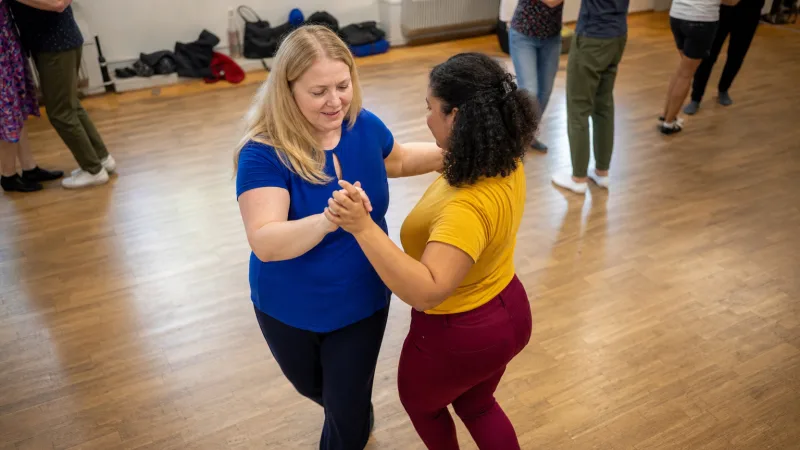
Even the pause between two movements can make a musical climax visible.

Recognition comes from selection and transitions

A Dirty Dancing choreography cannot be meaningfully reduced to a list of famous poses. Between approaching, turning and opening the arms are transitions: Your weight has to land on the right foot, a hand connection has to be able to release, and both people need time to face the new direction. In the film, camera angles and editing guide your attention. When you dance it yourself, the movement has to be clear on its own.

One possible version for learning, over eight counts, would be: four calm weight shifts facing each other, two counts for a small change of direction together, and two for an open arm position. This is explicitly not an original sequence from the film. It shows the principle: a short sequence keeps the rhythm, connection with your partner and a clearly readable gesture, without including difficult connections.

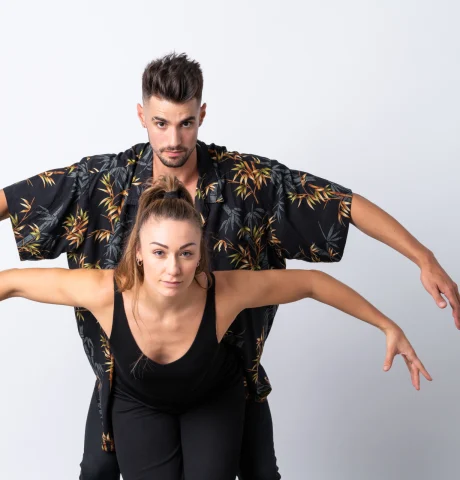
The musical timing matters too. Opening your arms has a different effect at the beginning of a sung phrase than in the middle of a transition. You can also stop and hold the position at a musical high point. Similarly, the V-shaped finger gesture in front of the eyes in the Pulp Fiction dance and the angular arms in the Wednesday dance help make them recognizable. This reinforces the idea of selection, but does not replace the partner-focused movement language of Dirty Dancing.

How to recognize a useful learning version

Like this

  • Combine a distinctive arm gesture with calm steps
  • Make a turn small and upright
  • Finish with both people on the floor
  • Pause briefly together for an accent

Not like this

  • Force arm gestures and quick steps at the same time
  • Speed up the turn by pulling on your partner's arm
  • Attempt the lift with a running start and improvised help
  • Fill every musical pause with more steps

A film version can omit steps, as long as the relationship between the dancers and the accents in the music remain visible.

udansa editorial team

The finale works with your feet on the floor, too

The famous overhead lift is an acrobatic move with a significant risk of falling. The takeoff, balance and support must all work together; strength alone is not enough. A strong partner, a soft carpet or friends standing nearby do not make the attempt safe. A lower lift is still a lift. These moves belong under qualified instruction with appropriate professional spotting, not in a version you work out on your own for the camera.

You can keep the dramatic climax without lifting anyone. One person stays standing and opens their arms while the other steps to their side; then they both turn outward together. This keeps the transition from a personal dialogue to a presented finale. It is an alternative in its own right, not a recreation of the lift. The approach, takeoff and overhead hold are all left out entirely.

Deep backbends are not a necessary substitute either. A stable shared stance gives you more freedom for facial expression and musical timing. Movement-friendly dancewear for training gives you room to move your arms freely, but it does not protect you from mistakes during lifts. The safe simplification comes from leaving out risky moves, not from wearing the right outfit.

Two forms of expression within the same film

Mambo

Small movements, direct dialogue

The dancers respond to one another

In Mambo sections, attention often lies between the dancers: rhythmic footwork, a mobile torso, immediate reactions. An instructional version can stay compact here. You don't need to travel far to show the shift between closeness and distance.

Finale

Big Gestures for the Whole Room

The Couple Opens Up to the Audience

The closing duet also directs its impact outward: open arms, clear positions and shared high points. A learning version can preserve this stage presence. To do so, selected gestures are given more space, while the connecting steps remain simple.

Frequently Asked Questions

  1. Mambo is important in the film, but not every dance sequence is a pure Mambo routine. The finale in particular combines different movement styles into a show choreography. If you practice Mambo, you’ll develop suitable rhythmic foundations, but that won’t automatically teach you the entire film scene.

Partner Dance and Latin for Your Film Idea

You can practice weight shifts, partner connection, and musical accents as a foundation for your grounded film interpretation.

View All Matching Courses

Your take on the movie needs a partner

On udansa, you can find dance partners to create a short, low-to-the-ground Dirty Dancing routine. Describe exactly what you're looking for: a partner scene and a final duet, without lifts.

Your take on the movie needs a partner