Movie scenes6 minutes

Learn the Napoleon Dynamite dance: The solo in 4 sections

By Mary De LucaUpdated

In short
  • You practice the solo to Canned Heat as a simplified sequence of four blocks, each with eight counts.
  • First, you learn side steps and weight changes, then add the arm movements for the same blocks.
  • You hold the final pose for four beats while continuing to count in your head.
  • The short learning version captures the alternation between movement and stillness, not every dance step from the film scene.

A broad arm movement can look confident, even when the feet are barely moving. Recreating this scene often gets hectic when every second has to be filled and the deliberately calm moments disappear.

What you need for the short sequence

  • “Canned Heat” by Jamiroquai, ready to play
  • A flat, clear space for small side steps
  • Comfortable clothes and clean sneakers that fit securely
  • An audible beat to count to eight
  • Pain-free movement of your knees, shoulders and ankles

The learning version needs contrast, not a film copy

In Napoleon Dynamite, the main character, played by Jon Heder, performs a stage solo to Canned Heat by Jamiroquai. You can recognize the mix of changing foot actions, striking arm gestures, and a deliberately deadpan attitude. For your short version, this contrast is enough: simple paths below, clearly visible gestures above, and time to pause in between. You don’t need to copy the costume or facial expression exactly.

The following 32 counts are a specially simplified practice sequence, not a transcription of the original choreography. Its four sections are called Side Steps, Arms, Heels, and Pause. Each section consists of eight evenly counted beats. This breakdown is a learning aid and doesn’t claim that the film scene is structured exactly this way.

The key is the difference between tapping and putting weight on a foot: you can lift an unweighted foot again straight away, while a weighted foot supports you. The guide to the Rock Step with a clear weight change also explains this distinction, but you don’t need to use its step sequence here. Keep your knees relaxed and your steps small. The practice plan between two class sessions can help you practice over several days. For now, your goal in this session is to complete one run-through without losing count.
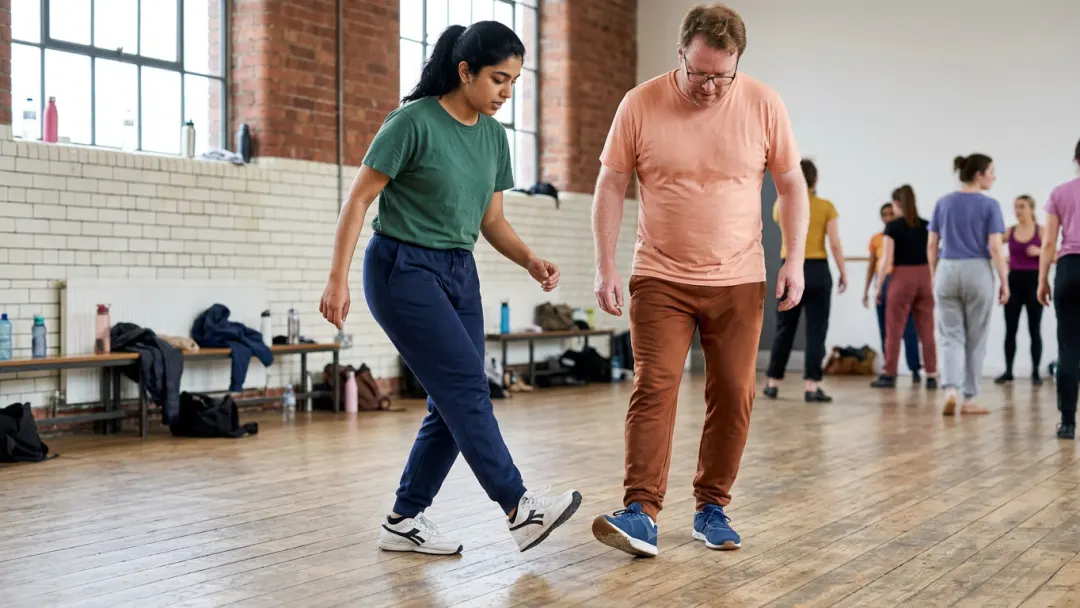
A light toe tap and a weighted step can look similar, but they require different transitions.

Connect the four blocks into a solo sequence

  1. Pick Up the Basic Beat

    Listen to Canned Heat while standing still and count evenly to eight twice. Begin your practice sequence on the next one; the exact entry point in the song is chosen freely for this learning version.

  2. Side Step

    Block A: Step to the right on 1, bring your left foot in and transfer your weight on 2; step to the left on 3, bring your right foot in and transfer your weight on 4. Repeat on 5 to 8. Keep your arms relaxed at first; you’ll end up roughly where you started.

  3. Lead your arms clearly

    Block B: Take eight small steps in place, starting with the right. Lead both arms diagonally up to the right on 1 and 2, then up to the left on 3 and 4. Open them out to the sides on 5 and 6, then lower them on 7 and 8.

  4. Tap your heels alternately

    Block C: Tap your right heel forward on 1, step back onto your right foot on 2 and transfer your weight. Tap your left heel forward on 3, step back onto your left foot on 4 and transfer your weight. Repeat on 5 to 8, keeping your hands on your hips.

  5. Make the Pause Visible

    Block D: Step small in place on counts 1 to 4, starting with your right foot. On 5, place your right foot hip-width apart, open both arms out to the sides, and stay still through 8. Keep your weight on both feet; continue counting without bouncing.

  6. Connect the transitions without music

    Dance A, B, C and D once while counting aloud. After A and B, your right foot is free for the next beginning. After C, start the walking section with your right foot; after D, the sequence is finished. If a transition feels awkward, make the steps smaller.

  7. Repeat the sequence to the song

    Dance all 32 counts to Canned Heat. If your arms fall behind the beat, shorten their paths instead of speeding up your feet. End each round with the held pose and start the next only after a deliberately counted lead-in.

This keeps the movements easy to read

Like this

  • Open your arms within your comfortable reach
  • Keep your upper body over your standing foot during the heel tap
  • Keep your gaze calmly forward when changing arms
  • Shorten your steps at a faster tempo

Not like this

  • Yank your arms behind your body
  • Throw your weight onto your front heel
  • Turn your head to follow each hand
  • Work against the tempo with longer steps

Check off your run-through

Before the first run-through

Preparation

After the individual sections

Building blocks

After the music run-through

Connection

Frequently asked questions

  1. No, you don't need to memorize the entire film scene for this learning version. You'll learn a connected selection with its own counting structure. If you watch the scene as well, pay attention to the switch between small foot actions and big gestures, not to as many details as possible at once. This prevents you from constantly expanding the short sequence with new movements.

Practice the next film sequence together

On udansa connect, you can find people to practice short film solos alongside. Arrange a run-through where one person counts and the other dances the transitions.

Practice the next film sequence together