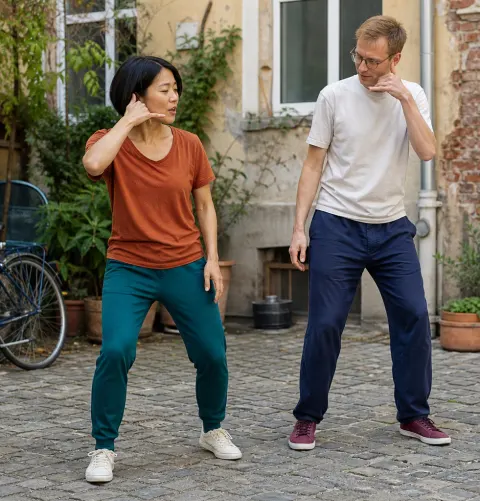
Nail the cues together
On udansa, you can find dance partners to practice the short Git-Up sequences with. Together, it's easier to hear when one move is already leading into the next cue.

By Mary De LucaUpdated
On udansa, you can find dance partners to practice the short Git-Up sequences with. Together, it's easier to hear when one move is already leading into the next cue.
A short clip can look convincing and still get the moves wrong. If you use the song as a guide rather than relying only on the visuals, you can pick the sequence back up even after missing a cue.
A tap is a brief touch of the floor with your free foot, without shifting your body weight onto it. Your other foot remains your supporting leg.
Blanco Brown's song The Git Up was released in 2019. For the classification here, what counts is the first uninterrupted block of instructions in the original recording, not an arbitrarily shortened clip. The footwork below is a simplified learning version, not a claim that every challenge video has to show the same details.
Step your right foot to the right and shift your weight onto it. Tap your left foot beside it without putting weight on the left. Then step your left foot to the left, shift your weight onto it and tap your right foot beside it. This step-touch movement is a simple way to perform the first instruction. The typical mistake: You put weight on the tapping foot too, so you need an extra step before you can change direction.
A common version uses sideways cross-steps: step right to the side, cross your left foot behind your right, step right to the side, then place your left heel lightly in front without putting weight on it. Then mirror the pattern to the left. This block belongs to the Cowboy Boogie instruction, not retroactively to the Two-Step. The heel at the end is an accent, not a new supporting foot. The explanation of counting in Line Dance can help you tell steps apart from intermediate accents.

After the Cowboy Boogie, the song calls for drawing a sweetheart in and turning out. Dancing solo, you can represent this part with small steps around your own axis. The cue does not specify a turn size that applies to every clip. For this learning version, a small turn is enough, after which you should be standing steadily facing forward again. Do not turn on a planted foot with your knee twisted.
The hoedown comes next. As a simple way to represent it, alternate stepping in place with your right and left foot, keeping your knees soft and your arms relaxed. The turn and the hoedown are two actions in sequence. If you do both during the Cowboy Boogie, you will be missing a movement for a later lyric cue.
Only after that does the cue direct you to the left. Step out to the left and comfortably bring your right foot in. For the dip, bend your knees a little lower while keeping your upper body controlled. On the following downward accent, you can move your hands down; when the drinking cue comes, bring a hand to your mouth in a drinking gesture. You do not need an actual drink. As you lean back afterward, keep your knees soft; make the accent small instead of arching your back. The hip movement and arm gestures belong here, not in the opening Two-Step.
Like this
Not like this
A verbal cue during a song names a movement, but it doesn't replace an explanation of which foot is carrying your weight.
In the later cueing section, you hear left twice, then right twice. A clear learning version turns this into two small steps to the left and two to the right: step left to the side, bring the right foot in with a weight transfer, then step right to the side and bring the left foot in with a weight transfer. Unlike the opening Step-Touch, bringing your foot in here is a weighted step. This leaves the right foot free for the next move each time.
Next come the cues to go left or right and kick. Step to the left side and kick the free right foot low to the front. Then step to the right side and kick the left foot low to the front. In this learning version, the side named describes the direction of travel, not the kicking foot. A common mistake is to interpret going left and kicking left as the same move.
You can do the following section, where you continue moving on your own, with relaxed alternating steps in place. It is not another Cowboy Boogie. Right and left refer to your body, not the half of the screen. Videos filmed from the front can make the sides seem reversed; the tips for not mixing up right and left when dancing explain this extra mental challenge.
Cues provide orientation
The voice marks when a movement block changes. So you can recognize the cues even when someone adds extra arm gestures in the video. The text alone, however, doesn't determine every foot placement or turn size.
Footwork makes movements easier to follow
A full-body video shows how someone shifts their weight between cues and places their free feet. Seeing how the movements are done helps you with the transitions. However, a mirrored clip or a personal variation can change directions and details.
No, you can dance the Git-Up Challenge on your own. The cue with the sweetheart invites you to do a partner move, but a partner isn’t essential. In a solo version, replace this move with your own turn and keep your arms close enough to your body so you don’t hit anyone.
No, the challenge to the song The Git Up isn’t a complete guide to the Country partner dance Two-Step. It combines named moves, gestures, and short foot sequences into a follow-along routine. The term Two-Step refers to one part of the song’s sequence here, not the entire challenge or a comprehensive partner-dance technique.
Skip the turn and join in again at the next clear cue. Rushing to add an extra turn can throw off the following move, too. Keep the beat with small steps and follow the next cue instead of trying to catch up on the skipped move.
Yes, you can dance the challenge with low-impact weight shifts instead of jumps. You can also keep the kicks small without losing their place in the song. For additional modifications, check out Line Dance Without Jumping for suitable substitute moves that keep the musical timing.