Screen Dances5 minutes

Choreography Course: Learn a Scene or Dance Freely?

By Bernhard De LucaUpdated

In short
  • A choreography class is a good fit if you want to dance a specific sequence of movements to a set section of music.
  • A style class is a good fit if you want to use characteristic movements to other songs and in a changing order.
  • Choreography classes don't automatically teach you to dance freely, and style basics don't automatically give you the movie scene you're looking for.
  • You can combine both learning goals if set sequences and their technical foundations are taught together deliberately.

A few seconds often stay with you from the screen: a shared stop, a change of direction, a particular expression. Whether you want to recreate that exact moment or dance in a similar way later changes what you need from a class.

DefinitionTransferable Style Fundamentals

Transferable style fundamentals are the characteristic movement principles, rhythms, and technical skills of a dance style that you can use in different sequences and to various suitable pieces of music.

A fixed sequence ties movements to the music

In choreography classes, you learn a planned arrangement of movements. It is not just the steps that are fixed: pathways, directions of gaze, pauses, and musical accents can also be part of the routine. If you want to repeat a particular screen dance scene, this connection is helpful. The group stop should then come at exactly the point where the music supports it.

Classes usually break the sequence into manageable sections and then connect them. Counts make the order easier to grasp; later, audible accents help you do more than simply work through the numbers. A movement can be technically correct and still come too early. That is why the learning goal includes the connection between movement, timing, and effect.

Fixed sequences are by no means just for performances. A Quickstep figure combination made up of three building blocks also uses a set order to make transitions clear. The difference lies in whether this order is your desired end result or a framework for practicing variations later. A specific movie scene, such as the Grease Hand Jive, can instead be identified by its recognizable movement motifs.
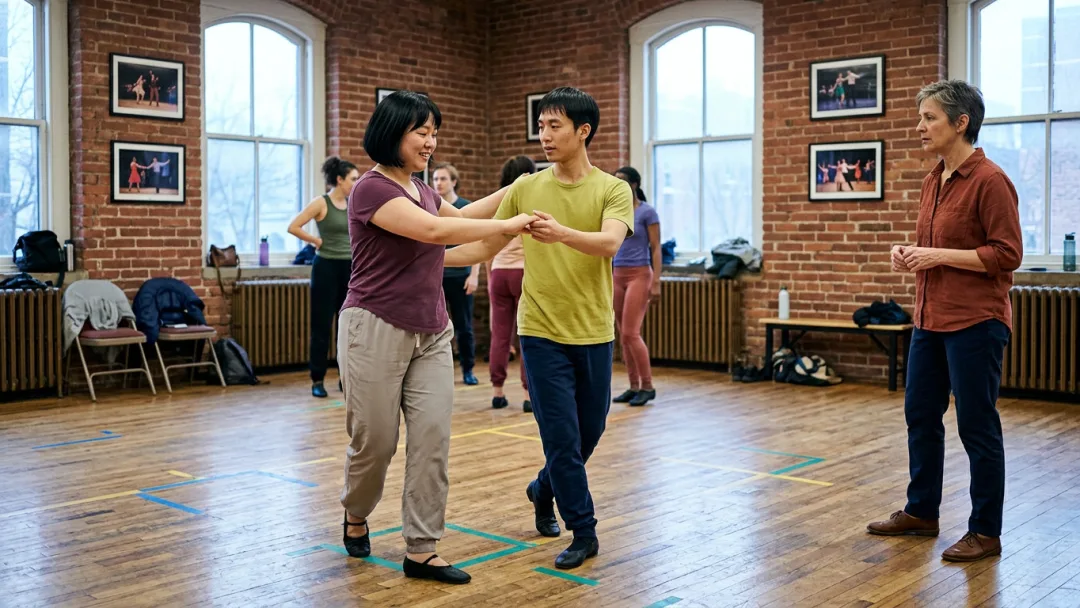
Floor markings can help keep pathways clear, but you need to work out the right distance with your partner.

The Visible Form Doesn't Reveal the Whole Technique

A film scene shows you where a body moves, but not always how the movement happens. Camera angles, editing, and clothing can hide foot contacts or weight shifts. If you copy only the visible form, you may have your arm in the right place but be standing on the wrong foot for the next step.

Dance technique focuses on these foundations: a stable stance, movement coordination, rhythm, and controlled transitions. In partner dancing, connection and communicating movement intentions also come into play. Knowing a shared turn by heart doesn't mean you can reliably lead or follow it with a different partner.

One example is weight transfer in Slowfox: The flow of movement comes not just from taking big steps, but from the way your body continues moving over the supporting foot. Principles like these remain useful when the sequence changes.

Choreography and dance technique are therefore not opposites. Even a fixed sequence requires technical work. The difference is whether you're learning to stabilize a particular passage or to apply a principle in several situations. Moments in class that look similar can therefore serve different goals.

How to tell you're making progress

Suitable learning goal

  • Dance the desired sequence through to the agreed ending
  • Use familiar movements to another suitable song
  • Consciously resume dancing after an interruption
  • Perform a sequence with controlled weight shifts

Wrong Standard

  • Judge every free variation as a mistake in the sequence of scenes
  • Measure free dancing only by whether you recognize a scene from a movie
  • Equate a memorized sequence with improvisation
  • Imitate only the outer pose without mastering your footing

A fixed sequence shows you what comes next; transferable fundamentals help you decide for yourself what could come next.

Dance guide editorial team

Your goal determines what should work later

The choice between choreography and dance technique becomes clearer when you picture the moment after class. Do you want to play the same music and dance the scene you want, from beginning to end? Then a set sequence is a useful reference point. You can work on precision without constantly having to come up with new moves.

On the other hand, if you want to dance to a different suitable song, your skills need more flexibility. Transferable style fundamentals let you choose moves, adjust their range and create new transitions. Dancing freely does not mean throwing every rule out the window. Rhythm and characteristic movement principles of the style remain useful guides.

Both can be part of the same class. A short choreography then serves as shared material for learning a movement principle. If the music changes afterward or the sequence is opened up, you get a chance to apply what you have learned. If every repetition stays the same, you mainly refine that version.

So wanting a film choreography class can mean two things: recreating the scene or understanding its movement language. Neither goal is more demanding simply because it is set or free. What matters is which result you actually want to use.

Two equally valid ideas of skill

Scene

You want to repeat a moment

Your reference point remains a specific moment in the music

You can recognize your progress when your pathways, accents, and expression come together. The reliability of the sequence gives you room to work on your gaze and the effect you create. A set version may be exactly what you’re looking for.

Style

You want to make your own choices

Your point of reference is the language of movement

You can see your progress in your ability to combine familiar movements in new ways. A different song that suits you becomes an opportunity to add your own accents. Your version doesn't need to look like a scene from a film to feel confident and make sense stylistically.

Frequently Asked Questions

  1. Yes, if the sequence and pace of instruction are designed for beginners. You don't need a long list of figures, but you do need enough repetition to work on rhythm, weight changes and transitions. A short sequence with clear movements can be more accessible than a seemingly simple scene with quick changes of direction.

From watching to dancing

On udansa, you’ll find people to practice with, whether you want to work on a set routine or freely connect familiar moves. Having similar learning goals helps you make the most of your practice session together.

From watching to dancing