Movie Dance Numbers5 minutes

Which Musical Dance Class Is Right for Your Movie Dance Number?

By Mary De LucaUpdated

In brief
  • For a film musical number, you need dance technique, musical phrasing and guided work on a complete choreography.
  • A suitable dance class combines movement with direction of gaze, expression and, where appropriate, formations or partner work.
  • Singing rehearsals and spoken scenes alone do not make a musical program dance lessons for the scene you have in mind.
  • The class must cover the movement style of your film number, such as jazz technique or tap dance if audible foot rhythms are involved.

On screen, the steps, looks, and music seem to flow together seamlessly. In class, they become different exercises, and the name of the musical doesn't tell you which ones you'll actually practice.

DefinitionPhrasing

In dance, phrasing means structuring and shaping movements to fit musical sections that belong together. This includes how you begin, build, and finish a movement phrase.

A musical film number includes several kinds of movement

Musical Dance does not refer to a single step technique. One musical number may rely on flowing, expansive movements, another on quick foot rhythms or precise group formations. So what matters for your course is the specific physical challenge in the scene. The film title alone does not describe it.

A Musical Dance course should bring together three elements: movement technique, musical expression and the context within the number. Technique, for example, means shifting your weight onto the supporting foot at the right time or finishing a turn with control. Musical expression is about whether a movement stops on an accent, continues over several beats or begins only after a pause.

Context comes from transitions, directions of gaze and pathways through the space. A step can seem searching, triumphant or hesitant without requiring an additional acting scene. When audible foot rhythms are involved, sound production also comes into play: the Cramp Roll in tap dance is a good example of how precisely foot contacts can be distinguished musically. Regular choreography training does not replace this specialized technique. A suitable film musical dance course works on the challenges your number actually involves.
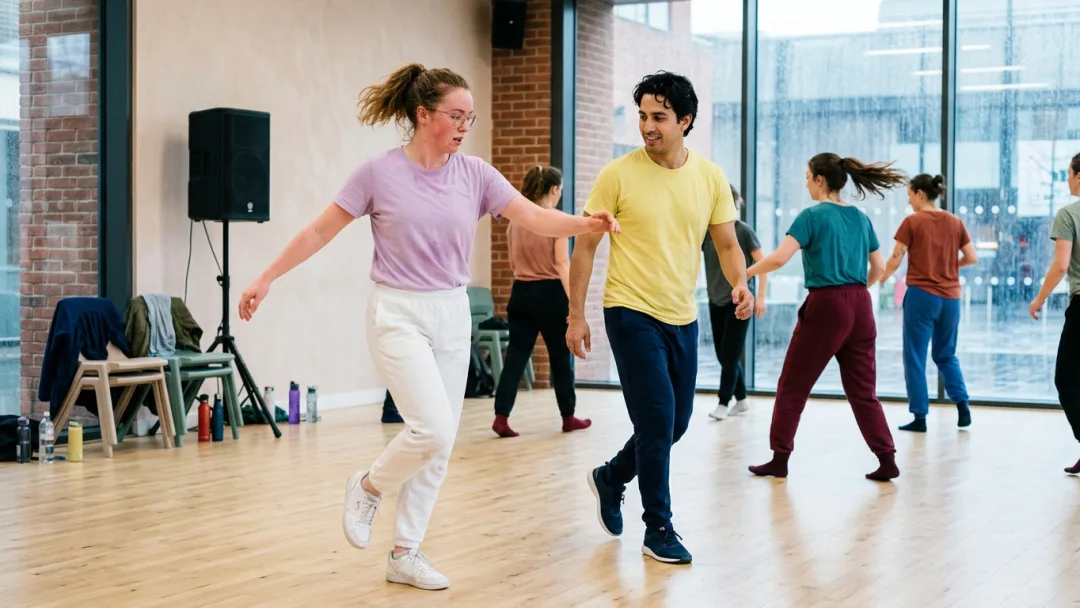
Even a short dance sequence needs space for traveling steps, not just steps in place.

Musical theatre classes don't automatically focus on dance

A musical combines several forms of expression. Accordingly, a class with this name might focus mainly on learning songs, developing roles, or preparing a short performance. These are worthwhile teaching goals, but they do not automatically meet your wish to learn a fully developed dance number from a film.

The difference lies in the kind of guided repetition. In a dance class, a sequence might be paused because a weight shift is missing, the arms are interrupting the flow of movement, or a group is losing its timing. Then you perform it again with that specific correction. In a singing rehearsal, the same repetitions might instead focus on pitch, pronunciation, or breathing together. Both groups are working on the same song, but on different skills.

Expression is not necessarily a sign of acting lessons either. If you turn your gaze toward your partner during a dance sequence or extend a gesture, that is directly part of the dance. But when dialogue, character biographies, and spoken scenes become the main focus, the emphasis shifts. A class called musical choreography should therefore not treat movement merely as an accompaniment to singing. The dance number you want to learn needs dedicated practice time and specific feedback.

How to identify the focus

Dance lessons

  • Weight shifts and movement quality are refined
  • The group repeats transitions with musical cues
  • Gaze and gestures are worked on in the dance sequence
  • Movement pathways are rehearsed alongside the steps

Insufficient evidence of dancing

  • Movements are demonstrated only once
  • The group sings the song without repeating the movements
  • Figures are developed only in spoken scenes
  • Formations are arranged only for the final photo

A well-known song is not yet dance content: What matters is which movement task you can actually work on with it.

udansa editorial team for dance classes

Film effects need to be translated into a teachable exercise

In film, a number’s impact also comes from camera angles, editing, costumes, and changing locations. A dance class cannot simply provide these elements. A close-up, for example, makes a small hand gesture clearly visible, while the same gesture can be lost from a distance in a large group. Classes need to make these differences understandable through movement.

For musical dance classes, this means that a passage needs a clear orientation, suitable spacing, and a range of movement that works in the space available. Ensemble work also means starting at the same time while taking up different positions. In a duet, the distance between partners affects whether a gesture comes across as an invitation or a rejection. These are specific choreographic tasks, not a matter of elaborate costumes.

A finished performance is not essential proof of quality. A sequence can be worked on in depth even without an audience. Conversely, a final presentation does not show how much individual feedback has been given. That is why, for compact programs, the structure of an intensive dance course matters: there needs to be time for technique, application, and further repetition. What matters is whether you can follow the dance relationships in the scene, even without a camera or a set.

Two Legitimate Teaching Goals

Dance

Choreographing a Number

Movement is the central focus

You work on how steps, accents and spatial relationships carry the scene. The vocals can come from a recording, so you can focus on the movement. This is a good fit if you want to understand and recreate the dance impact of a film number.

Musical

Combining several stage roles

Voice, role and movement share the time

You get into character, sing and move within a scene. The dance sequence can deliberately stay simple to leave room for the other tasks. This works well if you want to perform as both a singer and an actor.

Frequently Asked Questions

  1. You don't need to be able to sing for a class focused purely on dance. The music can be played entirely from a recording. When you sing while moving, breath control and vocal exertion become part of the class, which is a different learning goal from dancing to a song from a film.

Jazz Classes as a Foundation for Musical Theatre Dance

Here you'll find jazz classes focused on movement technique. A particular movie musical is not necessarily part of the course.

View all matching classes

Your on-screen dance number needs teamwork

On udansa, you'll find dance partners for rehearsals and classes where you can work on the dance fundamentals for the scene you have in mind.

Your on-screen dance number needs teamwork