
K-Pop cover dancers meet online
Find like-minded people who share your passion for K-Pop, and start your own crew. On udansa, dancers connect for joint training sessions, cover projects, and mutual feedback.



By Bernhard De LucaUpdated
Find like-minded people who share your passion for K-Pop, and start your own crew. On udansa, dancers connect for joint training sessions, cover projects, and mutual feedback.
K-Pop thrives on emotion and pure energy. With the right facial expression, you can turn a simple sequence of steps into a captivating performance that instantly draws your audience in.
Anyone who has ever seen a performance by K-Pop idols knows exactly: flawless dance steps are only half the battle. What distinguishes a good performance from an unforgettable one is the emotional charisma. In K-Pop, the face is the most important tool for telling the story of the song and building a connection with the audience. Every smile, every intense gaze, and every subtle wink is precisely timed to the beat. When you are learning K-Pop choreography, you should consider facial expressions as an integral part of the movement from the very beginning, rather than as an afterthought.
Expressive facial mimicry immediately compensates for minor dancing insecurities. It draws the audience's gaze to your personality and gives the performance the necessary depth. Without the appropriate facial expression, even the most technically perfect choreography appears cold and mechanical. Only through targeted interaction with the camera or the virtual audience does the dance come to life and leave a lasting impression.

Listen to the song carefully and divide it into emotional sections. Determine whether the part should feel sweet, cool, sexy, or energetic, so that you know which emotion your face needs to convey.
Stand close to the mirror and practice individual facial expressions completely without dance steps. Hold a wide smile, a serious look, or a cheeky wink for several seconds to get a feel for your muscles.
Now, connect your facial expressions with the pure head and shoulder movement while you feel the basic rhythm of the song. This is how you get used to tilting your head to match your angle of view, as udansa encourages you to do.
Dance the choreography at a slowed-down tempo and consciously apply the prepared expressions at the key moments. As soon as this works at a slow tempo, gradually increase your speed until you reach the original tempo.
Record yourself from the front and analyze your performance afterwards. Pay attention to whether your eyes look lively or if you fall into a concentrated stare during fast passages.
Like this
Not like this
Preparation
During
Follow-up
K-Pop idols use targeted facial muscle exercises and systematically train their expressions in front of a mirror. They analyze their performance videos second by second to perfectly coordinate the interplay of gaze, smile, and head position with the camera.
When dancing, the face often freezes because all concentration is on the steps. As soon as the body executes the movements automatically, mental capacity is freed up to actively control facial expressions and change them to the beat of the music.
Stage presence is created by the combination of a confident posture, direct eye contact, and dynamic facial expressions. Anyone who physically and facially experiences the emotions of the song automatically radiates a strong presence.
Find the right studio and learn expressive choreographies right in your area.
Hip HopOranienburg OT Lehnitz · Germany
Hip Hop 6-8 J.Monday · 17:00 · Oct 19
Kulturhaus Friedrich-Wolf
Hip HopLimbach-Oberfrohna · Germany
HipHop 11 - 13 JahreFriday · 15:45 · Oct 30
Limbach-Oberfrohna
Hip HopOranienburg OT Lehnitz · Germany
Hip Hop ab 9 J.Monday · 18:45 · Oct 19
Kulturhaus Friedrich-Wolf
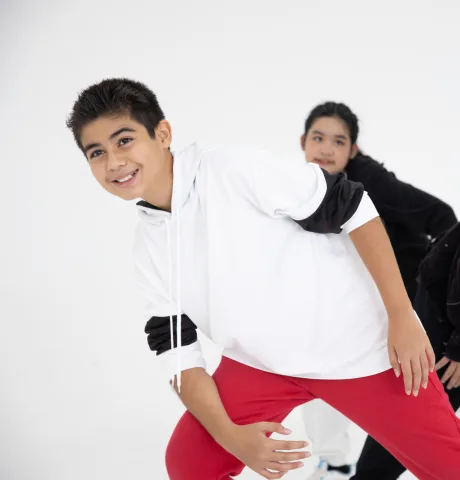 Learn to dance K-Pop: Your guide to perfect cover dancesDo you want to dance the spectacular choreographies of your K-Pop idols yourself? Our guide shows you how to master the moves step by step as a beginner.
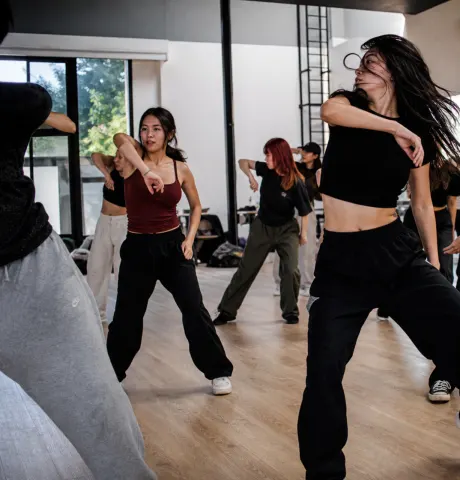 Learning K-Pop for beginners: Studio or at home?Learning to dance K-Pop for beginners poses the question for many: studio or living room? We compare both ways so that your start is guaranteed to succeed.
 Learn K-Pop choreography step by step: The guideLearn complex K-Pop choreographies systematically and flawlessly at your own pace. This guide shows you the way without frustration or distraction.
 K-Pop Dance Level Test: What is your choreo level?Find out your K-Pop dance level with our quick self-test and discover which choreographies perfectly match your skills.
 Top K-Pop dance apps comparedFind the best K-Pop dance app to mirror, slow down, and master choreographies at home without any mistakes.
 K-Pop Mirrored Dance: How to use mirrored videosIf you want to learn K-Pop choreographies at home, it is easy to get lost without mirrored videos. Learn how to use YouTube tools to master every routine flawlessly.
 Easy K-Pop dances for beginners: The top 10 choreos to followEvery beginning is easy: With these ten simple K-Pop choreographies, you are guaranteed to celebrate quick success on the dance floor as a beginner.