

Find your partner for partner dance
On udansa you will find like-minded people who want to practice the basic steps with you or hit the dance floor at the next party. Sign up and discover suitable courses and dance partners in your area.

Latin American dances bring energy, rhythm, and pure joy to the dance floor. Learn here how the four classics differ and how you can easily get started in a dance course with udansa.
The World Dance Program is an international collection of dances and figures, specifically developed for social use in dance schools. It ensures that dancers all over the world can dance together to common music.
Anyone entering a classic dance school will quickly encounter the term World Dance Program (WTP). This system was developed to make people worldwide fit for the social dance floor. In the field of Latin American rhythms, the program includes a fixed selection of dynamic dances. Specifically, these include Cha Cha Cha, Rumba, and Jive, as well as the fiery Paso Doble. Each of these styles brings its own unique energy, origin, and musicality.
What is special about this program is its focus on practice. It is not about competitive sports or stiff poses in the dance school, but about the joy of movement and the ability to move confidently on any dance floor. When you complete your first dance lesson, you will learn exactly these basics. They form the foundation upon which all later figures and advanced courses are built.
Although these dances fall under a common family, the Latin American dances and their differences could hardly be greater. Rumba is the emotional centerpiece: it is danced slowly, intensely, and full of body tension, with the interplay between closeness and distance taking center stage. Cha Cha Cha presents itself quite differently. It is playful, cheeky, and captivates with fast, precise chassé steps on the typical off-beats of the music.
Jive, in turn, brings pure joy of life and plenty of energy to the dance floor. With its fast kicks and bouncy character, it is closely related to rock ’n’ roll. The dramatic contrast to this is provided by Paso Doble, which depicts a Spanish bullfight. Here, the leader takes on the role of the torero, while the follower embodies the red cape. Anyone who wants to find the right dance style should simply try out these different characters for themselves.
At the beginning, do not focus too much on hip movement. If you bend and stretch your knees softly and shift your weight cleanly, the typical Latin movement will emerge all by itself.
The Latin American dances in the world dance program are perfect for everyday life, because they teach us to react flexibly to the music and the partner.
The path to confident dancing starts with the fundamentals. If you want to learn Latin partner dance, you always begin with elementary weight transfers and a sense of rhythm. Unlike ballroom dances, where the couple moves continuously through the room in a closed hold, you often dance Latin on the spot or in a more open hold with hand contact. This leaves plenty of room for turns and solo elements.
An important milestone after the first beginner courses are the so-called medal courses in Berlin or other cities. There, you refine your footwork, learn more complex figures, and develop a better feel for leading and following. However, the basics always remain the key: only those who have mastered the basic step in their sleep can later focus entirely on expression and the connection with their partner.
The slow art of seduction
Rumba thrives on slowness and intense eye contact. Here, you will learn to let movements flow softly and to emphasize the connection between partners through dance.
The cheeky rhythm from Cuba
The Cha-Cha-Cha brings good vibes immediately with its quick change steps. It challenges your coordination and is simply fun.
The Latin American list of the World Dance Program includes the Cha Cha Cha, Rumba, Jive, and Paso Doble. Samba is also part of competitive dance, but it is often covered separately in the WTP basic course.
Find the right course now and learn the steps of the world dance program from professionals.
Sunday · 14:30-16:00 · Nov 15, 2026 - Jan 17, 2027
Limbach-Oberfrohna
Sunday · 14:30-16:00 · Sep 6 - Nov 8
Limbach-Oberfrohna
Sunday · 14:30-16:00 · Nov 15 - Nov 29
Limbach-Oberfrohna
 Your first dance class in Berlin: How to prepareEvery beginning is easy: With this guide, you can prepare perfectly for your very first dance class in Berlin and get started completely stress-free.
 Which dance style suits me in Berlin? Take the testFind out which dance style in Berlin best suits your personality with our self-test. Discover your rhythm in the capital!
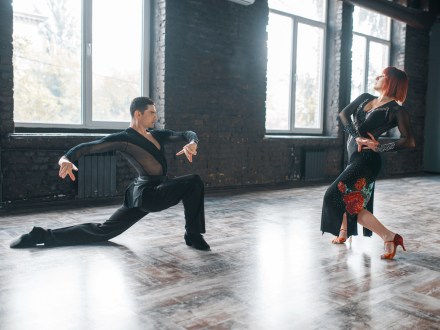 Medal Courses in Berlin: From the World Dance Program to CertificationThe structured path to your dance certification in Berlin: Learn how the World Dance Program and medal courses are structured and how to prepare perfectly.
 Latin Dance Technique: Mastering Latin MotionLearn how to master typical hip motion and stable posture in Latin dances. Use these fundamentals to improve your couple technique in no time.
 Latin dances: Steps and figures at a glanceDiscover the steps and figures of Latin dances in the world dance program. From Cha-Cha to Rumba, learn the basics for the dance floor here.
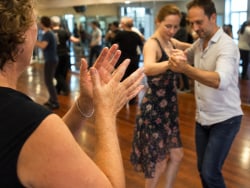 Latin dances: Understanding rhythm and beatRhythm is the heart of Latin dances. Learn how to understand the timing of Rumba, Cha-Cha, Jive, and Paso Doble and apply it confidently in partner dance.
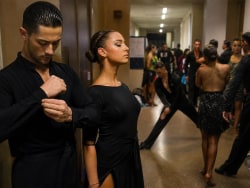 Latin Tournament Dance: From Badges to the FloorEntering the world of Latin tournament dance opens the door to athleticism, precision, and competitive ambition. Learn how to make your way to the competition floor through badges and tournament classes.