Latin American dances6 minutes

Learn Rumba: From individual steps to confident partner dancing

By Mary De LucaUpdated

In brief
  • When learning Rumba, complete weight changes connect individual steps into a calm dance guided together.
  • Small steps and clear preparation make simple transitions between figures easy for both dancers to understand.
  • Music in four-four time with an easy-to-hear pulse helps you get started, slow music is not automatically easier.
  • For a ball or wedding, a few figures connected with confidence are enough, without big poses or deep backbends.

With slow music, there’s little to hide: a step that’s too big or a hurried hand movement stands out immediately. That’s exactly why practicing together makes it easy to see where you lose connection.

DefinitionSupporting leg

In dance, the supporting leg is the leg currently bearing your body weight. Your other leg can move without you having to lean to the side first.

Steps become dance when the weight follows

In ballroom dancing, Rumba is one of the Latin American partner dances. It is not the same as Afro-Cuban Rumba, with its own musical and dance traditions. When you’re getting started, what matters most is how steps, body weight and connection work together. You can find the broader context in Latin American dances in ballroom dancing.

The basic Rumba step provides a recurring pattern. But confidence comes not just from placing your feet in the right spots. If your weight gets stuck between both legs, the next step requires an extra shift to one side. When dancing with a partner, this often feels like a delayed reaction.

A small step with a complete transfer of weight is more useful than a big step without a steady stance. As a short awareness exercise, shift your weight from one leg to the other without music. You should be able to briefly lift your free foot without your upper body tipping afterward. You don’t need a pronounced hip movement or a deep knee bend.

In class, this gives you a useful point to observe: During a familiar sequence, notice whether you really arrive over each new supporting leg. This explains many difficulties that at first seem like forgotten steps.
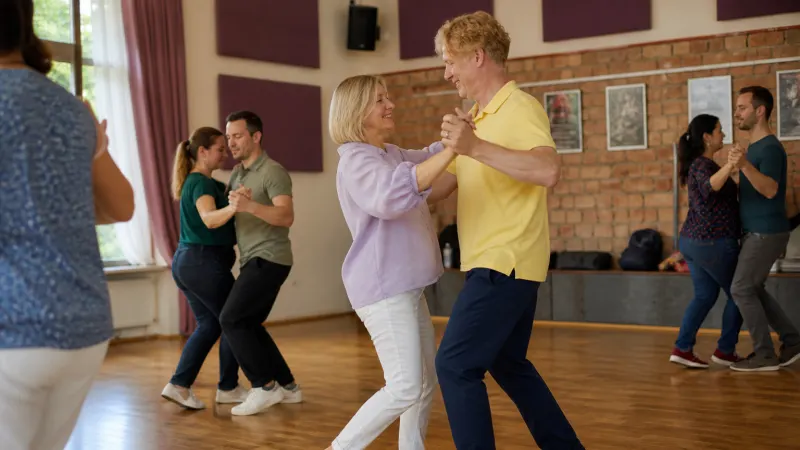
A foot that isn't bearing weight doesn't need to press into the floor, even if it is still touching it.

Leading at a Slow Tempo Takes Preparation, Not Pulling

Slow music leaves plenty of time between audible beats. That time can lead to calm movement, but also to waiting and then rushing off. In a couple, this can result in jerky hands, even though both people want to dance gently. Leading becomes clearer when the lead prepares their own movement in good time and the hand connection communicates that change.

The follow stays balanced throughout. They don't have to guess every planned figure or give their weight to the arms. A relaxed connection doesn't mean limp arms: the connection remains noticeable without holding on tightly. If a turn only works by pulling, the preparation or the space for it is usually unclear.

For your first Rumba figures, familiar building blocks from class, such as an opening and a simple underarm turn, work well. What matters is how you finish: after the figure, you should both be standing in a way that lets you continue with a basic step together. A short connection with a secure return gives you more understanding than a long sequence with an improvised ending.

To practice, repeat a familiar connection and deliberately do only basic movements in between. This makes it possible to hear and feel whether the rhythm keeps going. A dance course for couples gives you regular time to practice together.

How to spot a transition that works

Like this

  • Stay balanced with small steps
  • Use your body to prepare for the next direction
  • After a figure, return to the basic step together
  • If you make a mistake, return to a simple movement

Not like this

  • Bumping into your partner with big steps
  • Forcing the next direction with a yank on the arm
  • Going straight into the next combination after a figure
  • Frantically making up missed steps after a mistake

A figure combination is only useful if both partners can keep dancing afterwards without pulling or taking an extra step to find their footing.

udansa editorial team for partner dancing

Music and occasion determine how much room you have

Rumba is danced in four-four time. For beginners, a clearly audible pulse is often more helpful than an especially slow song: Long gaps can tempt you to start too early or stop moving in between. The same melody can be arranged differently depending on the recording. These three Rumba songs are therefore listening suggestions, not a guarantee of an identical tempo:

  • Doris Day: Perhaps, Perhaps, Perhaps. A starting point for listening to the regular accompaniment rather than just the vocals.
  • Nat King Cole: Quizás, quizás, quizás. The familiar melody helps you notice musical repetitions.
  • Andrea Bocelli: Bésame mucho. A romantic choice where the stretched vocals and accompaniment call for separate attention.

If you want to practice Rumba at home, a short excerpt is enough to start. Listen for the pulse before you dance a familiar connection together. If you lose it, return to the basic movement instead of trying to catch up on steps you missed.

At a ball, other couples limit your space. For a Rumba wedding dance, a full skirt or unfamiliar shoes can limit your step length. In either case, compact figures are useful. Lifts and deep backbends are not part of the beginner repertoire you need, a clear finish standing together works well even without those elements.

The Same Rumba, Two Occasions

Ball

Moving flexibly among other couples

Short sequences with an open ending

At a ball, a small repertoire that you can shorten at any time comes in handy. An open space isn’t an invitation to do a big figure: compact steps leave room for other couples and for your next change of direction.

Wedding

A familiar sequence for your moment

Predictable music and a clear ending

During your wedding dance, a familiar sequence offers guidance while lots of people are watching. Plan a simple start and an ending standing upright. Your dress, shoes, and nerves affect how movement feels, even when the steps are already familiar.

Frequently Asked Questions

  1. You can practice your balance, small steps, and listening to the musical pulse on your own. But you will only find out whether your movements make sense to someone else when you dance as a couple. Solo exercises prepare you to work together, but they cannot replace feedback through a real hand connection.

Rumba and partner dance courses

You can practice weight changes and short figure connections as a couple, instead of just memorizing step sequences.

See all matching courses

With a dance partner, it becomes clearer

On udansa, you can find dance partners to practice Rumba with in manageable settings. That way, your lead gets real feedback, and you develop a shared rhythm.

With a dance partner, it becomes clearer