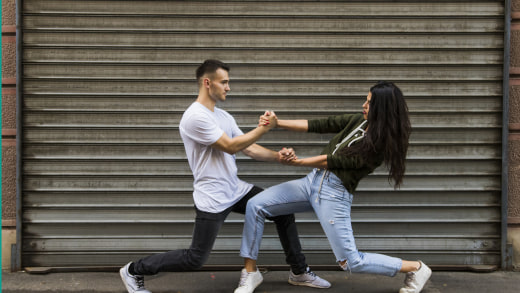
Lead & Follow: How teamwork works in a dance couple

Lead & Follow: How teamwork works in a dance couple

Leading and following in partner dancing

How teamwork in a dance couple works

Dancing is often described as a dialogue without words. But for this conversation to flow smoothly, both partners must not only know their role but also value it. Often, frustration or anxiety arises because we do not know what is going on in the other person's mind. Let us break down the old clichés: dancing is not about "calling the shots," but about creating together as equals.

The world of the leader in partner dance

The pressure of the decision

The world of the leader in partner dance

The biggest concern

"How do I make the dance varied?" or "Am I leading clearly enough, but not roughly?"

The learning

A leader needs focus. If they hesitate for a moment, it is not a sign of inexperience, but often a mental "calculation process" for the next step. 

3 Tips for Leaders: Confidence in Partner Dancing Through Calmness

Clarity over complexity

A cleanly executed basic step feels a thousand times better to your partner than a complicated figure where you both lose your balance.

"Announce" in good time

Leading is like using your turn signal when driving. Give the cue for the next figure a fraction of a second before the actual step.

The "safe space" on the dance floor

Your most important task is to protect your partner from collisions. Good navigation gives your partner blind trust.

The world of the follower in partner dance

The art of active reaction

The world of the follower in partner dance

The biggest concern

"Can I correctly recognize the leader's signals and react to them?" or "How can I let go of my own control?"

The learning

A follower is like a highly sensitive antenna. Following means giving back to the leader the energy they put into the impulse. 

3 Tips for Followers: Activity in Partner Dancing through Presence

Stay in your axis

Do not try to "guess" the figure. If you stand stable in your own balance, you are much easier to lead.

Extend the “antennas”

Maintain a constant, comfortable tension in your arms (the frame). This ensures the signals reach you without delay.

interpret freedom of space

Following is not passive. If the leader leaves you space, use it for your own styling. You are the color in the picture that the leader is painting. 

The golden rule for both roles in partner dancing

"There are no mistakes, only variations." If an impulse is missed or a step goes wrong, it is not a failure of the individual, but a moment where you as a dance couple can grow. The goal in recreational dancing is not perfection, but the shared moment of dance and the connection as a dance couple.

Would you like to dance as a couple, but you are missing a dance partner?

Find your dance match now in our dance partner app

Frequently asked questions about the dance roles

  1. Traditionally, this was often the case, but today the dance world is much more open and dancing is increasingly defined by roles rather than gender. Many dance enthusiasts even learn both sides (switch dancing) because it enormously improves their understanding of their partner. The only important thing is that you briefly agree before the dance on who will take on which role in that moment.