

Let's conquer the dance floor together
On udansa you will find like-minded people who will take the first steps with you, as well as suitable dance schools in your area for your successful start on the dance floor.
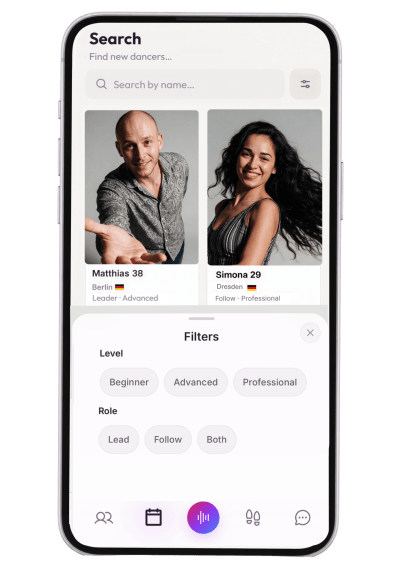

Entering the world of ballroom dancing opens the doors to stylish movement and social events for you. With the right foundations, you will quickly transform initial uncertainty into pure joy as you glide across the dance floor together with udansa.
The World Dance Program, often abbreviated as WTP, is a standardized collection of dances and steps that is taught in dance schools worldwide. It was developed to enable people all over the world to dance together without prior arrangement.
The term World Dance Program standardizes the basics of social dancing worldwide and ensures that you can find your way around almost any dance floor on earth. If you want to learn ballroom dances, you will encounter five dances in the classic program that differ greatly in character and tempo. The majestic Slow Waltz impresses with its flowing, soft rising and falling movements, while the Viennese Waltz delights with fast, sweeping turns in three-quarter time. The Tango brings passionate drama and sharply accentuated steps into play. The Foxtrot is considered the ultimate beginner dance, which is easy to learn due to its uncomplicated walking steps. Finally, the Quickstep is the lively, fast-paced progression of the Foxtrot, full of dynamics and small hops.
A systematic medal course for the World Dance Program helps you to clearly distinguish these five styles from the ground up and to develop a feel for the respective musical genre. Each of these dances trains different aspects of your posture and coordination, which makes the training extremely varied.
For beginners, a classic dance school for ballroom dancing is usually the best place, as you receive direct feedback from experienced teachers there. In a professional environment, you learn the correct posture as a couple correctly from the very beginning. However, modern alternatives are also becoming increasingly popular. An online ballroom dance course offers you the possibility to prepare the basic movement sequences at home, with flexible timing and at your own pace. If you just want to get a taste of it, you can also look into options like university sports.
A common misconception is that you cannot start dancing without a fixed partner. Many dance schools offer single courses where partners are rotated anyway. This way, you can easily learn ballroom dancing without a partner and quickly make contacts in the local dance community at the same time. The only important thing is that you prepare a little in advance so that you feel comfortable when you start. You can find a few useful tips for preparation, for example, in the guide for your first dance lesson.
In your first few lessons, do not focus too much on your feet. Look over your partner's right shoulder: this improves your posture and automatically stabilizes your balance.
Anyone who masters the basics of ballroom dancing holds a universal key to every dance floor in the world. It is not about perfection, but about the shared connection in the rhythm.
To look good on the dance floor, it is less about complicated sequences of figures and more about a solid foundation. The most important ballroom dance basics lie in footwork and the shared body axis. In contrast to Latin dances, where you often move on the spot, ballroom dancers move counter-clockwise around the room on the so-called line of dance. This requires a high degree of orientation and mutual coordination.
Advanced ballroom dance techniques focus primarily on the principle of leading and following, as well as controlled rising and lowering from the ankles and knees. A stable upper body frame, the so-called frame, ensures that the leader's signals are transmitted to the follower without delay. Once you have internalized these basics, gliding together across the wood feels like floating above the floor. It is therefore worth investing a lot of time in the first few weeks in the clean execution of the basic steps before you venture into complex turns.
Providing security and orientation
The leading role determines the direction and timing in the room. It requires clear body tension and forward-looking movement on the dance floor to elegantly avoid collisions with other couples.
Receiving and executing impulses
The following role reacts sensitively to the partner's impulses. It requires trust, actively maintaining your own axis, and the ability to complete the movement fluidly and without resistance.
Foxtrot is particularly well-suited for getting started. Its simple walking steps and uncomplicated rhythm in 4/4 time allow for quick success without complex prior knowledge.
Find the right course now and start your dance adventure on the dance floor.
Sunday · 14:30-16:00 · Nov 15, 2026 - Jan 17, 2027
Limbach-Oberfrohna
Sunday · 14:30-16:00 · Sep 6 - Nov 8
Limbach-Oberfrohna
Sunday · 14:30-16:00 · Nov 15 - Nov 29
Limbach-Oberfrohna
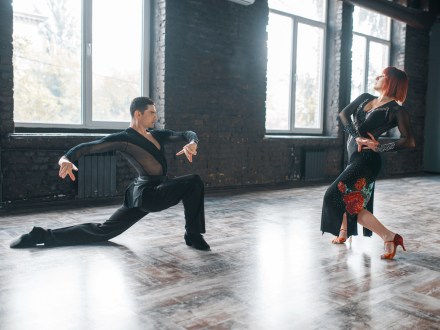 Medal Courses in Berlin: From the World Dance Program to CertificationThe structured path to your dance certification in Berlin: Learn how the World Dance Program and medal courses are structured and how to prepare perfectly.
 Your first dance class in Berlin: How to prepareEvery beginning is easy: With this guide, you can prepare perfectly for your very first dance class in Berlin and get started completely stress-free.
 Ballroom Dance Posture: How to build the perfect frameProper posture and a stable frame are the foundation of every ballroom dance. Learn how to glide elegantly across the floor with the right body tension and orientation.
 Ballroom dance steps: The basics for the dance floorThe five ballroom dances fascinate with their elegance and dynamics. Learn everything about the most important steps, figures, and typical movement sequences of Waltz, Tango, and more here.
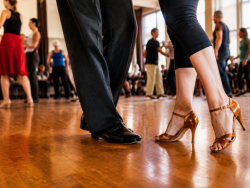 Recognizing the beat in ballroom dance: Understanding rhythm made easyThe secret to ballroom dance lies in listening to the music correctly. Learn how to confidently recognize the beat in Waltz, Tango, and Slowfox and move in harmony.
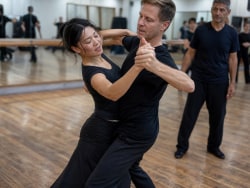 Ballroom Dance Competition: Your Path to the PodiumThe path from recreational to competitive ballroom dance requires targeted training and a clear structure. This guide shows you how to successfully master dance badges and competition classes.