Standard technique6 minutes

Learn Foxtrot with the feather step and three-step

By Mary De LucaUpdated

In a nutshell
  • The feather step and three step are foundational steps you can use to develop flowing sequences in Slow Foxtrot.
  • In the feather step, the third step passes outside your partner, while in the three step, you stay facing each other.
  • Open foot positions mean that you do not close your feet after every step when transferring your weight.
  • Suitable step lengths and fully transferring your weight make it possible to connect the steps without pulling your partner.

Three steps can look simple on paper and still feel awkward when you dance them with a partner. These short sequences show whether your body is keeping up or your feet have already run ahead of it.

DefinitionOutside Position

Outside position refers to a position in partner dancing in which the partner moving forward steps past alongside the other partner's foot track. In the standard feather step, this happens on the right side of the partner moving backward.

Two short sequences with different partner positions

If you want to learn Slowfox, two manageable building blocks will help: the feather step and the three-step. In their basic form, both consist of three steps. In the usual role distribution, the leading person moves forward and the following person moves backward. The roles are not tied to gender.

In the feather step, the leading person moves forward right, left, right. The following person moves backward left, right, left accordingly. The third forward step passes the partner in the outside position. To do this, your body orientation prepares the way during the sequence. Simply placing your right foot out to the side does not yet create a suitable connection.

In the three-step, the leading person moves forward left, right, left, while the following person moves backward right, left, right. Here, you move in front of each other again. Your feet do not come together between each step, but pass each other on the way to the next place.

These sequences are useful Slowfox figures for beginners because you experience different partner positions in just a few steps. However, they are not a circuit that you can repeat indefinitely. If you want to work on them together in class, the guide to the dance course for couples offers guidance on getting started as a regular couple.
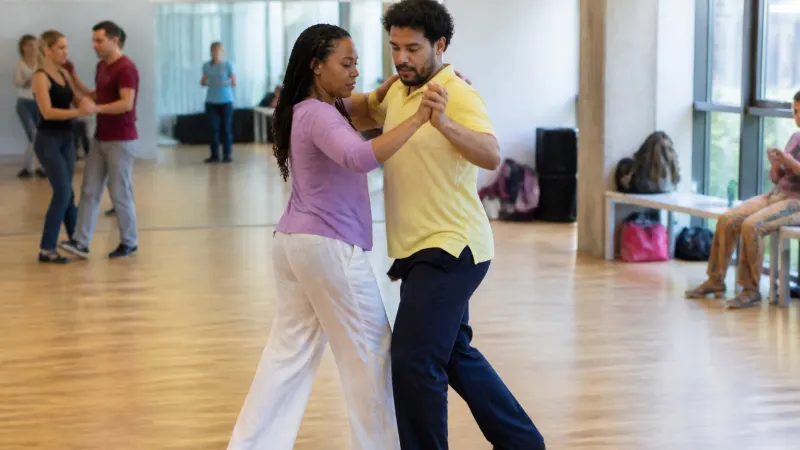
The free foot needs room to swing past, not the widest possible track alongside the supporting leg.

Connection comes from weight and suitable pathways

Open foot positions are easily mistaken for particularly large steps. At first, this simply means that your feet do not end up closed together after a step. Your body still needs to arrive over the new supporting leg. If your weight remains caught between both feet, the next step is often pushed or forced with the arms.

Continuous weight transfer therefore does not mean speeding up every movement. You transfer your weight fully and let the next movement arise from it, instead of pushing off again after every foot placement. This is especially noticeable when moving backward: setting a foot far back does little if your body stays over the previous leg.

The foot sequence basically fits when connecting the spring step and the triple step: after the right forward step, the left foot is free. But having a free foot alone does not make the transition correct. From the outside position, you need to get back in front of each other. This happens through coordinated body orientation and suitable foot pathways, not through a sideways jump.

Adjust your stride length so that both bodies can keep up. A shorter pathway is not inferior Slowfox. It shows whether the connection holds before you add more space and longer steps.

How to Recognize a Steady Flow of Movement

Yes, like that

  • Transfer your weight before moving the free foot on
  • Shorten your step if your body lags behind
  • When passing on the outside, turn your upper body toward your partner
  • To change direction, align yourselves as a couple

Not like this

  • Step forward with the next foot while both legs are still weighted
  • Make up for the missing movement with a longer step
  • When passing on the outside, turn sideways away from your partner
  • Twist only your feet and pull your partner with your arms

A short step gets you further when your body moves with it than a long step that pulls the couple apart.

udansa editorial team for dance guides

Solo practice and partner work reveal different gaps

If you want to practice Slowfox at home, you can start by separating the footwork from partner work. Take three small steps forward on your own, then reset and do the corresponding backward sequence. After a sequence, you can deliberately pause: this is a check-in during the exercise, not a model for the flow of movement later on. If you can release the unweighted foot without shifting to compensate, you have clearly transferred your weight.

As a pair, start with the three-step facing each other. Then work on the feather step, especially the space for the third step. Connect the two elements only once you both understand them. Pay attention to the distance between your bodies: it shouldn’t increase with every step. Your arms maintain the connection, they don’t pull anyone across the floor.

To begin practicing changes of direction, start a short sequence along a new diagonal. This trains you to orient yourselves together without introducing an additional turning figure. Corners in continuous dancing will later require suitable figures, a straight connection is no substitute for them.

So when you practice solo, you work on weight transfer and footwork, while as a pair you work on distance and coordination. The overview of dance classes for adults also explains which class format might suit you.

The same path from two directions

Forward

Offer a path

Give space without moving ahead

Moving forward, you can see the open space more clearly and control the distance. Your step should still be small enough for your partner to move backward with you. A foot reaching far forward is no substitute for moving together.

Backward

Carry the movement through

Step back without backing away

When stepping back, place your free foot behind you and let your body follow onto the new supporting leg. Keep facing your partner. This creates space to move forward without withdrawing from the connection.

Frequently Asked Questions

  1. Slowfox is usually learned through several basic figures, not one repeated basic step sequence. So when you look for the Slowfox basic step, you will often come across the feather step and the three-step. They are a starting point, but not a complete solution for corners and changes of direction.

Ballroom Dance Classes to Get Started with Slowfox

In a ballroom dance class, you can work together on the partner position for the feather step and the transition to the three-step.

View all matching classes

You'll find your connection as a pair

On udansa, you can find dance partners to practice feather steps and triple steps with at your own pace. In your profile, describe how you're working on the basics of Slow Foxtrot and short figure combinations.

You'll find your connection as a pair