
Ballroom Dance6 minutes

Slow Waltz: Link Figures and Understand the Music

By Bernhard De LucaUpdated

In short
  • In the Slow Waltz, closed changes link the natural turn and the reverse turn into a simple sequence of figures.
  • The starting alignment and your free foot determine which figure you can dance next.
  • The Slow Waltz is in 3/4 time and is usually danced at about 28 to 30 bars per minute.
  • You start on a musical count of one, ideally at the beginning of a new phrase.

A figure you've learned comes to an end, but the song keeps playing. This is exactly where a collection of steps becomes a repertoire: you recognize which movement can follow next.

DefinitionClosed Change

A closed change is a Waltz figure consisting of three steps over one measure. It ends with the feet closed and changes the free starting foot.

A Few Figures Make a Useful Repertoire

In Slow Waltz, figures are building blocks with a specific beginning and end. That means you can't string them together just any way: at the end, the foot needed for the next figure must be free. Your alignment also has to match its starting position. These connection requirements explain why a short sequence is often more useful than lots of figures learned individually.

A manageable repertoire includes the right turn, left turn and closed changes. The right turn is also called the Natural Turn, and the left turn the Reverse Turn. In their basic form, both consist of six steps over two bars. A complete figure does not automatically mean a full 360-degree turn.

A closed change, by contrast, takes one bar. It allows you to switch from one starting foot to the other without being a major turning figure in itself. You should already know the basic step and the individual left turn for this; their step instructions are not repeated here.

Later, you can add figures such as the whisk and chassé. They expand your connection options, but they are not required for the sequence described below. Seeing larger figures on TV does not make this foundation any less useful: looking at rhythm and posture in dance show dances helps you distinguish showmanship from the fundamentals of dancing.
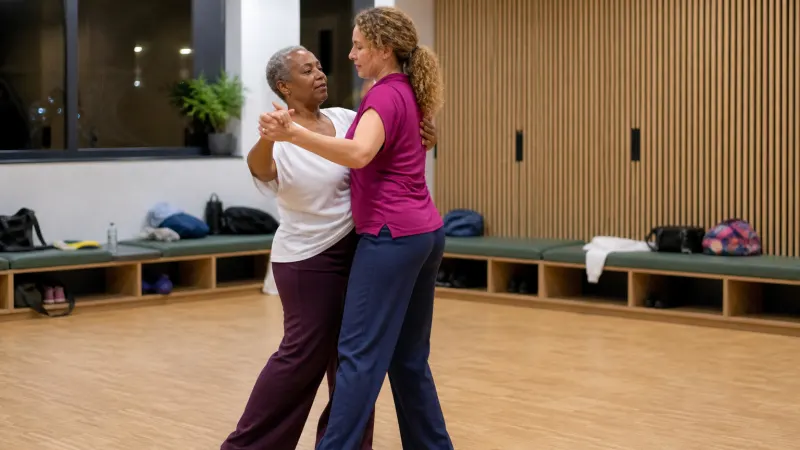
Even between two songs, counting helps you keep a sequence of moves in mind together.

A six-bar sequence explains the transitions

The following sequence describes the leader’s role in closed dance hold. The follower starts each time with the corresponding opposite foot. Dance direction means the path counterclockwise around the room. “Diagonal to the wall” means diagonally outward in the direction of dance, while “diagonal to the center” means diagonally inward.

To begin the right turn, the leader faces diagonally to the wall and has the right foot free. The sequence consists of four components:

  • Bars 1 and 2: Begin the right turn by stepping forward with the right foot. After six steps, the right foot is free again.
  • Bar 3: Dance a closed change forward with the right foot: right forward, left to the side, right close. The left foot is free afterward.
  • Bars 4 and 5: Begin the left turn by stepping forward with the left foot. After six steps, the left foot is free again.
  • Bar 6: Dance a closed change forward with the left foot: left forward, right to the side, left close. The right foot is free afterward.

In the usual basic version, the right turn ends facing diagonally to the center, and the left turn ends facing diagonally to the wall. The changes maintain these respective alignments. This brings the ending back to the starting position. The six bars form a repeatable figure sequence, but not a complete musical phrase: the movement sequence and the musical section do not have to be the same length.

How to tell if you have the right connection

Correct

  • Pay attention to the free starting foot for the next figure
  • Relate the starting direction to the next figure
  • Count a full right turn over two bars
  • Distinguish tempo in bars from beats per minute

Myths

  • Any figure can start with either foot
  • All figures start facing the wall
  • A full right turn fits into one bar
  • 30 bars per minute means 30 beats per minute

A sequence of figures makes sense when you know how it flows, not just the steps within each individual figure.

udansa editorial team for partner dance

Triple Meter, Tempo, and Recording Shape Your Musical Entry

Triple meter groups the music into sets of three beats. The one is the start of the measure; you often hear an accent or a new bass pulse there. A musical entry works especially well at the start of a new phrase, for example when the melody begins again after the introduction. An upbeat may come before this start.

The usual dance tempo of around 28 to 30 measures per minute corresponds to 84 to 90 quarter-note beats per minute. So if a tempo marking shows around 90 BPM, it can certainly suit a Slow Waltz. “Slow” describes the dance style here, not an arbitrarily low beat count.

These three well-known recordings are in triple meter and make good musical starting points:

  • Come Away with Me, Norah Jones: a calm pulse with understated accompaniment.
  • Moon River, Andy Williams: a clearly recognizable waltz melody with softly sung phrases.
  • Tennessee Waltz, Patti Page: an easy-to-hear triple meter and clearly structured melodic sections.

These are not standardized competitive dance recordings; small tempo fluctuations are part of the performance. Cover versions may have different arrangements. For a steady class tempo, instrumental recordings produced specifically for the Slow Waltz are more suitable. In a dance course for couples, these clear musical examples go hand in hand with learning how to connect the figures.

Two paths through the same music

Connection

Recognize a short sequence

The next figures are already set

A consistent connection gives you a sense of direction in the song. You know when the direction of the turn changes, and can notice the musical sections more consciously. For your first dances with connected figures, this reduces the number of spontaneous decisions.

Selection

Choose from familiar figures

The connection determines the options

A freer repertoire gives you several suitable continuations. You choose based on the starting foot, orientation, and available space. Even without a fixed sequence, each figure stays in time with the music.

Frequently Asked Questions

  1. No, a few figures that fit together are enough for a continuous dance. A right turn, two closed changes and a left turn already make a repeatable sequence. More figures will later expand your options rather than make the existing building blocks useless.

Ballroom Courses with Slow Waltz

In a ballroom dance course, you can experience how individual waltz figures flow into a continuous sequence.

See all matching courses

Find someone to dance your Waltz

On udansa, you can find dance partners for your Slow Waltz. With someone at a similar level, you can combine familiar figures into a dance together.

Find someone to dance your Waltz