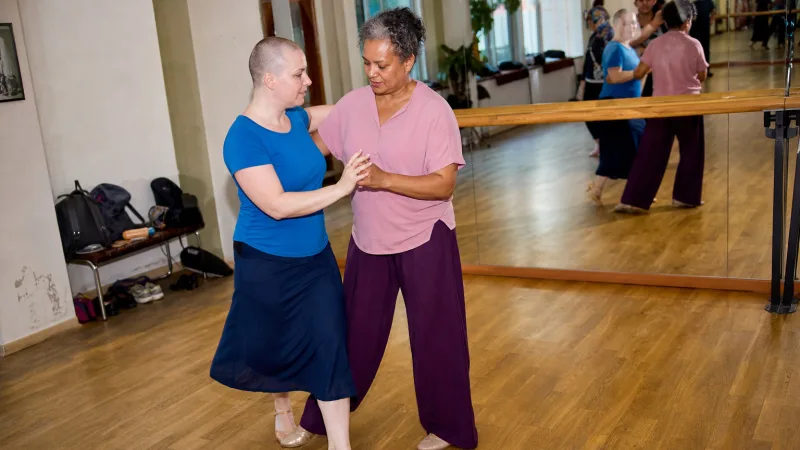
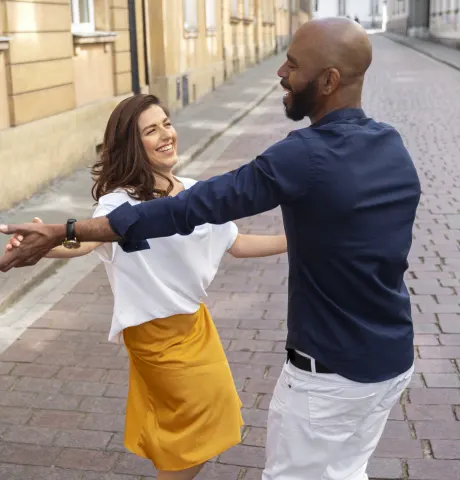
The left turn complements the familiar turning direction
The left turn rotates the couple counterclockwise while you continue moving through the room along the line of dance. Turning direction and direction of travel are two different things. That explains why a left turn is not simply a right turn on the way back.
For the leading partner, the forward half begins with left forward, right to the side, cross left in front of right. These three steps take one measure. The second half follows with right backward, left to the side, and close right to left. The following partner begins with the backward half and then takes over the forward half, including the cross step. The feet take turns bearing the weight, and the cross step is not an extra step inserted along the way.
This very cross step is what visibly distinguishes the left turn from an ordinary closing step. It is part of the figure and happens within the turning movement, not as a decorative leg cross after the measure. This small repertoire is enough to start with: another figure only makes sense once its transitions are clear. In a couples class where you learn together, you experience the same connection from two different directions of movement.