Prop technique6 minutes

Learn Carretilla with castanets: Connect four strokes

By Mary De LucaUpdated

In short
  • For a Carretilla, play with your little finger, ring finger, middle finger, and index finger in sequence.
  • First, link slow groups of four with even spacing and a deliberate pause after each group.
  • Only shorten the gaps once each finger can be heard clearly and your hand is relaxed.
  • Then link several groups of four without leaving an extra gap between your index finger and little finger.

A roll can sound fast and still stumble. This is especially frustrating when each finger reliably hits its mark on its own: when connecting them, the tiny gap between two notes suddenly matters too.

What you need for the exercise

  • Hand castanets properly positioned
  • Confident single strokes with all four playing fingers
  • Pain-free hands and flexible fingers
  • A quiet place to listen closely
  • A metronome or a short recording of your own playing

The transitions determine whether the roll flows

The Carretilla is a rapid sequence of individual finger strikes, not a simultaneous squeeze with four fingers. In the usual playing style, the right hand takes the role. For this exercise, keep your other hand still so you can clearly hear each tone and each gap. The slowly counted groups of four are a learning aid, not yet a rhythmic pattern for a particular Palo.

Even means that roughly the same amount of time passes between neighboring strikes. Often the index finger rushes ahead, while the transition from the ring finger to the middle finger takes longer. The sequence then sounds like two pairs instead of one continuous roll. More force will not eliminate this gap. It comes from the timing between the fingers, not from a lack of volume.

You can release a finger that has already struck while the next one strikes. So you do not wait for your entire hand to get ready again after each tone. At the same time, keep the movements small enough that no finger has to swing far back. A similar listening principle can be heard in the Cramp Roll with four clear sounds in tap dance: A rapid sequence must not lose its individual parts. For longer practice sessions, it also helps to follow the principle of increasing the strain gradually when dancing, instead of continuing to play with tired fingers.
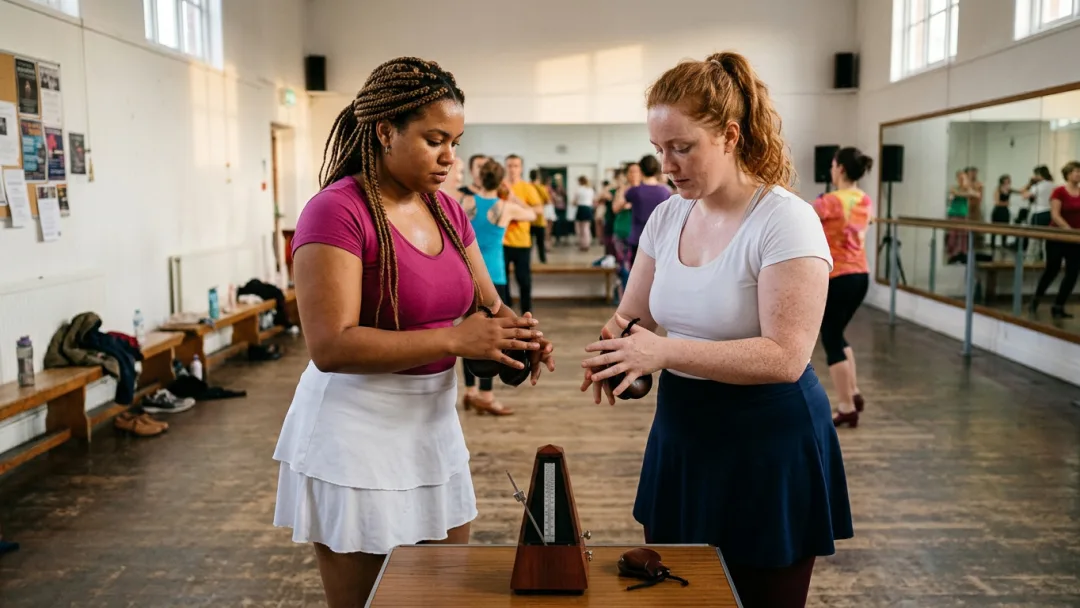
A short recording lets you hear whether you keep the tempo or speed up in your role.

In seven steps to a connected role

  1. Adopt a relaxed starting position

    Hold your playing hand comfortably in front of your body and keep your shoulders and wrist relaxed. During this exercise, play without moving your arm and without a strumming stroke from your other hand, so extra movements do not change the finger sequence or obscure individual notes.

  2. Play a slow group of four

    Play the little finger, ring finger, middle finger, and index finger, with clearly separated notes. Count evenly: one, two, three, four, initially one note per metronome click; this is an exercise grouping, not a compás. Pause after the group.

  3. Hear which transition is longest

    Repeat the group at the same tempo and listen especially to the spacing. Choose the transition with the longest gap or the swallowed note, and play only those two consecutive fingers slowly until both can be heard clearly.

  4. Reintroduce the transition

    Play the full group of four again, without speeding up at the transition that was difficult before. Let each finger return after its stroke as the next one takes over. The sequence is successful if no double strike occurs and the last note doesn’t rush ahead.

  5. Gradually shorten the intervals

    Increase the tempo by just a small step and keep the pause after each group. Listen for whether you can still hear four beats; if notes go missing or your wrist starts to tense up, return to the last tempo you could play cleanly.

  6. Connect Two Groups of Four

    Play two groups back to back and pause only afterward. Now pay attention to the transition from the index finger of the first group to the little finger of the second: there should be no extra gap or rushed restart.

  7. Record a short continuous roll

    Connect several groups into a short roll and record it. Then listen without playing along: if the beginning, middle and end stay similarly even, the connection is stable; end the series before your fingers feel heavy or the sound becomes unclear.

Fix common pitfalls

Like this

  • Play softly with your fingers, using small movements so they can be heard
  • Keep your wrist relaxed and flexible
  • After a group doesn't go well, deliberately start again
  • End the set when you get tired

Not like that

  • Replace gentle finger movements with a firm squeeze
  • Shake the roll with your whole wrist
  • Hectically pull a botched group along
  • Keep playing until your hand cramps

Your practice progress checklist

Before the first episode

Start

Before connecting

Transition

After the short role

Review

Frequently Asked Questions

  1. For this exercise, start with the right hand only, as in the usual way of playing castanets. Two-handed rolls can be added later, but they are not part of connecting the four fingers for the first time. So keep your left hand deliberately still until you can hear and control the transitions with your right, rather than working on two things at once.

Refine the role together refine

On udansa connect, you can find people to practice Flamenco with. While you play, your practice partner can listen to the intervals without playing along.

Refine the role together refine