Stage History5 minutes

How Famous Flamenco Dancers Shaped the Stage

By Mary De LucaUpdated

In short
  • Carmen Amaya and Vicente Escudero shaped solo dance through powerful footwork and an emphatically geometric body language.
  • Antonio Ruiz Soler and Pilar López combined Flamenco with larger ensembles and Spanish stage dance.
  • With works such as Bodas de sangre, Antonio Gades developed a narrative dance theater featuring Flamenco.
  • The sequence moves from solo dance to ensemble work and dance theater, not from better to worse.

A film clip often shows only a few seconds of footwork, while an entire production remains invisible. Knowing the paths that led there also helps explain why the same art of dance could give rise to such different stage worlds.

How the selection is organized

  • Documented Work

    Included are people with identifiable films, stage works, ensembles, or published statements about their dance.

  • From Solo to Dance Theatre

    The sequence prioritizes individual movement vocabulary first, then ensemble composition, and finally narrative choreography.

  • Work in the 20th Century

    What matters is their historical work on stage; the selection reflects the editorial status as of November 1, 2026.

  • No paid placement

    No one has paid to be included or to secure a position in this selection.

Close-up of flamenco dancers’ feet against a black background.
A recording preserves a performance, but not necessarily an artist’s entire way of working.

Five influential figures and their impact on stage

  1. 01

    Carmen Amaya

    Barcelona; film Los Tarantos, 1963

    • Solo dance
    • footwork
    • film

    Carmen Amaya comes first because her international impact arose especially directly from her own dance language: in recordings, her dense, energetic footwork, rapid changes, and an upper body that visibly carries the rhythmic intensification, rather than merely maintaining a decorative posture, stand out. Her dancing in Los Tarantos offers you a concrete way to experience this stage presence; the fact that she also performed in trousers and placed powerful footwork at the center went against contemporary expectations for the presentation of Flamenco dancers, but does not make her the inventor of this technique.

  2. 02

    Vicente Escudero

    Valladolid; Decálogo del buen bailarín, 1951

    • Solo dance
    • lines
    • stylistic principles

    Vicente Escudero offers a counterpoint to Amaya’s rhythmic density: his striking angles, upright posture and sparse, precise gestures show how much a solo can achieve through lines and deliberate restraint, without constantly adding movement. With his Decálogo del buen bailarín, formulated in 1951, he also left behind explicitly stated aesthetic rules, which you should read as the historical position of an artist, not as universally applicable teaching principles; his gender-specific ideas in particular belong in their historical context.

  3. 03

    Antonio Ruiz Soler

    Seville; own company from 1953

    • Virtuosity
    • Ensemble
    • Spanish Dance

    Antonio Ruiz Soler, often simply called Antonio, brings together in this selection the virtuosity of a solo performance and the grand ensemble stage: after his long-standing collaboration with Rosario, he built his own company, whose repertoire showcased Flamenco alongside other forms of Spanish dance. His Martinete in the 1952 film Duende y misterio del flamenco is a concrete example of his individual style, while the company represents his broader influence: solo brilliance became part of a program featuring changing casts, spatial arrangements and varied forms of dance expression.

  4. 04

    Pilar López

    Ballet Español founded in 1946

    • Ensemble work
    • teaching
    • repertoire

    Pilar López's significance stems above all from the combination of artistic direction and training within her Ballet Español: the dancers who worked in her company included the young Antonio Gades, so her influence cannot be measured by her solo recordings alone. She brought Flamenco and other Spanish dance forms together in a shared stage repertoire. When viewing her work, pay particular attention to the transitions between individuals and the group, as this is where artistic expression through roles, casting and the interplay of an entire company becomes visible.

  5. 05

    Antonio Gades

    Bodas de sangre, 1974; the film Carmen, 1983

    • Dance theater
    • dramaturgy
    • film

    Antonio Gades concludes the selection because, in his work, the narrated action becomes the guiding principle of organization: in his choreography for Bodas de sangre, based on Federico García Lorca, encounters, group scenes and conflicts take shape through dance, so that individual movements serve a dramatic purpose rather than merely providing spectacle. His collaboration with director Carlos Saura, including the film Carmen, brought this combination of Flamenco and dramatic expression to international audiences; Gades should be regarded as a dancer and choreographer, and Saura as a director, not as an interchangeable co-author of every movement on stage.

Stage influence is not only visible in solo performance

The selection reveals an important difference: a striking dance technique can be recognized in a short excerpt, while ensemble direction often only becomes clear in a complete scene. That is why Amaya and Escudero are especially accessible if you first want to observe posture, accents and movement density. With López or Gades, the same tight crop would conceal essential work.

For each portrait, take a look at the entire stage once. Who stays still while someone else dances? When does the focus shift from the individual to the group? In a narrative work, these decisions reveal what kind of relationship is taking shape. They are part of the choreography, even when no spectacular footwork is involved.

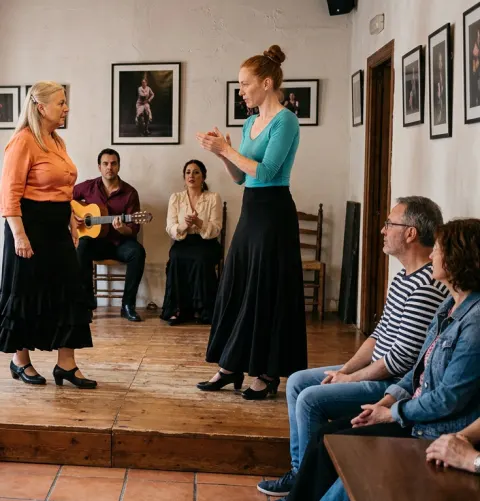
Also distinguish between performance settings: the intimacy of a small stage, as explained in the guide to the Tablao as a flamenco stage, creates different viewing conditions than a theater. And a Peña Flamenca dedicated to shared cultural traditions serves a different purpose than a professional company. These differences help you avoid equating personal renown with the entire history of Flamenco.

The selection in numbers

Featured stage personalities
5
Key areas of stage presence
3
Founding of López’s Ballet Español
1946

Frequently Asked Questions

  1. No, Antonio Ruiz Soler and Antonio Gades are two different dancers and choreographers. Ruiz Soler was often known simply as Antonio and led his own company with a Spanish dance repertoire. Gades is particularly associated with narrative works such as Bodas de sangre and his collaboration with Carlos Saura.

Watch dance role models together watch

On udansa, you can find dance connections to watch historical recordings with and exchange observations about solo, group and dance theatre.

Watch dance role models together watch