Stage practice5 minutes

Cuadro Flamenco: How the stage ensemble works together

By Mary De LucaUpdated

In short
  • A Cuadro Flamenco is a stage ensemble where dance, singing, and guitar work together.
  • The dance shapes movement and foot rhythms, the singing carries the lyrics and melody, and the guitar accompanies and connects them.
  • Palmas and, where appropriate, other percussion support the Compás and add further accents.
  • Musical leadership shifts from one passage to another, rather than remaining with a single person throughout.

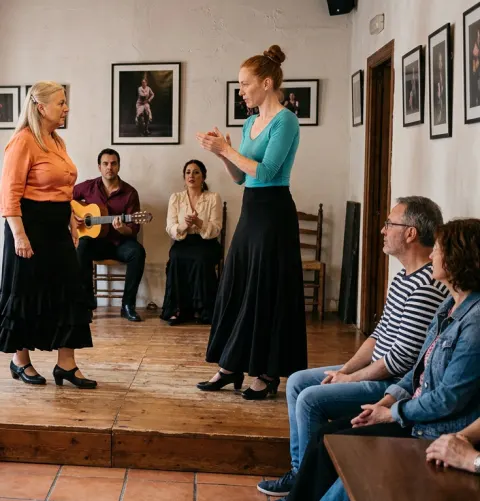
Your eye may first be drawn to the dancer. Once you also watch the seated participants, the same performance takes on a second layer: you notice who is listening, making space, or responding to a change.

DefinitionCompás

In Flamenco, compás refers to the rhythmic structure of a piece, including its pulse and characteristic accents. It provides a shared point of reference for everyone involved.

Baile, Cante and Toque have their own roles

Baile, Cante and Toque refer to dance, singing and guitar playing. In the Cuadro Flamenco, these forms of expression come together in a shared performance. The term describes the lineup, not a particular dance or a fixed sequence of steps. There may be several dancers or several singers, but this is not required.

Baile makes musical tension visible through posture, arms, movement across the space and footwork. At the same time, the shoes themselves create sound. If you know Planta and Tacón as different foot contacts, you can understand this percussive element more easily. Not every movement has to be audible.

Cante adds sung lyrics and melodic phrases. Breath, emphasis and stretching give a passage its specific shape. The guitar provides harmony and rhythm, responds to the singing and can come forward with its own melodic contributions.

The roles complement one another, but remain distinct. A sung line is not simply a time cue for steps. A guitar passage is not automatically a break in the performance itself. Even without continuous footwork, the ensemble can be musically rich and present.

A restrained contribution can make another voice stand out more clearly than an additional accent.

The accompaniment responds instead of staying in the background

The image of a solo dancer in front of seated musicians suggests a simple hierarchy. Musically, it is misleading: whoever stands visibly at the center does not necessarily determine every moment. During a vocal phrase, the dance and guitar follow its progression. In a pronounced footwork passage, the dance can take on a stronger role in shaping the rhythm.

Such changes rely on familiar musical forms, listening, and recognizable cues. An accented ending can bring a passage to a close; a Llamada, meaning a call or signal in the dance, can announce the next entrance. Exactly how this sounds and looks depends on the piece and its arrangement. A single glance cannot replace a shared musical understanding.

The guitar does not respond mechanically either. It can support a vocal phrase, fill the spaces between phrases, or create a link to the next section. Its own solo passages give it additional room.

The intimacy of a Tablao as a small flamenco stage can make these responses easy to see. But listening remains essential: a shared ending feels unified because the contributions relate to one another, not because everyone plays the same rhythm all the time.

How to spot the connection

That's it

  • When listening to the singing, also pay attention to how the dancers respond
  • Follow the guitar between vocal phrases
  • Listen for the palmas as a deliberate rhythmic voice
  • Observe the changing impulses between the performers

Not like this

  • Treat the dance as the only main character throughout
  • Treat the guitar as mere background noise
  • Confuse palmas with just any applause
  • Attribute every entrance to a permanent conductor

If you're playing very little on stage right now, you can still make a crucial contribution to ensuring another voice remains clear.

udansa editorial

Additional Voices Change the Balance of the Performance

Palmas add rhythmic handclaps to the ensemble. They can clarify the compás, build tension, or remain deliberately sparse. This role is taken on by dedicated performers or by people who are not singing or dancing at that moment. Their seated position does not make their contribution any less important.

A cajón can add further timbres and accents. However, it is not a required part of the ensemble. Nor does a cuadro need a specific number of dancers to function as an ensemble. The lineup determines which musical and stage possibilities are available, not the performance's rank.

Short calls, known as Jaleo, can support the performers and make the shared focus audible. They are different from an additional melody or a continuous drum part. Too many accents at once, on the other hand, can obscure the words and subtle foot sounds.

This gives you a more precise way to watch: the largest lineup is not automatically the most compelling. You can pay attention to whether each voice remains clear and the transitions fit together. Ensemble quality is also evident in how thoughtfully the performers share the space. This explains the stage roles without yet turning them into a plan for a group rehearsal.

Two ways to be present in the ensemble

Taking center stage

A voice takes center stage

A contribution becomes a point of reference for a moment

A vocal phrase, a guitar solo, or a footwork passage can focus attention. The other performers create a fitting framework and respond to its progression and ending.

Holding back

A voice creates audible space

Less sound is an active choice

A sparse accompaniment lets lyrics, timbre or individual foot taps come through more clearly. When you hold back, you remain musically involved and can help prepare the next change.

Frequently Asked Questions

  1. There is no set number of people for a Cuadro Flamenco. A performance can work with a small lineup of dance, singing, and guitar, or include several people in each role. Additional palmas or percussion change the sound without requiring a specific ensemble size.

Grow together musically

On udansa, you’ll find people to learn Flamenco with and share your appreciation of singing, guitar and dance. A shared learning goal gives your conversations a clear direction.

Grow together musically