Stage Practice6 minutes

Flamenco Group Performance: Coordinating Formations, Pathways, and Solos

By Bernhard De LucaUpdated

In short
  • For your spacing rehearsal, first transfer the learned sequence to the stage area without using the full footwork.
  • Staggered rows and set pathways keep sightlines clear and prevent collisions when you change places.
  • Each solo passage needs a target spot, an agreed start, and a route back into the formation.
  • Coordinate your shared footwork based on body alignment, direction of steps, and sound before dancing through the sequence.

In class, you often use the mirror and familiar dancers around you as reference points. On stage, those aids are missing, and a small detour can suddenly shift the entire line.

What you'll need for the spacing rehearsal

  • A sequence you have learned together, with fixed transitions
  • All the dancers in the planned cast
  • An open area the size of the usable stage
  • A suitable dance floor and your Flamenco shoes
  • Floor-safe, flat marking tape and a room plan
  • The familiar recording or your shared counting method

A formation needs more space than its standing positions

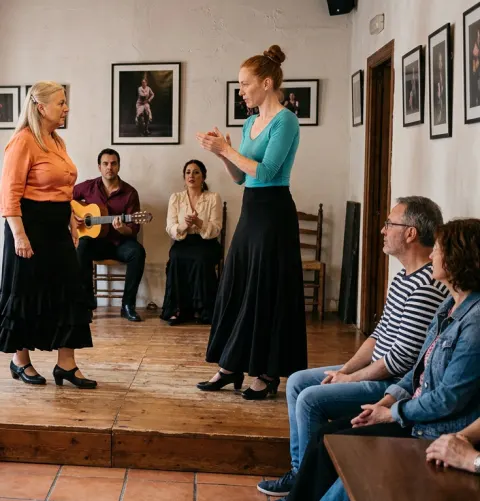
A Flamenco formation consists of more than the spots where you stand. It also includes space for arms, turns, skirts, and every transition between these spots. Your spacing rehearsal therefore translates the familiar sequence into a shared spatial arrangement. The steps stay the same at first, while their pathways become visible.

Decide which direction is front from the audience’s perspective, and consistently use right and left from the dancers’ perspective when they face forward. During a turn, these stage directions keep their meaning. This way, “back right” means the same place for everyone, even when someone is facing sideways.

Staggered rows can keep faces and upper bodies visible. The formations for a larger dance group also show how different shapes take up space; for your sequence, however, the actual movement space is what matters. With a cloth, you also need to account for its range of motion, as with the arcs and grip changes with the Mantón.

Don’t mistake a new orientation for new technique: a passage along the diagonal changes your viewing angle, but not automatically your footwork. This guide covers spatial group rehearsals, not coordinating with live music or the organizational arrangements for the performance.

A floor marker is only useful if you can find it again without looking down.

How to coordinate your stage routine

  1. Marking out the performance area

    Mark the usable area and the front edge, leaving some distance from the actual stage edges. Add starting positions and reference points to a simple plan; afterwards, everyone can point to the same stage directions without a mirror and identify their starting spot.

  2. Stagger the rows

    Take your starting positions and assume the widest arm position in the sequence. One person briefly views the formation from the audience's perspective, then returns; shift any positions that are obscured and test turns too, until your movement spaces no longer overlap.

  3. Walk through the changes slowly

    Walk through each position change with small steps and your familiar counting method. At crossings, decide who passes in front and who behind; everyone reaches their target position within the allotted passage without having to stop or move out of the way.

  4. Fitting in the solo sections

    Choose a spot for each solo, along with its start, end, and return route. The rest of the group tries out their planned movements at the same time. Keep the solo space visible, and make sure nobody walks through it. Note the familiar point where everyone joins in again.

  5. Align Your Footwork

    First dance the shared footwork passage in a simplified way and facing the same direction. Compare your starting foot, step direction, and finishing position without changing the technique you’ve learned; then listen for the shared accents. Clean coordination matters, not stamping as loudly as possible.

  6. Connect the transitions at tempo

    Connect line changes, solo, and return at the intended tempo, using the actual arm movements. Start each time before the transition and finish only after it; correct one specific bottleneck per repetition. The transition works when no one hurriedly shortens their steps or pulls their arms in.

  7. Document the Full Version

    Dance the entire sequence and have it filmed from the front with everyone’s consent. Then record the final positions, crossing paths, and solo transitions in the plan. Identify any deviations by noting where they occur in the sequence, so the next rehearsal uses the same version.

Stay focused when making spatial adjustments

Like this

  • Repeat only the problematic transition
  • Note a spatial change in the plan for everyone
  • If the path is too narrow, change the formation together
  • Point out corrections in a familiar passage

Not like this

  • Start the whole sequence over after every sticking point
  • Whisper new places to individual people only
  • Get past the bottleneck with ever bigger steps
  • Correct people with “over there” and “sometime earlier”

These are the results you record

After setup

Room

After the individual sections

Transitions

After the Run-Through

Version

Frequently asked questions

  1. Shorten the distances between positions first and adjust the formation instead of dancing the entire sequence faster. Keep the familiar rhythmic sections and try the tightest spot using full arm movements. If there still isn’t enough space, you need a change to the formation that you work out together, not individual evasive movements during the run-through.

Together rehearse for the stage

On udansa connect, you can find dancers for regular Flamenco rehearsals. Share the sequence you’ve learned and your planned lineup, so you can meet up with a specific practice goal.

Together rehearse for the stage