Dance Rhythm5 minutes

Distinguishing Flamenco Palos: What Changes Your Steps

By Mary De LucaUpdated

In short
  • Flamenco palos differ in their dance through their compás, tempo, accent patterns, and typical phrases.
  • Soleá and Alegrías often use twelve-count cycles with basic accents on 3, 6, 8, 10, and 12.
  • Bulerías are often felt in twelve-count cycles or groups of six, while Flamenco Tangos use a four-beat pulse.
  • You can’t identify a palo by its accent sequence alone, because related forms share rhythmic patterns.

You can hit every beat cleanly and still miss the phrase. That's why a comparison using just a few steps is especially revealing: What happens if you change only the tempo, the emphasis, or the ending?

DefinitionPalo

A Palo is a form of Flamenco with characteristic rhythmic, musical, and expressive features. It sets a framework for your dance, within which you shape movements and pauses.

Soleá and Alegrías share the same numbers, not the same feel

When you compare dancing Soleá and dancing Alegrías, the commonly used basic count first gives you the same map: 1, 2, 3, 4, 5, 6, 7, 8, 9, 10, 11, 12, with accents on 3, 6, 8, 10 and 12. The intervals are uneven: two groups of three are followed by three groups of two. This distribution is part of Flamenco Compás, but it does not identify the Palo on its own.

The first comparison exercise covers just two cycles. Mark each pulse with a small shift of weight, and use Palmas to mark only the five basic accents. For the first round, choose a relaxed Soleá tempo and consciously leave space for movement between the beats. For the second, use an Alegrías accompaniment: the flow of movement typically feels lighter and more forward-moving, even though the accent numbers stay the same.

This is not a rigid rule for every interpretation. Soleá can speed up during a dance, and Alegrías are not light throughout. The exercise isolates one difference instead of recreating complete choreographies. In the guide Learn to dance Flamenco, you’ll find an introduction to the broader topic. Here’s the key observation: the same rhythmic map allows for different dance phrasing.
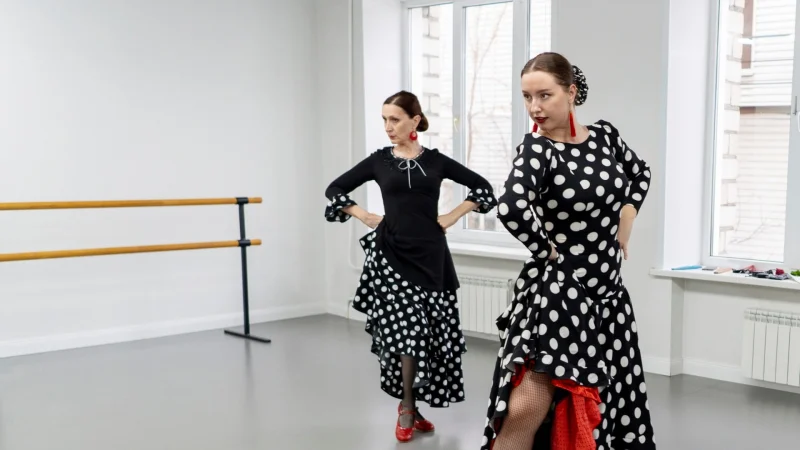
Flamenco dancer in a studio
An audible foot strike takes up space in the phrase, even if your movement remains small.

Bulerías tighten the cycle, Tangos change the grid

A common starting point for dancing Bulerías is the count 12, 1, 2, 3, 4, 5, 6, 7, 8, 9, 10, 11. One widely used basic pattern emphasizes 12, 3, 6, 8, and 10. In actual accompaniment, you’ll encounter variations and groups of six. So the following pattern is a practice model, not an unchanging blueprint for every Bulerías.

Your task: First clap only on 12 and 6 while continuing to count the other pulses in your head. Then add 3, 8, and 10 without adding any extra foot strikes. These two larger reference points help you keep the cycle together, even at a faster tempo. The dance’s intensity comes from short, pointed phrases, not from fitting in as many actions as possible.

With Flamenco Tangos, on the other hand, you switch to 1, 2, 3, 4. For this exercise, leave 1 silent and clap on 2, 3, and 4. This is a common learning pattern, not a rule for every Tangos accent. Then add exactly one Contratiempo clap on the and after 2: 1 and 2 and 3 and 4 and. This way, you can hear the space between the beats without losing the four-count grid. Here, Flamenco palmas make the timing audible, they don’t replace a dance phrase.

How you make the difference audible

That's right

  • Soleá: Carry the pulse between the accents
  • Alegrías: Shape the same counts with a lighter flow
  • Bulerías: Keep a short phrase within the recurring cycle
  • Tangos: Arrive back at 1 after four pulses

Not like this

  • Soleá: Skip unaccented beats
  • Alegrías: Just play the Soleá exercise faster
  • Bulerías: Fill every fast pulse with a beat
  • Tangos: Add a 12-count accent pattern on top

A pause on the right count can make the distinction between two dance phrases clearer than ten extra steps.

udansa editorial team

At the end, you can tell whether your phrase fits the Palo

Llamada, Remate and Cierre can be meaningfully distinguished through a specific Soleá exercise. A Llamada is a dance phrase that calls out, announcing an entrance or a change. A Remate is a pointed finish; a Cierre marks a clear ending. In practice, the terms can overlap. So for this exercise, what matters is their function, not a supposedly universal sequence of beats.

Take two Soleá cycles with the familiar basic accents. In the first, use a short, recognizable call phrase as an imagined Llamada. In the second, build intensity only on counts 8, 9 and 10 to create a Remate. For the Cierre, pause after the final beat on 10 and let 11 and 12 pass without a foot strike. The end of the movement does not stop the Compás from continuing. Ending on 10 is a common learning convention here, not a universal rule for all Palos.

This limited exercise shows why the same combination does not fit Tangos unchanged: its four-beat structure requires a different sense of timing. If you want to experience these differences physically for the first time, a taster course to try out a dance style is one possible way to get started. You do not need a complete stage routine for this comparison.

Two approaches to the same phrase

Counting

You hold the position steady

Counting makes the start and finish verifiable

When counting, you notice whether your ending lands on 10 or accidentally on 11. This approach is especially helpful with a new phrase. You can state its length without performing all the dance details yet.

Listening

You recognize the return

Accents connect individual pulses into groups

When listening, you notice when the same rhythmic pattern returns. This approach is especially helpful when fast counting gets in the way of dancing. You keep the phrase together without saying every number out loud.

Frequently Asked Questions

  1. No, Flamenco Tangos and Argentine Tango are different dance forms. In the Tango exercise on this page, you follow a four-beat pulse and dance without the typical partner lead of Argentine Tango. The similar name does not mean they use the same step sequence.

Build your rhythm together

On udansa, you can find people to practice with. Arrange a short session where you take turns clapping and dancing the same dance phrase.

Build your rhythm together