Choreographies6 minutes

Line Dances: Three Choreographies from Country to Pop

By Bernhard De LucaUpdated

In short
  • Cowboy Charleston, Cupid Shuffle and Jerusalema offer practical starting points for country repertoire, pop and South African music.
  • The versions selected here comprise 16 or 32 counts and each turn a quarter turn.
  • Cowboy Charleston and Cupid Shuffle are suitable for beginners; Jerusalema also requires quick weight shifts.
  • Each choreography has a fixed step sequence, a suitable recording and a deliberately chosen musical entry point.

A familiar song helps you recognize it, but not dance along just yet. Only the right choreography version explains why a line turns left while you're still waiting for the next chorus.

DefinitionChoreography version

A choreography version is a specific, set sequence of steps for a dance, including counts and changes of direction. The same song can have several different choreographies.

Cowboy Charleston combines country with 16 counts

Cowboy Charleston by Jeanette Hall and Tonya Miller is a beginner dance with 16 counts and four walls. It is part of the country repertoire and combines two Charleston sequences with side heel taps. A suitable song is Sold (The Grundy County Auction Incident) by John Michael Montgomery. The recording is fast-paced, but the short sequence stays manageable.

Here is the complete sequence, right and left refer to your feet:

  • Counts 1 to 4: Tap your right toe forward, step back on your right foot, tap your left toe back, step forward on your left foot.
  • Counts 5 to 8: Repeat the same four movements.
  • Counts 9 to 12: Tap your right heel diagonally to the right twice, cross your right foot behind your left, step to the side with your left, and cross your right foot in front of your left. The last three steps count 11 & 12.
  • Counts 13 to 16: Tap your left heel diagonally to the left twice, cross your left foot behind your right, step forward with your right foot while making a quarter turn to the right, then step forward with your left foot: 15 & 16.

To start practicing together, you can begin with the first sung verse, which is a chosen starting point, not an additional rule of the choreography. After that, the sequence continues without waiting for the chorus. The two quick three-step sequences are what set this dance apart from a simple Charleston repeat. The guide to line dance steps and their building blocks explains the movement terms used here.
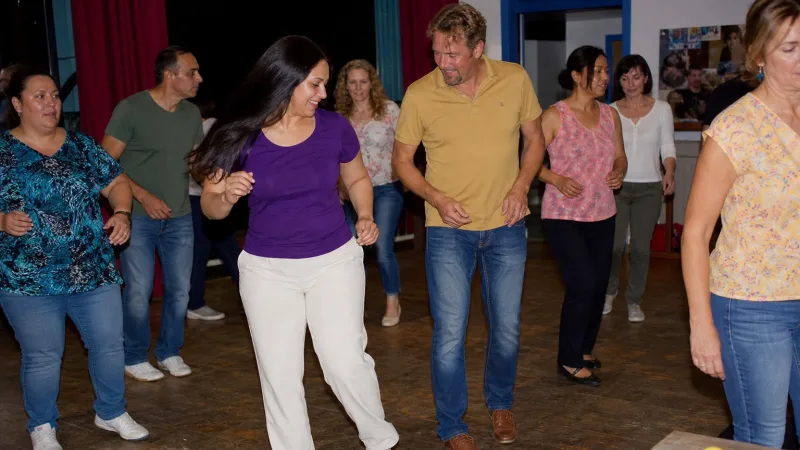
You can often tell which version it is from the feet before you can tell from the music.

Cupid Shuffle connects 32 counts with lyrical cues

Cupid Shuffle, danced to Cupid's song of the same name, is a popular beginner dance with 32 counts and four walls. Here, it refers to the familiar sequence of side steps, four alternating kicks and a quarter turn to the left. It has no quick in-between counts. This makes it an example of simple line dances to contemporary music, not the distinct dance style Modern Dance.

The sequence consists of four blocks of equal length:

  • Counts 1 to 8: Step right to the side, bring left together, step right to the side, bring left together, step right to the side, bring left together, step right to the side, touch left beside right.
  • Counts 9 to 16: Repeat to the left, starting with the left; at the end, touch right beside left.
  • Counts 17 to 24: Low kick right forward and step down, then do the same with the left, right and left.
  • Counts 25 to 32: Take eight small steps in place, starting with the right, while making a quarter turn to the left in total.

The first instruction, to the right, is an easy-to-recognize musical cue for the start. The later lyrical cues match the left, kicks and turn. So you don't need to know the entire song lyric. The total turn is important: eight steps here don't mean eight separate quarter turns. Unlike some dances from film and television, you also don't need a stage production to recognize the sequence.

Distinguish between the song and the choreography

That's right

  • Associate Cowboy Charleston with the names Hall and Miller
  • Dance the quarter turn at the designated point
  • Start the next round independently of the chorus
  • Associate Jerusalema with the version mentioned here

Not like this

  • Treat every Charleston step sequence as the same dance
  • Turn spontaneously whenever a direction is sung
  • Start again from step one with every chorus
  • Assume all Jerusalema videos have the same steps

A song title tells you what's playing; the name of the choreography tells you what your feet do to it.

udansa editorial team

Jerusalema needs a clearly identified version

Jerusalema by Master KG featuring Nomcebo Zikode comes from South Africa. However, the viral group dance video by the Angolan group Fenómenos do Semba is not the same as every later line dance version. This specifically refers to Jerusalema by Colin Ghys and Alison Johnstone: 32 counts, four walls, beginner level with quick foot changes.

The sequence for this version can be divided into four blocks:

  • Counts 1 to 8: Stomp the left foot forward without transferring your weight, pulse the left heel three times. On &, bring the left foot in; stomp the right foot forward and pulse the right heel three times. On &, bring the right foot in.
  • Counts 9 to 16: Tap the heels forward, alternating left, right, left, right, bringing each foot in on &. Then cross the left foot over the right, step the right foot to the side with a quarter turn left, cross the left foot over the right, step the right foot to the side.
  • Counts 17 to 24: Tap the left toe diagonally forward left and bring it in; tap the right toe to the right, the left toe to the left, and the right toe to the right, bringing each foot in afterward.
  • Counts 25 to 32: Step back left, right, left, tap the right foot. Step the right foot to the side, bring the left foot in, step the right foot to the side, tap the left foot.

The intended starting point is after a 32-count intro. Use the original recording, not a remix with a changed intro. Although this version is considered a beginner choreography, the quick changes in the second block make it more challenging than Cupid Shuffle. The song title alone is therefore not enough to describe the steps.

Two ways to connect music and steps

Adaptable

One dance, several suitable songs

Cowboy Charleston as an example

A short sequence can work with different songs that have a suitable rhythm. You keep the steps and discover how different they feel with another recording. The musical character changes, even though the choreography stays the same.

Song-specific

A song as a shared point of reference

Cupid Shuffle as an example

The recording provides audible cues that hold the group together. You associate certain movements with recurring lyrics. This makes the dance easier to recognize, but also more dependent on this music and its arrangement.

Frequently Asked Questions

  1. No, you don't need a dance partner for these three dances. Everyone dances their own sequence of steps and follows the same music. Standing in a line makes it easier to find your way, but no one guides you through hand contact or a partner hold.

Your next song is better together

On udansa, you can find people to practice Cowboy Charleston, Cupid Shuffle, or your next choreography with. Name your favorite dances so you have a repertoire in common.

Your next song is better together