Choreographies6 minutes

Jerusalema Line Dance: Ghys and Johnstone step by step

By Mary De LucaUpdated

In short
  • The Jerusalema choreography by Colin Ghys and Alison Johnstone has 32 counts, four walls and a Beginner level.
  • You dance heel pulses, quick heel switches, a quarter turn to the left, as well as side sequences and backward steps.
  • This version starts after 32 intro counts to the original recording by Master KG with Nomcebo Zikode.
  • The line dance version is not identical to the Angolan challenge by Fenómenos do Semba.

When dancing together, a foot mix-up often goes unnoticed until the whole line has already turned. A clearly labeled version saves you the guesswork and lets you keep dancing even without someone beside you to follow.

What you need for this episode

  • The recording “Jerusalema” by Master KG featuring Nomcebo Zikode
  • Comfortable shoes and a flat, non-slip floor
  • Clear space to the side and for three small steps backwards
  • A clearly identifiable starting wall for orientation
  • Confidently counting from 1 to 8, with “and” for the counts in between

A set version keeps step sequences from getting mixed up

“Jerusalema” is a South African song by Master KG featuring vocals by Nomcebo Zikode. The internationally popular challenge became known through the Angolan group Fenómenos do Semba. Their videos of people dancing while eating are part of the trend’s history. The line dance choreography taught here by Colin Ghys and Alison Johnstone is a set-count version: 32 counts, four walls, beginner level, no tags or restarts. So you don’t add an extra sequence or restart a round early.

“Four walls” means that each round changes the direction you’re facing by a quarter turn to the left. After four rounds, you’re facing the starting wall again. Beginner level doesn’t require learning a long list of figures, but it does involve quick foot changes on the in-between counts. Small steps help you get your weight over your supporting foot in time.

First, learn it without music and be consistent about distinguishing between a step that takes weight and a touch that doesn’t. For several short practice sessions, the line dance training plan for your first four weeks gives you a good structure. If the heel pulses start to feel tiring, you can gradually increase the intensity of your dancing instead of dancing through the entire recording right away.
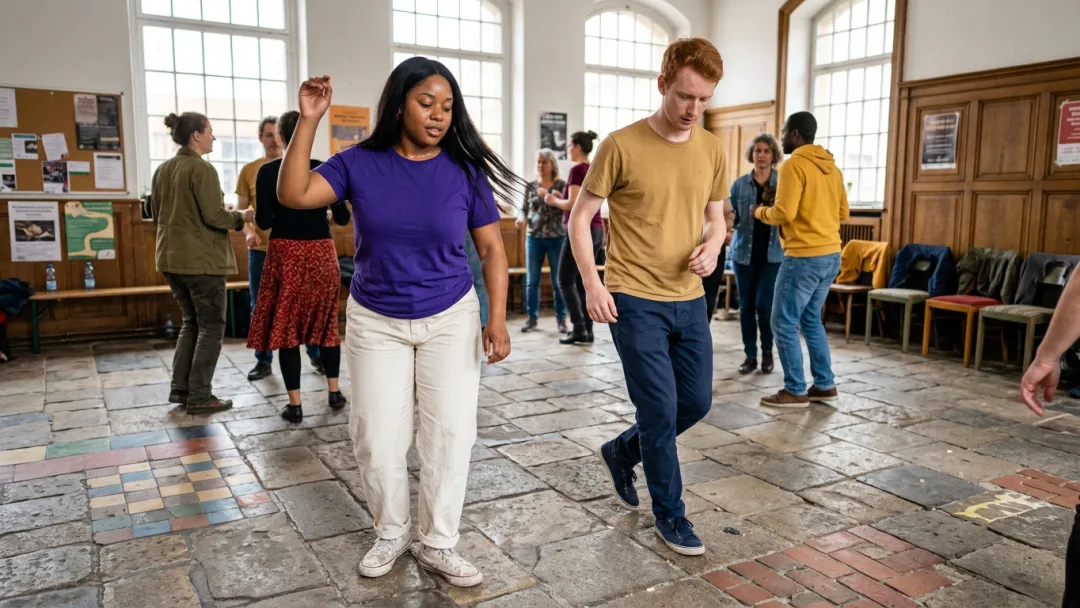
A flat, even surface lets you practice the counts between beats without compensating for unevenness with extra steps.

Putting the 32 counts together

  1. Practice the left and right heel pulses

    Counts 1 to 4: Stomp forward with your left foot, then raise and lower your left heel three times; your right foot remains your main supporting leg. On “and,” bring your left foot in; perform the mirror image with your right foot on counts 5 to 8, then bring your right foot in on the following “and.”

  2. Perform four quick heel switches

    Counts 9 to 12: Tap your left heel forward, on “and” step your left foot in; right heel forward, on “and” step your right foot in; repeat on the left, then repeat on the right. After count 12, also step your right foot in on “and” so your left foot is free for the turn.

  3. Turn left to face the new wall

    Count 13: Make a quarter turn to the left and step left to the side. On 14, cross right over left; on 15, step left to the side; on 16, cross right over left; you finish with your weight on your right foot, facing the new wall.

  4. Step sideways and walk back

    17: Step left to the side; 18: hold; “and”: close right; 19: step left to the side; 20: tap right next to left, without weight. On 21, 22, 23, walk backward right, left, right; on 24, tap left next to right, keeping your weight on the right.

  5. Connect two side triple steps

    25: Step left to the side; 26: bring right together; 27: step left to the side; 28: tap right without weight. On 29, 30, 31, step right to the side, bring left together, step right to the side; on 32, tap left. Left is now free for the next forward stomp.

  6. Dance the sequence to all four walls

    Connect the four eight-counts without an extra pause and repeat them four times. Each quarter turn takes place in the second eight-count; at the end of the fourth round, you’ll be facing your starting direction, with your weight on your right foot and your left foot free.

  7. Start dancing to the music after the intro

    Start the original recording and count four sets of eight from the moment the steady beat starts. After count 32, start on the next 1 with your left foot forward; with shortened clips, this intro length may not necessarily fit.

These details hold the sequence together

So ja

  • Keep the heel pulses close to the floor and your knees soft
  • Make the quarter turn with the step on count 13
  • Take short backward steps under your body
  • Let your arms move loosely alongside your steps

Not like this

  • Jump up with both feet on every heel accent
  • Turn away during the fast heel changes
  • End up in the next row with big steps backward
  • Use extra arm poses to trigger the foot changes

Mark your practice run as complete

Before the First Run-Through

Orientation

After practicing without music

Connection

After the run-through with music

Timing

Frequently Asked Questions

  1. No, you don't need a dance partner for this line dance version. Everyone dances the same sequence of steps independently, usually in rows and facing the same direction. There is no leading or following role. So you can practise on your own and join others later without having to change your steps.

The next row dances with you

On udansa, you can find dance partners to practice the version by Ghys and Johnstone with. Mention both names so you can start on the same 32 counts.

The next row dances with you