Music Selection5 minutes

Choosing Music for Line Dance: What Suits the Dance

By Bernhard De LucaUpdated

In short
  • An alternative song works if its tempo, musical phrases, and special sections fit the chosen choreography version.
  • The same BPM does not guarantee that transitions between the steps and the sections of a song will fit.
  • Tags and restarts are part of the specific music mapping and cannot be transferred automatically to other recordings.
  • For Cindy Meehl's Cowboy Hustle, the recurring 32 counts serve as a reference point for your music selection.

Your favorite song is playing through the speakers, the steps feel solid, but when the chorus comes around, the restart suddenly feels off. That feeling of stumbling can come from how the recording is structured, even if you haven't forgotten a step.

DefinitionPhrasing

Phrasing refers to the timing alignment of sections of a choreography with corresponding musical sections of a song.

A fixed version makes the comparison meaningful

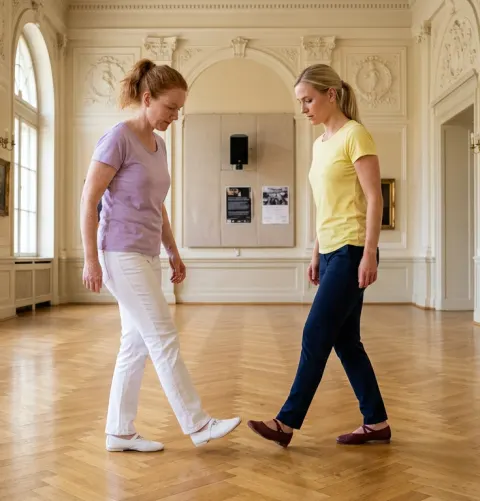
The reference here is Cowboy Hustle by Cindy Meehl, with 32 counts. This means the continuous basic version, not a variation you have added yourself. The complete step sequence belongs on the dance page. For choosing music, the first thing to note is: after 32 counted beats, the same sequence starts again.

A country or pop song offers two different conditions for this. Its pulse has to carry the movement in time. Its structure also determines where a new round coincides with a chorus, a verse or an instrumental transition. These two things can fit together, but they do not have to.

In a hypothetical example at 120 BPM, 32 beats last 16 seconds. So two songs at this tempo give you the same amount of time for the sequence. Still, one may regularly change sections after 32 beats, while the other has extra beats before the chorus. The fact that your steps take the same amount of time tells you nothing about these differences.

The recording is also part of the reference point: a radio edit, a live version and an album version may have different intros or intermediate sections. The song title alone therefore does not describe a reliable musical match.
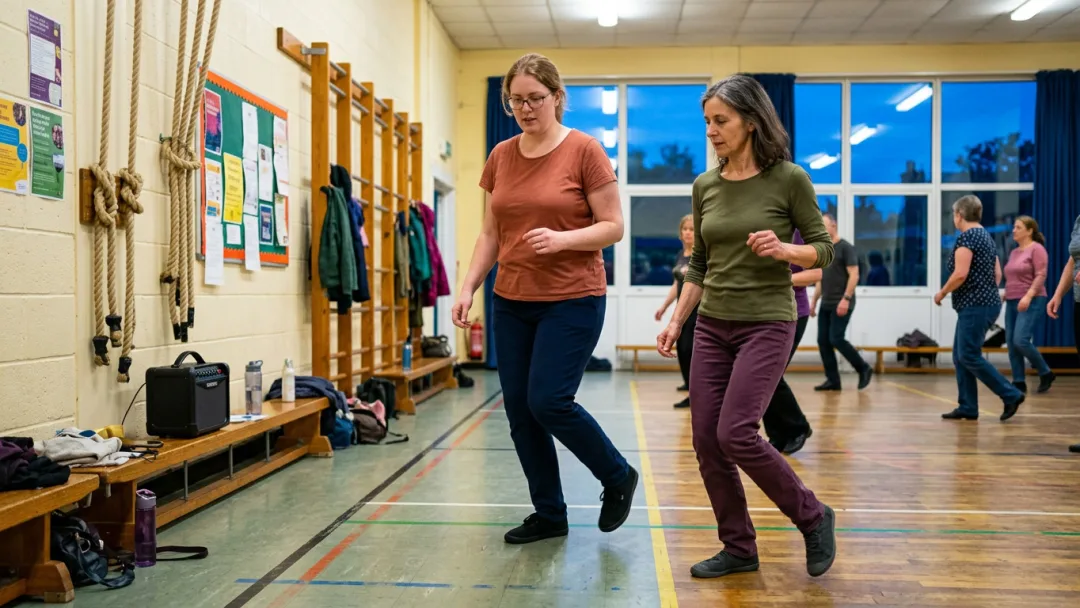
Even a different recording of the same song can change the entry point and the placement of musical transitions.

Tempo carries the steps, phrases organize the accents

You can tell a workable tempo by whether you can fully execute the intended movements. If you only suggest weight changes or regularly land too late, this recording is too fast for your current level. The Rock Step with a clear transfer of weight shows how to make a clean change. A suitable BPM number on the display cannot replace this physical ability to keep up.

Phrase alignment, on the other hand, is about where the musical transitions fall. Suppose a song is structured around 32 beats plus four additional beats at one point. Your Cowboy Hustle sequence finishes after 32 counts, but the next major musical section does not begin until four beats later. You can keep dancing, but count one and the beginning of the section are now out of sync.

This kind of shift is not automatically a dance mistake. Practicing continuously can work even across this boundary. However, the discrepancy matters for a performance closely aligned with refrains and prominent accents. What matters, therefore, is not only whether the steps are possible, but what kind of musical alignment you expect from the alternative.

How to tell if a music alternative is right for you

This is how

  • Use the established 32-count version as your reference
  • Dance to the tempo with complete weight transfers
  • Listen for transitions even after several repetitions
  • Relate special sections to the specific recording

Not like this

  • Mix different versions of the same dance name
  • Call the BPM suitable despite frantic steps
  • Use only the first run-through as evidence
  • Apply tags and restarts unchanged to every song

A song can be danceable all the way through without every chorus starting exactly at the beginning of your step sequence.

udansa Editorial

Special points determine transferability

Tags and restarts explain why some choreographies are tied to a particular recording. A tag adds extra counts at a designated point. A restart ends a sequence early and begins again at count one. In a version arranged accordingly, these adjustments align the sequence with the music that follows. They are not arbitrary fixes for every song.

For our continuous 32-count basic version of Cowboy Hustle, this means that a song you like with an additional musical passage does not automatically call for a tag. You can keep the sequence going continuously and accept that the section beginnings will not always line up. If, on the other hand, you add four counts to hit a particular transition, you create an adaptation for that recording.

Conversely, a tag from a different music pairing may cause a shift in a song with an even structure. An imported restart could shorten the sequence without any musical reason. Special points therefore always belong to the pairing of version and recording.

A convincing alternative carries the movements at the right tempo and maintains the desired phrasing match throughout the song. When changes are necessary, it is important to distinguish between using the unchanged choreography to different music and using an explicitly adapted version.

Two useful ways to use a different song

Practice

The sequence stays in focus

A steady pulse carries the repetition

When practicing, a steady song can help you connect the steps without interruption. Not every section change has to fall at the beginning of your sequence. This way, you consciously practice repetition, not the exact arrangement of this recording.

Design

The recording determines the accents

Musical transitions carry the dance

For a musically tailored version, the chorus, pauses and transitions take on special importance. The step sequence should place its accents at suitable points. A musical alternative may be less suitable for this, even though it works well during practice.

Frequently Asked Questions

  1. No, a pop song can also work for a Line Dance choreography. What matters is its pulse, a tempo you can dance to, and the structure of the specific recording. A country sound alone does not make a song suitable, just as a pop chorus does not make it unsuitable.

Let's dance together to your favorite song

On udansa, you can find people to practice Line Dance with. With a set choreography, you can try out how your favorite music feels over several rounds.

Let's dance together to your favorite song