Choreography5 minutes

Line Dance: The Difference Between a Tag and a Restart

By Mary De LucaUpdated

In short
  • A tag adds extra counts to the regular step sequence and is often called a bridge.
  • A restart ends a sequence early and immediately resumes with count one of the choreography.
  • The wall and count identify the repetition in question and the point where the exception occurs.
  • A specified step change prepares the correct supporting leg or direction for the following start.

Your feet know the sequence, but suddenly the line next to you starts over from the beginning. Such moments may seem like memory lapses at first, even though the choreography deliberately deviates from the familiar pattern at those points.

DefinitionRegular run-through

A regular run-through is a complete repetition of the specified basic sequence from the first to the last count. Add-ons and early restarts alter this sequence only at the explicitly designated points.

A tag lengthens, a restart shortens

A tag and a Restart do not fundamentally change the entire dance. They are set exceptions in the sequence of an otherwise repeating pattern. You can tell the difference by what happens to the length of the relevant repetition.

As a hypothetical example, let’s use a basic sequence with 32 counts. If the instruction says “after the third repetition: tag with four counts,” you first dance all 32 counts, then the four additional counts, and then start again from the beginning. So extra counts are added at this point. The specific steps of the tag are part of the choreography, you don’t make them up yourself.

If instead the instruction says “during the third repetition: Restart after count 16,” that repetition ends right there. Counts 17 to 32 are skipped this time, and count one of the basic sequence follows the 16 you danced. The next regular repetition includes all 32 counts again.

The guide to the 16-count Cowboy Charleston shows a complete, easy-to-follow sequence. The numbers in our two examples are made-up figures for illustration, not instructions for this dance.
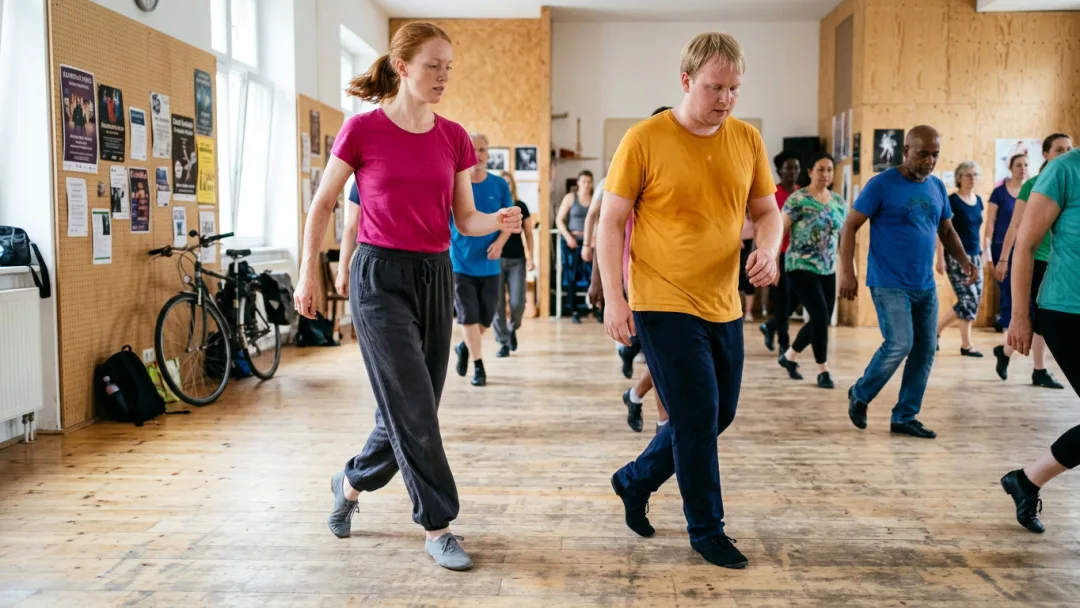
Even a count held in silence is part of the choreography and shouldn't be skipped when you continue counting.

Wall and count determine where the exception occurs

An instruction like “Restart at Wall 3 after Count 16” contains two different pieces of information. In this context, “Wall 3” usually means the third time through the sequence. “After Count 16” identifies the point within that repetition. You still dance Count 16 before the sequence starts again. So the term wall here does not refer to an additional turn.

It is also important to distinguish between “at” and “after”: a tag after a specified wall comes after it has finished. A restart in that wall interrupts it. A time reference like “facing 6:00” adds the direction you are facing at the specified moment. It does not replace the repetition number or the count.

The music often explains why these exceptions are included: a section lasts longer or shorter than the regular sequence would suggest. In line dancing, the word bridge is often used for a tag. But that does not necessarily mean that the same section is also called a bridge in the music.

Breaks in Boogie Woogie show how a musical interruption can be used differently in choreography. So an audible pause alone is not evidence of a line dance tag.

Putting the exception in the right context

That's right

  • In the tag, dance the explicitly stated extra counts
  • At the restart, start again on count one after the specified count
  • Make a step change only at the indicated point
  • Pay attention to the repetition number and facing direction separately

Not this way

  • Fill every musical pause with extra steps of your own
  • Dance out the remaining counts after the restart
  • Include the changed ending in every run-through
  • Determine which repetition you're on based on only one facing direction

The most important information about an exception is where the normal sequence is interrupted and where it resumes.

udansa editorial team

The Supporting Leg Determines the Transition

A restart is not an invitation to stop briefly and somehow rearrange your feet. The last movement before the restart must make the beginning possible. That depends not only on foot position, but especially on which foot is carrying your weight.

Suppose the basic sequence begins with a step to the right. Then your right foot must be free to take that step. But if the shortened sequence ends with your weight on the right, a transition problem arises unless you make an adjustment. Some choreographies therefore change the last step before the restart, for example by replacing a normally weighted closing step with an explicitly described unweighted action. This is one possible solution, not a general restart rule.

The specified change applies only where it is intended. It does not turn the restart into a tag either: that would require adding extra counts. Changing a movement on an existing count initially changes the transition, not the length.

A tag can also end with a deliberate distribution of weight so the beginning follows cleanly. To distinguish the two, however, the sequence is what matters: extra counts or an early return to count one. The supporting leg and direction of gaze then explain how this transition works physically.

Two ways to hit the music just right

Extra

The tag creates extra space

The basic sequence gets an insert

A tag can accommodate a musical extension, for example before the next section begins. You keep the familiar sequence and add the designated movements at the specified point.

Restart

The restart begins anew earlier

One run-through is deliberately shorter

A restart can align the beginning of the sequence with a section of music that comes in earlier. You skip the remaining part of that run-through and return immediately to the familiar beginning.

Frequently Asked Questions

  1. No, many Line Dances have no tags or restarts. Their basic sequence repeats without such exceptions. Whether a choreography includes them depends on how it is designed and the music it is intended for, not on how advanced you are as a dancer.

It's better to practice exceptions together

On udansa connect, you can find people to practice Line Dance with. You can arrange to repeat the transitions between an extra sequence and a restart.

It's better to practice exceptions together