
Find your perfect dance partner
On udansa you can find like-minded people in your area who share your passion for rhythm and want to conquer the dance floor with you.


By Bernhard De LucaUpdated
On udansa you can find like-minded people in your area who share your passion for rhythm and want to conquer the dance floor with you.
Whether on the glittering tournament stage or in the thick of a smoky club, Mambo is fascinating in every form. But anyone who understands the difference between competitive dance and social dance will find their personal connection to this fiery rhythm much faster.
Mambo competitive dance vs. social dance describes the contrast between highly structured, presentation-oriented dance sport and free, improvised partner dance in the club scene. While visual perfection counts in sports, the focus in the club is on the social connection.
Mambo has been on a fascinating journey, taking it from the lively clubs of Havana and New York to the smooth parquet floors of international competitive dance. Anyone looking for Mambo today will encounter two completely different worlds. On one side is the highly stylized competitive dance, which plays a fixed role as part of the Latin American disciplines in dance sport. On the other side, free social dance pulses in the clubs, where improvisation and a spontaneous connection to the music take center stage. These two forms differ fundamentally in their dynamics, their aesthetics, and the way the couple communicates with each other.
In dance sport, Mambo is characterized by fixed structures and extreme physical precision. Every movement is designed to achieve maximum visual impact and to utilize the space optimally. Those who move in the world of competitive dance often specifically look for a fixed dance partner for structured training. Helpful tips for this search can be found in the guide on finding a dance sport partner. In the club, however, social interaction is the priority. Here, you change partners, constantly adapt to new leading styles, and dance primarily for the shared moment and the joy of the music.
A fundamental difference between the two dance worlds lies in choreography and freedom on the floor. In competitive dance, couples leave nothing to chance. Every sequence of steps, every turn, and every pose is precisely planned in advance and rehearsed down to the millisecond. The goal is a flawless presentation that radiates power, elegance, and synchronicity. This perfection requires months of disciplined training and leaves almost no room for spontaneous decisions on the dance floor.
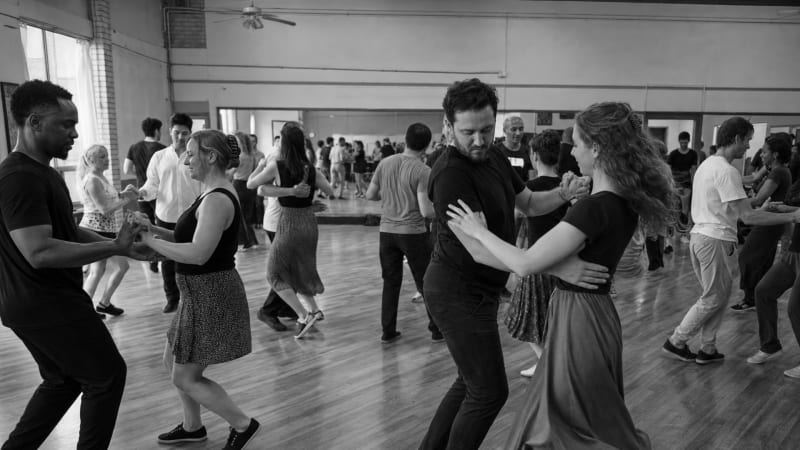
Social dance in clubs works in exactly the opposite way. Here, Mambo is a pure lead-and-follow dance based on constant improvisation. The leader decides in a fraction of a second which figure follows next, while the follower reacts sensitively to the slightest signals. This spontaneity is what makes club dancing so appealing. It is not about being flawless, but about interpreting the music together and reacting flexibly to the partner's movements as well as to the space on an often crowded club dance floor.
In the club
Don't do this
In a club, you dance for your partner and the music, but in a competition, you dance for the judges and the audience. That changes every movement from the ground up.
Body posture and visual presentation could hardly be more different. Competition dancers use an extremely proud, upright posture with expansive body tension to maintain presence even in the back rows of the audience. The movements are sweeping, the arm lines are fully extended, and the footwork is emphatically athletic. Every detail is designed to project energy outward and captivate the audience.
In the club, however, the posture is significantly more compact, relaxed, and grounded. Since space on the dance floor is usually limited, couples move in a much tighter area. The steps are smaller, the knees are softer, and the hip movements are more natural. Instead of dancing for an audience, the focus is directed inward, toward the partner and the connection within the pair. If you are looking to get started in this vibrant club scene, you will find valuable basics for your first steps on the social dance floor in the article learning to dance Mambo.
Perfection for the audience
Everything here revolves around precision, peak athletic performance, and a perfect visual presentation for the audience. Couples train fixed choreographies for maximum impact in the space.
Freedom on the club floor
Improvisation, social interaction, and a spontaneous connection to the music take center stage. You dance for each other and for the pure joy of sharing the rhythm in the club.
In competitive dance, you dance exclusively with a fixed partner with whom you have rehearsed choreographies for months. In the club, it is common and encouraged to change partners after every song to train your own improvisation skills.
Yes, Mambo in the club is significantly easier to learn because it is based on natural movements and social interaction. In competitive dance, the extreme physical discipline and the required precision demand years of intensive training.
No, that is not advisable. The wide, expansive movements and fixed choreographies of competitive dance require a lot of space and disrupt the flow on a crowded club dance floor, where flexibility is required.
Find the right course and learn the fiery rhythms from scratch.
Couple danceLimbach-Oberfrohna · Germany
PaartanzkreisFriday · 18:15 · Oct 23
Limbach-Oberfrohna
BallroomMeißen · Germany
Tanzkreis | PROFESSIONALTuesday · 20:15 · Oct 27, 2026 - Jan 5, 2027
“Ein Haus für Vieles” - Saal Tanzkurse
 Mambo vs. Salsa: Which rhythm suits you?Mambo and Salsa may look similar at first glance, but their rhythm and dynamics are fundamentally different. We show you how to distinguish these styles in your ears and your feet.
 Mambo vs. Salsa music: The subtle rhythmic differencesMambo music is considered the wild, complex sister of Salsa. We show you how the rhythmic structures differ and what that means for your steps.
 Mambo Jazz vs. Partner Dance: Solo Steps and Partner DynamicsMambo Jazz or classic partner dance? Learn how the solo groove differs from traditional partner dancing and which style suits you best.
 Mambo or Kizomba: Which dance style fits your mood?Mambo or Kizomba? Discover the differences in tempo, closeness, and origin to find the exact dance style that perfectly matches your current mood.
 Mambo vs. Swing: Footwork and GrooveMambo and Swing in direct comparison: How weight transfer, tempo, and footwork differ and what that means for your dance feel.
 Rhythm test: Are you ready for Mambo On 2?Are you ready for the challenging Mambo On 2, or is Salsa On 1 a better start? Take our rhythm test and find out.
 Mambo vs. Cha-Cha-Cha: Comparing Rhythms and StepsMambo and Cha-Cha-Cha share the same roots, but they sound completely different. We compare the rhythms and steps for your success on the dance floor.