

Find your rhythm in Raqs Sharqi
On udansa, you will find like-minded people, passionate dance schools, and exciting workshops in your area to begin your journey into the fascinating world of oriental dance.

Oriental dance has fascinated generations with its fluid movements, its rhythmic variety, and its deep expressiveness. Experience an art form that strengthens both body and mind equally and transports you into a rich culture.
Raqs Sharqi is the Arabic name for the classical oriental dance that established itself as a professional stage dance in Egypt in the early 20th century. It is characterized by a fine coordination of fluid movements, rhythmic accents, and emotional expression.
The roots of the dance that we mostly refer to as belly dance in the West today go back centuries. Its cradle lies in the Middle East and North Africa, where it was and is much more than mere entertainment: it was and is an integral part of family celebrations, weddings, and communal festivals. In Egypt, the classical stage dance Raqs Sharqi developed from this in the early 20th century, which simply translates to oriental dance. This art form combines folkloric elements with influences from classical ballet and modern dance styles.
Anyone who understands the historical background looks at the movements with different eyes. It is not about mere exhibition, but about telling stories and making music visible. The body of the dancer becomes an instrument itself, reflecting the subtle nuances of drums, flutes, and string instruments in the room. This rich tradition distinguishes oriental dance from pure fitness trends and gives it a deep, emotional dimension.
Learning the art of oriental dance means experiencing your own body in a completely new way. In contrast to many western dance styles that rely heavily on spatial patterns and jumps, oriental dance focuses on the center of the body. The movements originate in the core and isolate individual muscle groups from one another, while the rest of the body remains seemingly still. This requires fine coordination and strong deep muscles.
No special physical requirements are necessary for the Raqs Sharqi introduction. Every age, every physique, and every fitness level is welcome. The gentle, circular movements are easy on the joints and simultaneously strengthen the pelvic floor as well as the back muscles. Many beginners report that they develop a completely new, positive body awareness through the training and that everyday tension noticeably subsides. Anyone who commits to it trains not only their balance, but also their ability to concentrate.
Use a large mirror when practicing at home. It is the only way you can check whether your hip movements are truly isolated or if your upper body is moving along unconsciously.
Oriental dance is like a visual translation of the music, where every drum and every flute finds its place in the body.
The world of oriental dance is amazingly diverse and reaches far beyond the classic image of the shimmering sequin costume. A well-founded overview of belly dance styles shows how broad the spectrum is. The classic Raqs Sharqi impresses with elegance, flowing veil movements, and sophisticated step combinations on half-toe. In contrast, there are earthy folk dances like the Egyptian Baladi, which radiates pure joy of life and down-to-earthness, or the Saidi, which is traditionally danced with a cane.
In recent decades, modern fusion styles have also developed that integrate elements from contemporary dance, Flamenco, or Hip-Hop. Anyone discovering oriental dance belly dance for themselves today can freely unfold between traditional folklore and experimental forms of expression. Every studio and every teacher sets their own priorities here, which is why it is worth trying out different trial classes. If you are still unsure which dance style generally suits you, a playful approach like our dance style quiz might help you to get to know your dancing preferences better.
Tradition and cultural heritage
The traditional form places great importance on the cultural roots, the specific music theory, and the classic movement sequences of the countries of origin.
Creative freedom and a mix of styles
Modern fusions blend oriental isolation techniques with elements from Contemporary, Hip-Hop, or Tribal Style, offering space for creative experiments.
No, you absolutely do not need to show your belly to get started. You can train in comfortable sportswear, such as leggings and a simple T-shirt, in which you feel comfortable and can move well.
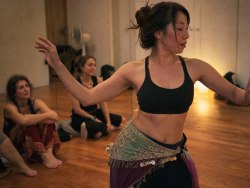 Oriental Dance: History and Styles OverviewDive into the fascinating history of oriental dance. Learn more about the roots of Raqs Sharqi, the earthy Baladi, and the variety of regional styles.
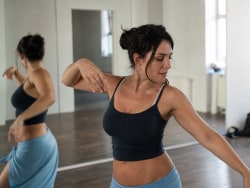 Learn Belly Dance Technique: Mastering Isolations and ShimmiesLearn how to perform basic isolations, shimmies, and hip accents in oriental dance with precision and improve your coordination.
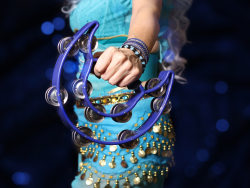 Belly Dance Music & Rhythms: Feel the soul of Raqs SharqiDiscover the fascinating world of Middle Eastern rhythms and learn how to expressively integrate Maqsum, Malfuf, veils, and zills into your dance.
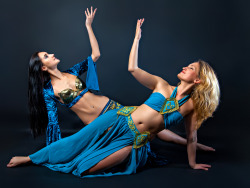 Belly Dance Performance Prep: Costume, Makeup, and PracticeYour first belly dance performance requires thorough preparation, from choosing your costume to applying stage makeup. Learn how to prepare optimally and master the art of improvisation.