Stagecraft5 minutes

Burlesque without taking your clothes off: The costume does the teasing

By Mary De LucaUpdated

In short
  • Burlesque without undressing creates tension through costume, movement, and theatrical choices, without requiring you to remove any clothing.
  • Opening, adjusting, and deliberately keeping things as they are can each create a visible change in your scene.
  • An open jacket can reveal its lining while your body remains fully covered.
  • You don't need a particular body shape or gender for these costume actions.

Perhaps your strongest stage moment hinges on a single button. When the audience understands its significance, it doesn’t need a costume change to notice a transformation.

DefinitionCostume Action

A costume action is a deliberate action performed with a worn item of clothing that changes its meaning or appearance within a scene.

The costume becomes a counterpart to your movement

A jacket is clothing to begin with. On stage, it can also be a uniform, a shield, or a prized possession displayed with pride. Which meaning comes across depends on how you handle it. Smoothing the lapel matter-of-factly has a different effect than presenting that same spot as a precious find.

In burlesque without striptease, this relationship drives the costume action. The audience needs to be able to see a choice, not just a gesture. A touch on the collar takes on meaning when you give it your attention and then continue performing in a changed way. By contrast, if you keep adjusting your clothes while dancing, it initially looks like a practical fix.

One striking detail is often enough: a wide collar, a contrasting lining, or a flowing scarf. The rest of the outfit can stay simple. That way, several moving fabrics are not competing for attention. The page on gaze direction in burlesque explains how to shift the focus between the garment and the audience. What matters here is the role your costume takes on in that moment: Is it being displayed, rearranged, or deliberately left unchanged?
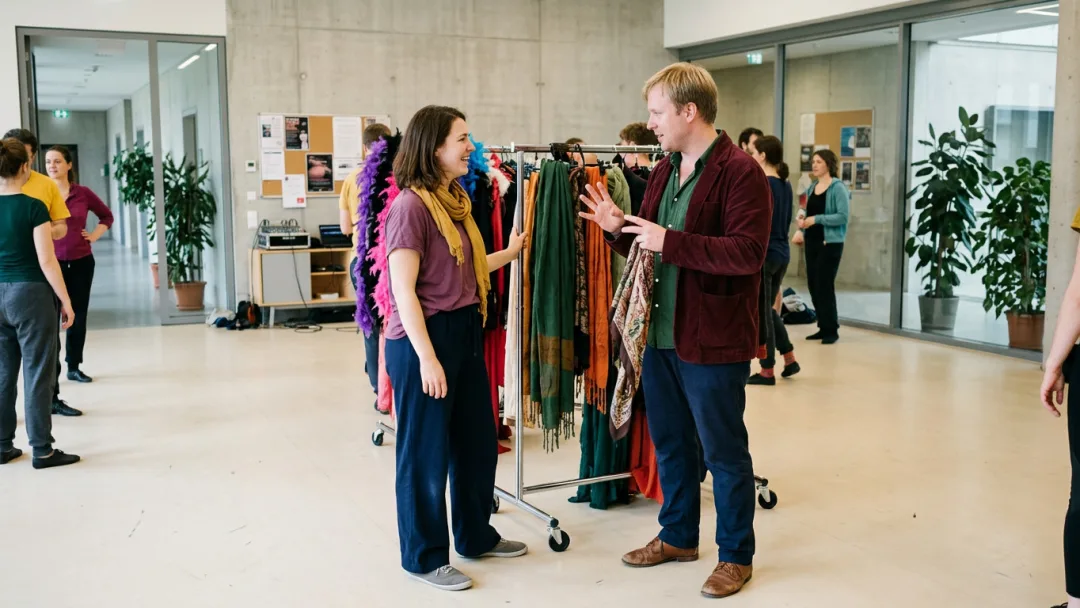
A second cloth prepared in advance can make the same idea read differently without judging your body differently.

Opening, repositioning and keeping in place say different things

Opening something does not automatically mean undressing. When you turn a lapel outward, a surprisingly colourful lining can appear. The jacket stays on, and the shirt underneath still covers your torso. What you reveal is a design detail. You don't need to open a fastening any further than the planned area of visibility requires.

Repositioning changes the arrangement. A wide scarf, initially draped loosely over both shoulders, now lies like a sash on one side. This can suddenly make a casual look seem festive. The material stays with you, its new position makes the statement. Short, clear fabric paths help make the change recognisable, so it doesn't look like a tangle.

By contrast, consciously keeping something in place needs a visible reference to the possible change. Your hand reaches for a coat button, pauses, then smooths the closed coat instead. This shows a decision. If the clothes simply remain untouched, that isn't yet a performed costume action.

All three options can fit a musical accent. A short sound might emphasise flipping open the lapel, while a longer note gives you time to change the position of a scarf. You don't need to illustrate every beat or build the entire routine around fastenings.

A stage choice or a mere physical action

Like this

  • Present the lining as a surprising detail
  • Visibly move the fabric into a new position
  • Deliberately leave the reach for the button unfinished
  • Link a costume movement to an audible accent

Not like this

  • Casually open your jacket and immediately keep walking
  • Adjust your scarf behind your back without anyone noticing
  • Fiddle with the button without making a decision
  • Move every clothing detail at the same time

A costume choice tells a story when the meaning of the moment changes along with the fabric.

udansa editorial team

The scene adapts to you, not to a body ideal

A costume gesture becomes legible through contrast, position, and movement. You don’t need a slim waist, long legs, or a particular gender presentation for that. An open lapel can reveal the same thing on different bodies. A sash can signal authority without tying that role to a gender.

Choose where to place the detail based on how you actually move. If a shoulder movement feels comfortable for you, a scarf change can happen there. If smaller arm movements work better for you, an easy-to-reach lapel can carry the idea. The same stage logic applies when seated, only the visible area and the fabric’s movement change. Flat shoes work for these gestures too, because the expression doesn’t come from heel height.

Heavy fabric responds differently from light fabric. Wide sleeves can conceal the detail, and a tight fastening can interrupt the movement. These are qualities of the material, not judgments about your body. To practice the gesture, it helps to rehearse one costume action separately from long dance sequences. You can use ideas for short practice sessions between classes. The key question is whether the movement you choose makes the meaning of the garment visible.

Two equally valid paths to visible change

Material

The garment changes

A detail takes on a new function

You move a scarf from both shoulders to one shoulder. It stays on your body, but now looks like a small sash. The change comes from its position, not from how much skin it covers.

Meaning

The garment stays the same

The way you handle it changes the scene

Your coat stays closed, but suddenly you treat it like a precious award. You adjust the collar and present the front. The change comes from your relationship with the costume, not from altering it.

Frequently Asked Questions

  1. No, an item of clothing you already own with a clearly visible detail is enough to create a stage idea. A light-colored collar, a contrasting lining, or a wide scarf can be presented clearly. What matters is how easily the material moves and whether its function is recognizable, not whether it sparkles or how much it costs.

Your costume needs an idea

On udansa, you can find people to rehearse with and try out how your costume ideas come across. Describe your idea as burlesque without stripping, so your plan is clear from the start.

Your costume needs an idea