Course Selection5 minutes

Heels Dance Course for Beginners: Technique Before Choreography

By Mary De LucaUpdated

In brief
  • A suitable beginner Heels class gradually gets you used to wearing heels instead of expecting you to perform a complete choreography right away.
  • Good technique instruction explains movement principles and lets you try short sequences again after receiving feedback.
  • A beginner-friendly class offers suitable options without heels, without excluding you from learning together with the group.
  • A trial class shows you whether the pace of explanations, feedback, and physical demands suit your actual starting point.

Being able to dance along to a sequence at the end of a class feels like progress. Whether you've actually learned anything often only becomes clear when the teacher is no longer standing in front of you.

DefinitionTechnique portion

The technique portion refers to the class time during which movement principles are explained, practiced individually, and corrected with targeted feedback. It can also take place within a choreography and does not need a separate block.

A beginner course needs to combine two learning tasks

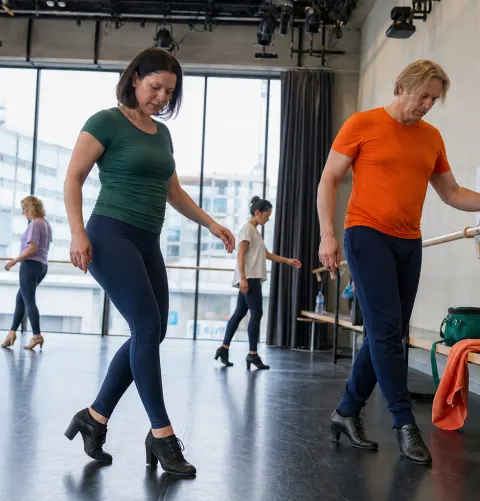
In Heels Dance, you learn a dance language and how to manage an unfamiliar standing position at the same time. Even if you wear heels in everyday life, repeating movements to music is a different task. A true introduction therefore takes into account not only how quickly you can remember a sequence, but also how long you can work with control and focus.

Getting used to heels in class means that the strain is introduced gradually, breaks are possible, and more challenging content is not all added at once. Preparatory work can initially take place without heels. After that, not every exercise has to be danced in heels until the end of the class. How to gradually increase your dance workload is also relevant for this introduction.

The term “beginner” should describe the prerequisites, not just a short choreography. Even a sequence with only a few movements can be taught too quickly. Conversely, a musically varied class can be suitable for beginners if the fundamentals are introduced clearly. For your introduction, it also matters that flat-shoe variations can work toward the same learning goal. They do not replace all of the heel technique, but they let you take part while you get used to the new strain.

Changing shoes during class can be a sensible adjustment, not a sign that you're not cut out for it.

Technique becomes visible through repetition after feedback

A technique block at the start of a class is not proof of quality on its own. If a long sequence is then demonstrated without interruption, the connection to actual dancing may be missing. Good teaching makes clear where a movement principle is needed in the choreography. The instructor can take out a passage, point out the tricky part, and have you practice the same passage again.

Movement corrections are helpful when they remain clear and focused. “Make it cleaner” does not tell you what you can change. Feedback on the timing of a weight transfer or a change of direction that comes too early, on the other hand, identifies something you can observe and work on. You do not have to reorganize several parts of your body at once. A manageable correction followed by repetition makes learning easier to follow.

Personal feedback requires attention and a chance to put it into practice. Group size alone therefore tells you little: even a smaller group may simply dance along behind the instructor. What matters is whether the instructor pays attention and responds to noticeable difficulties. Physical corrections through touch require your consent. Explanations, demonstrations, and verbal cues are also possible. Between classes, briefly practicing content you have already learned can help, without taking on new challenges on your own.

How to recognize beginner-friendly classes

Like this

  • Dance a passage again after the explanation
  • Get time to try it out after a correction
  • Use a simpler variation within the group
  • Slow down the tempo if you're unsure

Not like this

  • Move on immediately after demonstrating something once
  • Listen to corrections as the next section begins
  • Only watch from the sidelines, with no breaks
  • When unsure, just dance along faster

A trial lesson doesn't have to deliver a finished result, but it should help you understand what you're working on right now.

udansa editorial

The right class clearly states its learning goal

If you want to find a Heels Dance class, the announced content tells you more than a spectacular end-of-class video. “Foundations,” “Basics” or “Beginner” can point to foundational learning, but they are not protected quality labels. More specific details include getting used to heels, regular technique practice, short dance sequences and possible variations without heels. A class focused solely on choreography can be well taught, but depending on its format, it may already assume some movement experience.

Compare classes on udansa or at a dance school using these four points: gradual acclimation to heels, dedicated time for technique, opportunities for movement corrections and alternatives without heels. It also helps to distinguish clearly between formats. An ongoing foundational course builds on what you learn from one class to the next. A drop-in class often covers a self-contained sequence and may have changing participants. So what you book with a single class with no subscription is also relevant to getting started.

A Heels Dance trial class gives you a chance to experience the teaching, it is not a test of your ability. You can take your time learning and still be doing it right. If a flat-shoe option is included as a matter of course, explanations are easy to follow and you can repeat the moves, that points to a supportive learning environment. A fast final sequence alone does not.

Two useful starting points

Basics

A course with progressive classes

Recurring content provides guidance

A continuous beginner course revisits familiar movements and builds on them step by step. It’s a good fit if you want to attend regularly and make use of feedback over several sessions.

Trial class

A single class to get acquainted

Get a feel for the pace and teaching style

A single introductory class shows you how explanations and hands-on practice work together. It’s a good fit if you’d first like to experience what a Heels class feels like, without committing to a longer series.

Frequently Asked Questions

  1. You don't need dance experience for a class that doesn't assume any prior knowledge. Previous experience can help you remember sequences, but it doesn't replace getting used to dancing in heels. Terms like “Beginner Choreo,” on the other hand, may imply some dance experience if rhythm, changes of direction, and learning by counts are no longer explained.

Getting started takes time to learn

On udansa, you’ll find dance classes to help you get started. Use the four criteria to choose a Heels class that teaches the fundamentals and leaves room for your questions during class.

Getting started takes time to learn