The hands give meaning to the foot movements
Azonto is part of Ghanaian popular dance culture and became known internationally in the early 2010s through music videos and social media. Its development is often linked to older Ghanaian dance practices such as Kpanlogo. However, no single, unchanged sequence of steps fully describes the dance: the execution, gestures and musical accents vary.
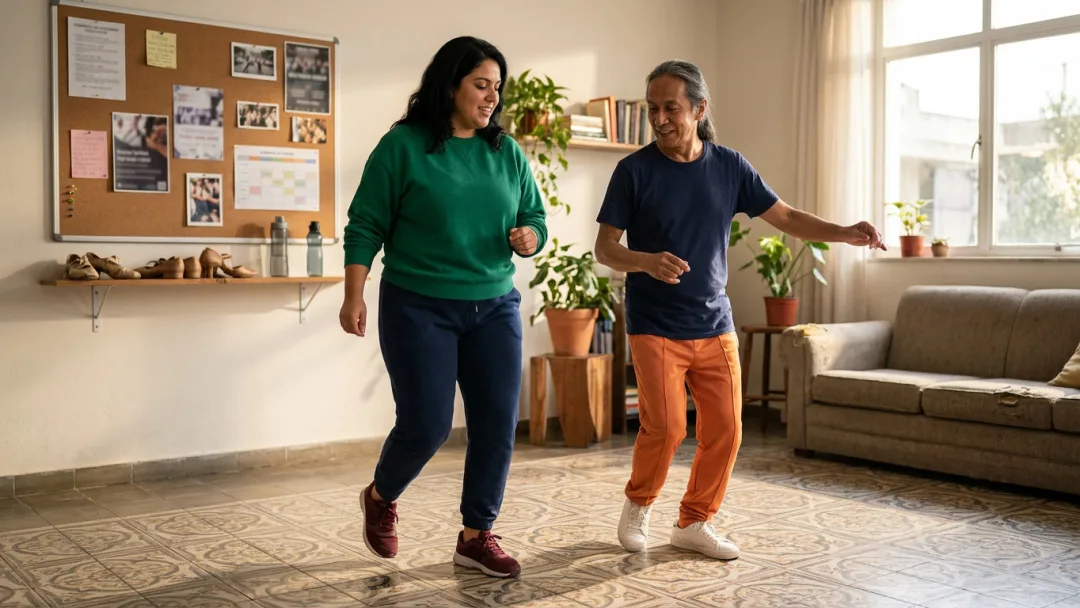
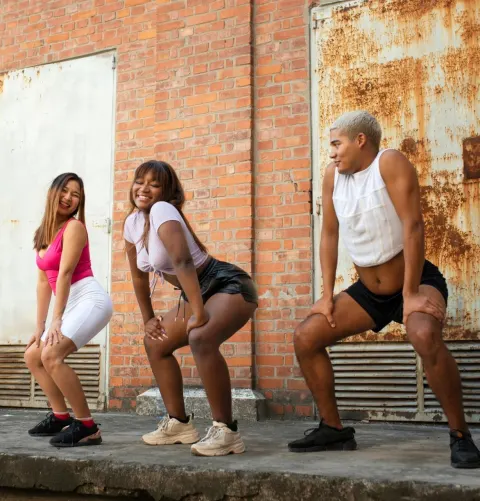
It is characterized by the combination of rhythmic body movement and expressive gestures. For example, you can mime washing, ironing or talking on the phone. The hands illustrate a recognizable activity, while the feet, knees and upper body carry the musical pulse. You don't need to make big movements or act out a whole scene. You can repeat a short action, make it smaller or add a glance.
This exercise breaks down this connection for learning, it does not establish a universally applicable Azonto choreography. You use alternating weight shifts and forefoot taps as a simple foundation. The washing gesture is a freely chosen everyday motif, not a prescribed sign with only one meaning. This lets you understand the coordination without equating your exercise with the entire dance.
The origin also matters: Azonto is Ghanaian. The Nigerian Shaku Shaku, with its own foot and arm coordination, is a different dance form. So describe your combination as an introductory Azonto exercise, not generically as an African basic step.