
Course planning6 minutes

Plan your graduation ball dance course between January and June

By Mary De LucaUpdated

In brief
  • For a prom in June, starting a course between January and March gives you more time to practice.
  • The number of lessons you need depends on your previous experience and how much dancing you want to learn, not just the date of the prom.
  • A crash course covers a few basics in a compact format, while private lessons can focus on the things you find difficult.
  • You don't necessarily need new dance shoes for a single prom, but you do need to practice between lessons.

Between exams and final exams, adding another regular commitment can quickly become a burden. A suitable course still leaves you room to study, instead of creating a second timetable just before prom.

DefinitionLesson unit

A lesson unit is the period of time a provider uses to bill for or structure their classes. It does not automatically correspond to a 60-minute hour.

The start date determines how much time you have to practice

For a graduation ball in June, January to March offer one main advantage: time between first learning a movement and recalling it later. In class, you can often do a step with a cue. On the dance floor, you have to find it again without that help. That’s why spaced-out practice is more valuable than packing as much as possible into one class evening.

Starting in January or February works well if you want to learn several dances and have time to practice regularly. In March or April, it becomes more important to keep things focused: for example, the basics of slow waltz and Discofox, if those dances are planned for your ball. In May or June, a crash course can offer a small introduction. But it can’t replace the practice between lessons that a longer course allows.

There’s no set number of dance lessons that will make everyone ready for their graduation ball. If you already know the rhythm and basic steps, you’ll need different lessons than someone with no prior experience. Even an extensive course can’t guarantee confidence if nothing sticks between classes. You’ll find a broader timeline in the guide to preparing for your graduation ball from January to June. The group opening dance is its own rehearsal area, not a replacement for your individual lessons.
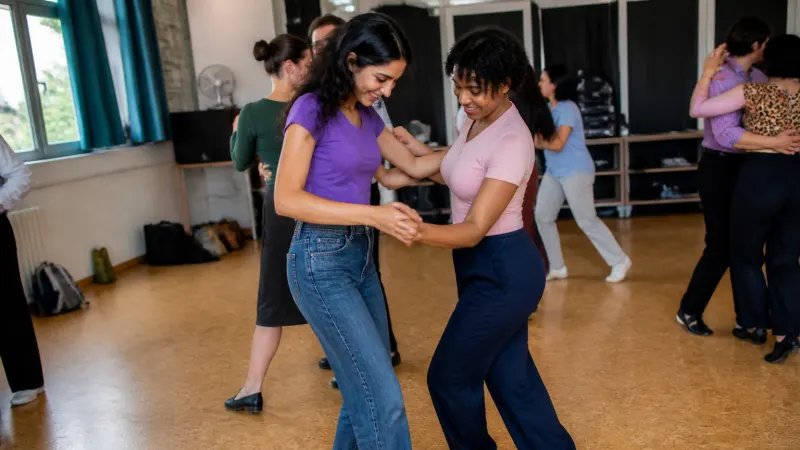
A second pair of shoes in a bag keeps street dirt off delicate practice floors.

Course costs only become meaningful when you consider what's included

When it comes to price, what matters is how much instructor-led learning time you actually get. An advertised number of hours may refer to lessons of different lengths. That is why you cannot compare a short intensive course with a course lasting several weeks based on the number of sessions alone. The total commitment also includes travel time and, if applicable, additional practice sessions.

A well-focused prom dance course covers more than just figures. You also need an introduction to the music, an easy-to-follow basic tempo and repetitions where the instructor can spot mistakes. If lots of dances are only briefly introduced, there is less time to consolidate the fundamentals of each one. For a one-off occasion like yours, a course that covers less may therefore be a better fit.

Private lessons are especially useful if you have a specific challenge: you lose the rhythm, cannot find the beginning or struggle to return to the basic step after an interruption. Private lessons can also work if you have no previous experience, but they need to be deliberately limited in scope. They are not automatically cheaper or faster than a group course.

Before booking, all you need is to clarify a few things: the total price, the actual lesson duration, which dances are included and what happens if you miss a session because of exams. That way, you book a clearly defined course rather than an unclear promise.

How to tell what scope is right for you

Do this

  • Consider lesson duration and total price together
  • Plan a few basics with repetition
  • Take course time and your own practice time into account in your calendar
  • Use private lessons to work on a specific challenge

Not like this

  • Count only the number of advertised hours
  • Pack as many figures as possible into a short course
  • Count only class attendance as preparation
  • Book private lessons as an automatic guarantee of success

A course fits into your exam month if there’s still room for short review sessions alongside classes.

udansa editorial team for dance guides

Short review sessions and familiar shoes take the pressure off

Between final exams and dance rehearsals, your personal preparation doesn’t need to involve long extra evenings. As a practical example, ten calm minutes are enough for a review: first recall a familiar sequence, then try the same sequence to music. This isn’t a guaranteed amount of learning, just a manageable time slot. Fatigue and time pressure make new material unnecessarily difficult.

On your own, you can recall the rhythm and steps. That can’t fully replace dancing with a partner. So practice what you already know on your own, without turning every study break into a new dance task. Just before the ball, a small set of steps you feel confident about is more helpful than a collection of figures you only half remember.

New dance shoes aren’t a must-have for a single prom ball. What matters is that you can stand securely and move with control in the shoes you plan to wear. Special dance shoes can be useful if you take lessons regularly, but their soles are often designed for indoor floors, not for walking around town. For help with fit and choosing a style, see the guide to finding suitable dance shoes. If you’re bringing a spare pair, the custom-designed dance shoe bag offers a simple way to carry them separately.

Two teaching formats, two strengths

Group

Build your foundation with others

Regular sessions and a shared learning pace

In a group course, you see how others work through the same move and practice together to the music. The set pace takes the pressure off planning, but leaves less room for lengthy personal feedback.

Private

Work on your own challenge

Individual feedback and a targeted focus

In private lessons, the instructor can spend more time on your basic step, sense of rhythm, or a movement you feel unsure about. This focused feedback is especially suited to a clear goal, but you'll also need to practise independently afterwards.

Frequently Asked Questions

  1. There is no reliable set price, because course length, group size, and included services vary. What matters is the total cost for the planned lessons, including any additional sessions. A low introductory price tells you little if you need more lessons afterward.

Prom dance classes to get ready

On udansa, you'll find classes where you can practice the basics for your prom night.

Browse all suitable classes

Your prom night needs practice

On udansa, you’ll find graduation ball dance classes to build your foundation. Choose a course length that leaves you time to review alongside your exam dates.

Your prom night needs practice