
Experience Samba de Gafieira together
Find like-minded people on udansa who share your passion for the Brazilian partner dance, and discover suitable courses in your area.



By Bernhard De LucaUpdated
Find like-minded people on udansa who share your passion for the Brazilian partner dance, and discover suitable courses in your area.
The magic of Samba de Gafieira lies in the rhythmic interplay with the music. Once you learn to feel the syncopation in your own body, you transform steps into pure joy of life.
Samba de Gafieira musicality refers to a dance couple's ability to intuitively hear the complex rhythms, syncopations, and tempo changes of Brazilian samba music and translate them into dance steps in sync.
Anyone hearing Brazilian Samba music for couple dancing for the first time immediately feels the infectious energy. However, the rhythmic structure differs fundamentally from European ballroom dances. The key to understanding lies in the pulse of the drums, which takes hold of the entire body. Instead of rigidly counting the beats, Samba de Gafieira musicality is about shifting your weight flexibly and letting yourself be carried by the flow of the music.
The basic rhythm is based on a regular two-four time, which is brought to life through subtle delays and accents. To build this Samba de Gafieira sense of rhythm, it helps to first focus entirely on the heavy beats. These mark the foundation upon which the dance couple builds their steps. Only when this foundation is firmly anchored in the body can the subtle rhythmic playfulness begin.
A typical entry is achieved by consciously listening to the deep surdo drum in interaction with your own breath. Once you have internalized the basic step, use this pulse to build an elastic connection with your partner. You can find out how the interaction of the roles works in detail in our guide on leading and following in Samba de Gafieira.
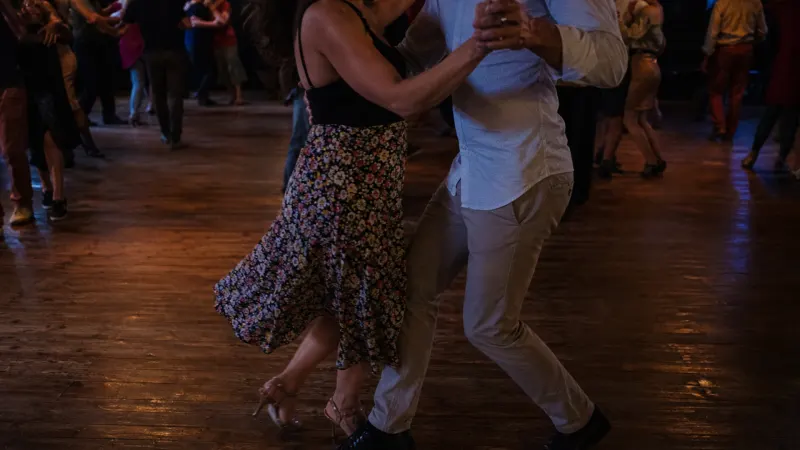
The true secret and greatest fascination of Brazilian music lie in syncopation. A syncopation shifts the emphasis from the heavy, expected beats to the light spaces in between. For the dance couple, this means: dancing Samba de Gafieira syncopations means placing the step at the exact moment the music seems to pause briefly, only to flow on explosively.
This rhythmic shift must not create a stumble, but must be caught in a springy manner. The body works like an elastic spring in the process. The knees remain soft, and the pelvis absorbs the rhythmic delay. This creates the typical, supple dynamic that makes this dance appear so elegant and lively.
It becomes particularly exciting when the couple uses syncopations to spontaneously vary the tempo of their steps. A short delay, followed by two quick, syncopated steps, makes the dance unpredictable and exciting. This play with time requires blind trust and fine non-verbal communication so that both partners react synchronously to the musical accents.
Correct
Mistakes
Only when we stop counting the steps do we begin to translate the music with our bodies and truly dance together.
Musicality in partner dance is not a theoretical concept, but arises in constant dialogue. When dancing to the Samba de Gafieira rhythm, the couple reacts not only to the instruments, but also to each other. The leader suggests the rhythmic interpretation, while the follower picks up this movement, stabilizes it, or responds with their own small embellishments, the so-called Estilistas.
To achieve this quality, the couple must learn to perceive the music as a third partner. When the melody becomes softer, the steps become more fluid and longer. When the percussion kicks in with full force, the footwork becomes more compact and rhythmically accentuated. This is how a visible translation of music into movement is created.
Those who reach this level of connection no longer just dance through figures, but improvise in harmony with the musicians. This makes every social dance event a unique experience, where no two dances are the same. It is worth training your ear from the beginning and shifting the focus away from complex figures toward a pure sense of rhythm.
Maintaining the rhythmic foundation
You focus entirely on the steady basic beat of the music. This gives you and your partner maximum security to build a stable connection and keep your orientation on the dance floor.
Playing with the spaces in between
You use the rhythmic spaces in between and place accents away from the heavy beats. This brings dynamics, moments of surprise, and that typical Brazilian lightness to your movement.
You find the beat by listening to the deep surdo drum, which emphasizes the heavy beat on count two. Let this pulse carry you through your body.
Keep your knees slightly bent at all times and your center of gravity low. This allows you to absorb sudden rhythm changes and syncopations elastically in your body without losing your balance.
Focus first on simple steps like the Passo Básico. Once this works to the music without thinking, you can start incorporating small pauses or faster steps.
Find the right course on udansa and take your rhythm to the next level.
Couple danceLimbach-Oberfrohna · Germany
PaartanzkreisFriday · 18:15 · Oct 23
Limbach-Oberfrohna
BallroomMeißen · Germany
Tanzkreis | PROFESSIONALTuesday · 20:15 · Oct 27, 2026 - Jan 5, 2027
“Ein Haus für Vieles” - Saal Tanzkurse
Couple danceLimbach-Oberfrohna · Germany
Silberkurs für PaareSunday · 16:15 · Oct 25 - Nov 15
Limbach-Oberfrohna
 Samba de Gafieira vs. Ballroom Samba: A ComparisonTwo dances, one name: Learn why the Brazilian Samba de Gafieira and the classic Ballroom Samba differ fundamentally in technique, posture, and spirit.
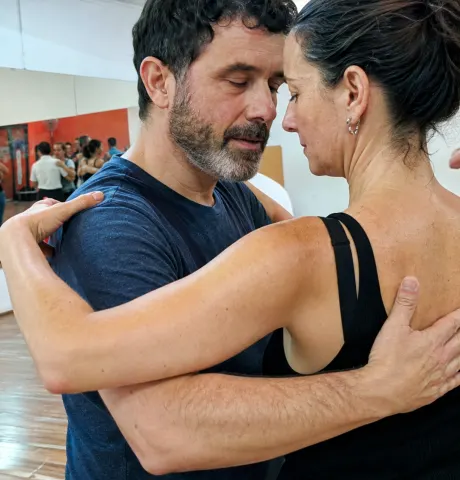 Leading and Following in Samba de Gafieira: A Technical GuideMaster the art of leading and following in Samba de Gafieira. This guide shows you how proud posture and precise weight transfer create a perfect connection as a couple.
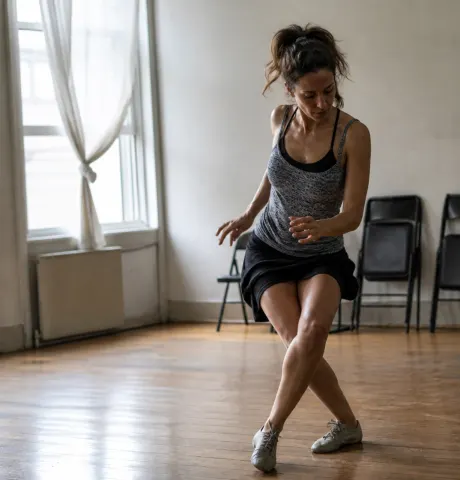 Learn the Samba de Gafieira basic step: step by stepLearn the Passo Basico of Samba de Gafieira with our simple step-by-step guide for beginners and dance your way into the Brazilian way of life.
 Samba as a partner dance: Experience GafieiraDiscover Samba de Gafieira, the elegant Brazilian partner dance. Learn more about steps, technique, and how to find your dance partner.Samba de Gafieira vs. Ballroom Samba: A ComparisonTwo dances, one name: Learn why the Brazilian Samba de Gafieira and the classic Ballroom Samba differ fundamentally in technique, posture, and spirit.Learn the Samba de Gafieira basic step: step by stepLearn the Passo Basico of Samba de Gafieira with our simple step-by-step guide for beginners and dance your way into the Brazilian way of life.Leading and Following in Samba de Gafieira: A Technical GuideMaster the art of leading and following in Samba de Gafieira. This guide shows you how proud posture and precise weight transfer create a perfect connection as a couple.
 Find a Samba de Gafieira dance partner on udansaAre you looking for a dance partner for the elegant Brazilian partner dance Samba de Gafieira? With this guide, you can find your perfect match for the dance floor on udansa.
 Samba de Gafieira Etiquette: 7 Rules for the Dance FloorSamba de Gafieira is pure elegance and joy. With our compact guide to dance floor etiquette, you will master every social with ease and always leave a great impression.
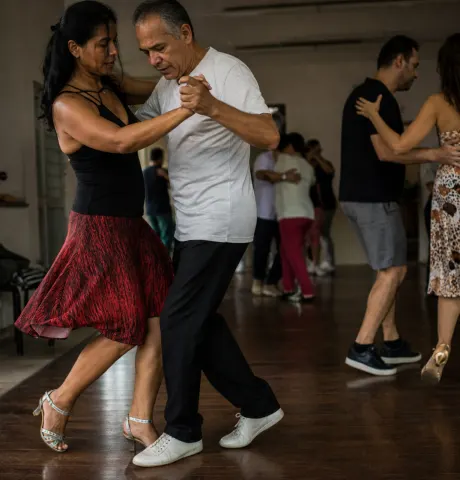 Samba de Gafieira Outfit: The Right Clothes & ShoesThe Brazilian partner dance Samba de Gafieira fascinates with its elegance and dynamics. Learn here how to choose the perfect clothes and the right shoes for the dance floor.