The roots in Angola: How Kizomba originated
If you want to understand the history of Kizomba, you have to look at Angola in the late 1970s and early 1980s. The term comes from the Kimbundu language and simply means "party" or "social gathering". The Kizomba history is inseparably linked to the music genre Semba, which was accelerated and modernized by Caribbean influences such as Zouk. In Angola, this dance was and is an integral part of family and social life. People dance at backyard parties, weddings, and neighborhood festivals. It is about community, grounding, and a deep, familiar togetherness. The Salsa, Bachata & Kizomba comparison already shows how strongly this warmth is transferred to the dance floor.
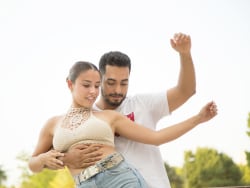
Traditional Kizomba is characterized by a soft, circular movement in space. The connection between dance partners is extremely close, the upper body remains calm, while the hip movements (Ginga for women, Banga for men) flow organically. It is a walking dance where the steps are softly cushioned and the weight is anchored deep in the ground. This rootedness reflects the African origin, where music and movement form a unity and the dance is an expression of pure zest for life.