
Find your personal dance community
Whether it is Salsa, Swing, or Bachata: on udansa you will find the right community, exciting events, and dance partners in your area who share your passion for social dance.


By Mary De LucaUpdated
Whether it is Salsa, Swing, or Bachata: on udansa you will find the right community, exciting events, and dance partners in your area who share your passion for social dance.
Social dance is far more than just a hobby. It is a global language of movement that connects people without words and clears your head in no time.
Social dance refers to improvised, communal partner dancing in one's free time, where social interaction and the joy of movement take center stage.
Anyone hearing about Social Dance for the first time often wonders about the exact definition. The meaning of social dancing is best described as relaxed dancing at parties, in clubs, or at casual gatherings. Unlike competitive dancing or strictly choreographed stage shows, it is not about perfection, strict judges, or flawless routines. In social dance, the focus is on social interaction, the joy of movement, and the spontaneous connection with changing dance partners.
The roots of this vibrant dance culture run deep. Whether it is Salsa in the streets of Havana, Lindy Hop in 1930s New York, or modern West Coast Swing: each of these styles emerged from the need to experience music together and without rigid requirements. When you try out social dance styles, you will quickly notice that every dance brings its own history and dynamics. What they all have in common, however, is the uncomplicated structure that allows even beginners to connect extremely quickly.

The heart of social dancing is improvisation in partner dance. Because there are no fixed choreographies, no two dances are the same. Every step is created in the moment, carried by the music and the constant dialogue between partners. For this interaction to work without words, dancing is based on the principle of leading and following. You can find out what this teamwork looks like in detail and why it has absolutely nothing to do with dominance in our guide on lead & follow in partner dance.
This constant improvisation clears your head and trains your mindfulness. You have to fully engage with the here and now, your partner, and the music. This makes a social dance evening an excellent balance to an often stressful and tightly scheduled everyday life. Since partners are also traditionally changed after every song, you will meet many new people in a very short time. The barrier to entry is low, because everyone present shares the same passion for movement.
That's how it's done
Don't do this
Social dance is not about how the steps look, but about how the connection feels. It is a conversation without words.
The benefits of social dance go far beyond physical fitness. In addition to coordination and stamina, dancing is proven to boost mental well-being and reduce stress. Anyone who is regularly active in the social dance community trains their social empathy and learns to adapt flexibly to different people. Furthermore, the scene is incredibly open: age, background, or profession play no role on the dance floor. Only the shared joy of the rhythm counts.
If you now want to learn social dance yourself, you do not have to be a natural talent. Most dance schools offer special beginner courses where the basics are taught in such a way that you can apply them immediately at the next party. You do not even need a fixed partner for this, as people rotate in the courses anyway. If you are still a bit unsure before visiting a party for the first time, you will find valuable starting help in our guide social dance for beginners, which shows you how to shake off your initial nervousness in no time at all.
Community and improvisation
This is all about spontaneous interaction in the moment. You adapt to the music and your partner, exchange ideas, and experience community on equal terms without any pressure to perform.
Tournament and choreography
In tournament dance, it is all about precision, fixed choreographies, and technical perfection. Couples often train the same routines for years to compete against each other in front of a jury.
Social dance is an umbrella term for all partner dances that are primarily danced for leisure and social interaction at parties. The focus is on improvisation and fun, not on athletic competition.
The most popular styles include Salsa, Bachata, Kizomba, West Coast Swing, Lindy Hop, Argentine Tango, and Discofox. They all thrive on free leading and the constant changing of dance partners.
No, you do not need a fixed partner for the vast majority of courses and parties. Since partners are constantly rotated in the community and during classes anyway, you will find someone to dance with immediately on site.
Comfortable everyday clothing and shoes with a clean sole that does not have too much grip are perfectly sufficient to start with. Special dance clothing is generally not a must at casual parties.
Choose your favorite style and learn the basics for the dance floor.
 Social dance styles: Find your dance communityDive into the fascinating world of social dance styles. Learn what sets the Salsa, Bachata, and Swing scenes apart and how to find your place in the community.
 Lead & Follow: Partner dance as teamworkLeading and following is more than just "directing" and "trailing." Learn how you and your partner can achieve perfect harmony on the dance floor!
 Social Dance Preparation: Your Mindset for the Dance FloorMentally and physically ready for your dance night: This guide shows you how to prepare, ease your nerves, and start with the right mindset.
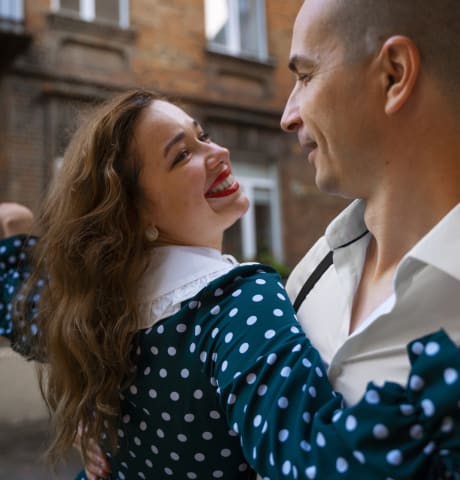 Social Dance Clothing & Shoes: The Practical GuideLearn how to choose the perfect social dance clothing and the right shoes for long, carefree nights of dancing so you can feel completely comfortable.
 Social Dance Etiquette: Guidelines for stress-free dancingThe social dance etiquette is your guide to respectful interaction on the dance floor. Get to know the unwritten rules of social dancing.Social dance styles: Find your dance communityDive into the fascinating world of social dance styles. Learn what sets the Salsa, Bachata, and Swing scenes apart and how to find your place in the community.Social Dance Preparation: Your Mindset for the Dance FloorMentally and physically ready for your dance night: This guide shows you how to prepare, ease your nerves, and start with the right mindset.