
Feel the Samba-beat together
On udansa you will find like-minded people to practice the Samba hip movement with, as well as suitable courses in your area for your perfect start.



By Bernhard De LucaUpdated
On udansa you will find like-minded people to practice the Samba hip movement with, as well as suitable courses in your area for your perfect start.
Samba is pure joy of life, packed into infectious rhythms and fluid movements. Let yourself be inspired by the Brazilian way of life and find out how you can master your first steps on the dance floor.
Samba Bouncing refers to the continuous upward and downward movement in partner dance, which is created by the rhythmic bending and stretching of the knees and ankles.
When you think of Samba, you immediately picture dazzling costumes, drumming Escolas de Samba, and the pure joy of life at the Carnival in Rio de Janeiro. Yet, behind this world-famous phenomenon lies a fascinating diversity. The roots of this dance lie in Africa, from where enslaved people brought their rhythms to Brazil. There, the drum beats merged with European and indigenous influences to create a unique cultural asset. When we talk about Samba today, we must distinguish between two worlds. Brazilian Samba is a lively street and club dance, often danced solo and full of improvisation, while ballroom Samba is firmly established as a partner dance in international competitive sports.
Learning Samba means embarking on a rhythmic adventure. Regardless of whether you choose the solo version or the classic partner dance: the heart of it is always the music. The driving Samba rhythm in the typical two-four time signature immediately captivates everyone. For beginners, it is important to loosen up your core, because the characteristic hip movement does not come from forced wiggling, but from the rhythmic bending and stretching of the knees. Anyone who takes their first steps in a Samba dance school will quickly notice how the energy of the dance changes their own body awareness.
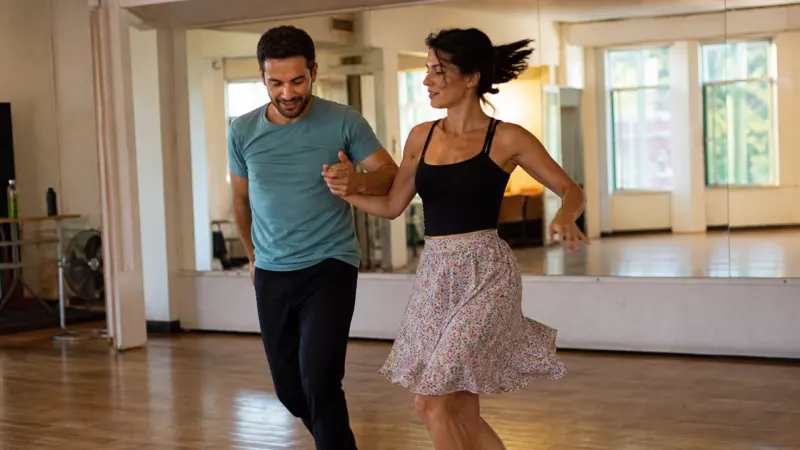
Getting started with partner dance differs significantly from other Latin American dances. While you dance a clear forward and backward movement in Salsa, for example, the Samba couple moves in a circle counter-clockwise around the dance floor. This so-called floorcraft ensures dynamics and requires good orientation. The basic Samba steps are based on the so-called bouncing. This gentle, springy movement in the knee joints gives the dance its floating yet grounded character. Once you have internalized this spring step, you can concentrate much more easily on the turns and promenade paths.
A typical beginner's mistake is to take steps that are too large. Since the tempo of the music is often very high, large steps quickly lead to getting out of rhythm. Keep your movements compact and stay close to your partner. If you try your hand at Ballroom dance vs. Social Dance, you will notice that Samba is interpreted in a very athletic and expansive way in the tournament hall, while you dance in a more space-saving and relaxed way at social events. The key to success lies in keeping your knees soft and keeping your weight over the balls of your feet.
Correct
Wrong
Samba is not a dance you only dance with your feet: It starts in the heart and flows through the knees into the entire body.
To truly internalize Samba, theory is not enough: you have to experience it. A structured Samba dance class is the best way to learn the complex coordination of steps, hip movement, and rhythm under professional guidance. Experienced instructors see immediately when your hips are blocked or you lose the beat, and they can provide targeted assistance. Furthermore, you will meet other beginners at the dance school with whom you can exchange ideas and laugh together. After all, the most important ingredient for this dance is and remains the joy of movement.
If you do not have a fixed partner, that is no obstacle. On udansa, you can specifically search for like-minded people who also want to dance Samba. Before your first lesson together, a quick chat helps to align expectations. Feel free to use our tips for trial dancing with a new dance partner. As soon as the music starts and the drums kick in, your initial nervousness will disappear all by itself. Let yourself be infected by the Brazilian zest for life and take the first step onto the dance floor.
Samba no pé in the spotlight
The traditional solo dance, as known from the Rio Carnival. It thrives on rapid footwork, maximum hip activity, and improvised joie de vivre to live percussion.
Latin tournament dance
The European-influenced variation for couples. It moves in a circle around the dance floor and combines expansive steps with athletic elegance and set figures.
Samba is counted in a fast two-four time. For beginners, the counting method one-and-two is particularly helpful to correctly time the quick intermediate step on the ball of the foot.
No, you do not need special shoes to get started. Clean shoes with a smooth, flexible sole are perfectly sufficient to perform turns and bouncing in a way that is gentle on your joints.
That depends on your learning pace. The absolute basic steps and the principle of bouncing can be learned well in a multi-week beginner course at a dance school.
Find the right dance school and start your Samba adventure.
BallroomMeißen · Germany
Tanzkreis | PROFESSIONALTuesday · 20:15 · Oct 27, 2026 - Jan 5, 2027
“Ein Haus für Vieles” - Saal Tanzkurse
 Dance Class Etiquette: The 10 Essential Rules for BeginnersFeel confident and relaxed during your first dance lesson: With our dance class etiquette for beginners, you will avoid common pitfalls and start your journey on the dance floor with ease.
 Ballroom vs. Social Dance: A ComparisonBallroom or Social Dance? Our guide compares the worlds of the classic ballroom and the modern dance scene regarding atmosphere and rules.
 Trial dance with a new partner: The chemistry checklistYour first trial dance determines your success on the dance floor. Learn in this guide how to test your dance chemistry in a targeted and simple way.
 Samba as a partner dance: Experience GafieiraDiscover Samba de Gafieira, the elegant Brazilian partner dance. Learn more about steps, technique, and how to find your dance partner.
 Dancing Samba solo: The guide for Samba no Pé and show danceDancing Samba solo brings the pure joy of life from Brazil directly to you. Learn everything about the technique of Samba no Pé and how to master the carnival dance.
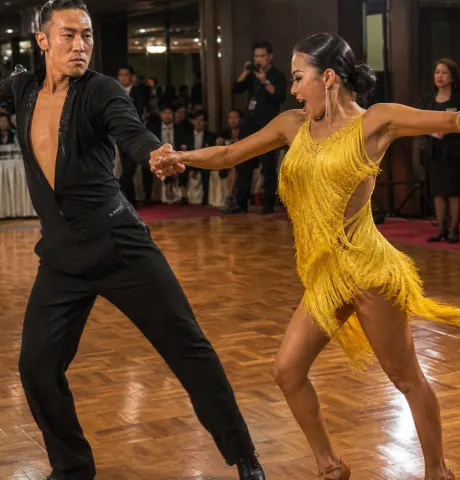 Samba in ballroom and competitive dance: technique & rulesSamba in competitive dance fascinates with its speed and precision. Learn how the Latin American tournament dance differs from the Brazilian social dance.
 History of Samba: The roots of the Brazilian heartbeatThe history of Samba is a journey full of rhythm, culture, and resistance. Discover the fascinating African roots and the instruments that shaped this global success.