
Find your dance partner for Samba
On udansa, you meet motivated dance partners and find the right dance courses for competitive sports or the world dance program in your area.



By Bernhard De LucaUpdated
On udansa, you meet motivated dance partners and find the right dance courses for competitive sports or the world dance program in your area.
The transition from casual social dance to precise competitive sport requires a completely new understanding of movement. Learn how European Samba works on the dance floor and what judges pay special attention to.
Samba ballroom dance refers to the European academic form of Samba, which is subject to fixed rules as a Latin American partner dance in the world dance program and in tournament sports. It differs fundamentally from stationary Brazilian solo dances due to its progressive movement through the room.
Samba, as we know it today from the world dance program and from national and international dance competitions, has come a long way. Originally from Brazil, the dance was fundamentally transformed and academicized for the European dance floor. Today, Samba is firmly anchored in the system of Latin American dances in terms of ballroom technique. It differs drastically from the solo movements of the Rio Carnival or traditional Brazilian social dances.
In competitive sports and in the classic ballroom dance vs. social dance comparison, it quickly becomes clear that ballroom Samba follows strict rules. Couples move in a circle counter-clockwise along the line of dance around the floor. The dynamics are characterized by expansive steps and demanding rhythm that challenges the entire body. While street Samba thrives on spontaneity, European competition Samba requires exact lines, controlled weight shifts, and perfect coordination between partners.

If you want to prove yourself in competitive dancing, you cannot avoid the Samba basic step in a tournament. In contrast to the simple rock step of social dancing, the sports version requires extreme precision in footwork and the typical bounce effect. The knees and ankles work with a constant springy motion, without the upper body appearing restless. This elastic upward and downward movement, the so-called bounce, is created by the controlled bending and stretching of the standing leg joints and requires a high level of strength and coordination.
A typical mistake for beginners is just hopping. In real Samba tournament dancing, the head remains at a relatively constant height, while the hips perform the characteristic forward and backward movement. The weight is distributed over the balls of the feet, with the heels touching the floor only for an extremely short time or, in certain steps, not at all. Only through this clean footwork does the dance gain the necessary lightness and speed required by the judges at tournaments.
Correct
Wrong
Samba is technically the most demanding Latin American dance, because it requires two opposing rhythms in the body and feet at the same time.
For ambitious dancers, reaching the Gold level in competitive dance is an important milestone. The Samba figures for Gold include complex choreographies like the Rolling off the Arm, the Botafogos in various variations, or the fast-paced Voltas. In the lower performance classes of competitive dance, strict step limitations apply to ensure that couples master the basics perfectly first. Only in the higher classes are free choreographies allowed without these limitations.
When judging at tournaments, the judges pay particular attention to timing, footwork, and couple harmony. If you want to shine here, you should also master etiquette and behavior on the floor. A look at the dance course etiquette for beginners helps to internalize the basic rules of conduct on the dance floor. In competitive dance, the Samba is presented in a Latin American style with maximum presence and athletic elegance, which makes this dance one of the most exciting disciplines of the entire world dance program.
Precision and peak athletic performance
The focus is on the exact adherence to the dance direction, the precise timing of the 3/4 and 1/4 beats, and compliance with the regulations regarding the permitted figures for each performance class.
Harmony and the joy of dancing
In social dancing, the focus is on the shared experience. The figures are less complex, the bounce effect is performed more gently, and adapting to your partner takes precedence over athletic scoring.
The Samba basic step in competitive dance is based on a fast three-step rhythm, which is usually counted as long-and-short. This involves a quick weight transfer on the balls of the feet, combined with the typical knee bounce.
In lower competition classes such as the D and C class, strict step restrictions apply, which only allow figures from the official syllabus. This is to ensure that couples demonstrate the technical foundation cleanly before they dance their own choreographies.
Judges primarily look for the correct sense of rhythm, footwork over the balls of the feet, the typical hip movement, as well as couple harmony and posture in the arm frame during progressive movement.
Find the right training for your level and learn Samba from scratch.
Couple danceLimbach-Oberfrohna · Germany
PaartanzkreisFriday · 18:15 · Oct 23
Limbach-Oberfrohna
BallroomMeißen · Germany
Tanzkreis | PROFESSIONALTuesday · 20:15 · Oct 27, 2026 - Jan 5, 2027
“Ein Haus für Vieles” - Saal Tanzkurse
Couple danceLimbach-Oberfrohna · Germany
Silberkurs für PaareSunday · 16:15 · Oct 25 - Nov 15
Limbach-Oberfrohna
 Ballroom vs. Social Dance: A ComparisonBallroom or Social Dance? Our guide compares the worlds of the classic ballroom and the modern dance scene regarding atmosphere and rules.
 Dance Class Etiquette: The 10 Essential Rules for BeginnersFeel confident and relaxed during your first dance lesson: With our dance class etiquette for beginners, you will avoid common pitfalls and start your journey on the dance floor with ease.
 Samba in competitive dance: How judges scoreIf you want to impress at Samba competitions, you need to know the judges' strict criteria. This guide explains what really matters in technique, rhythm, and presentation.
 Mastering Samba bounce technique: Step-by-step guideLearn the essential Samba bounce for an elegant look. Our step-by-step guide shows you how to perfectly execute the bounce from your knees and ankles.
 Avoiding Samba mistakes: The 7 most common pitfallsDancing Samba is fun, but it requires precise technique. Learn here how to avoid typical mistakes in posture and rhythm when dancing in a ballroom setting.
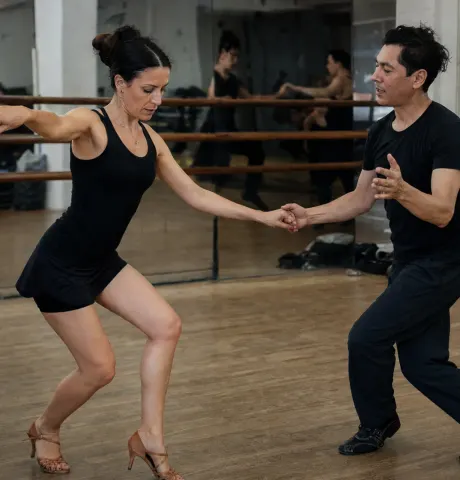 Which Samba competition class suits you? Take the testFind out which Samba competition level, from D-class to S-class, best matches your dance skills with our in-depth self-test.
 Samba competition dress: The official rulesIf you want to shine in Samba competitions, you need to know the associations' strict dress rules. Our guide shows you what matters for the perfect Samba competition dress.
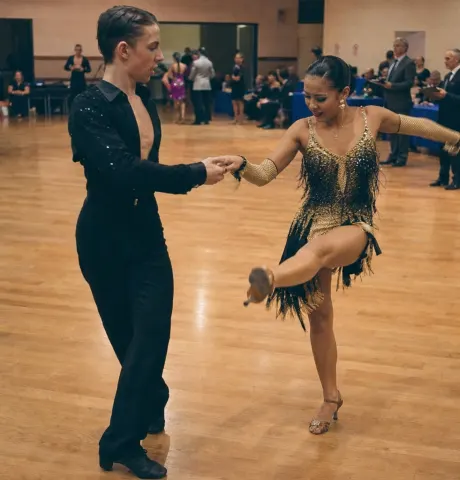 Creating a Samba choreography: A guide for couplesA harmonious Samba choreography is the key to success in the D-class. Learn how to create a secure and expressive routine for the tournament floor.
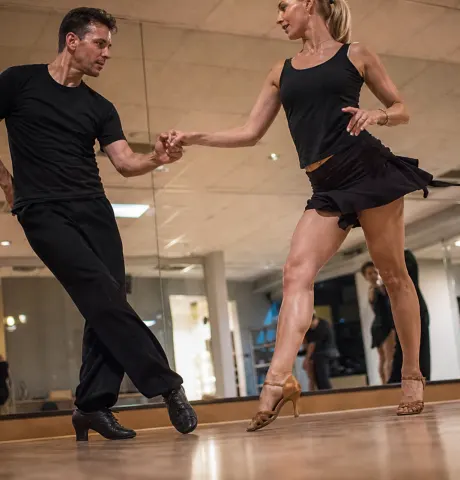 Samba Music Trends: Modern Beats in Dance SportExperience the evolution of samba music: modern pop remixes and electronic beats are currently revolutionizing dance schools and competitive sports.
 Samba Step Limits: Allowed Figures in TournamentsLearn everything about the strict step limits in tournament Samba from class D to S and how to design your choreography in compliance with the rules.
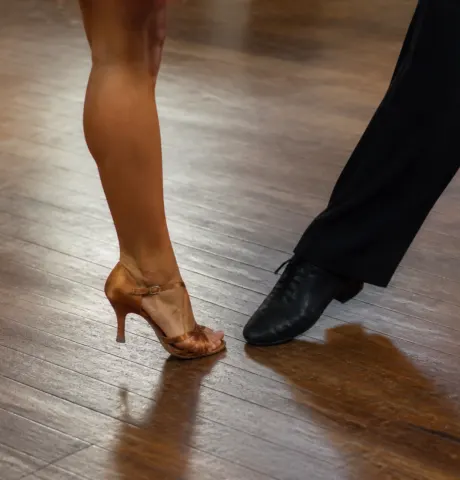 Improve Samba footwork: 5 exercises for fast feetFast feet and precise footwork are the key to success in competition Samba. These five field-tested exercises will take your dance technique to the next level.
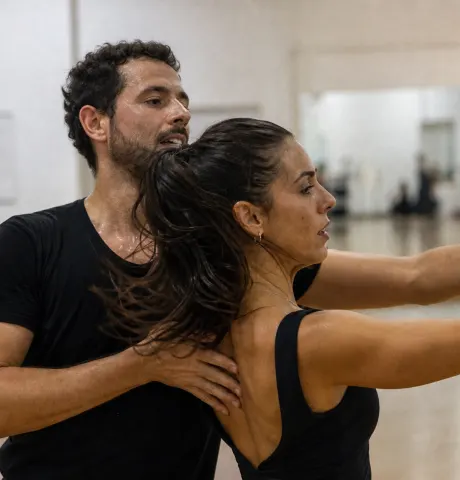 Samba Dance Hold: Perfect Partner Contact in CompetitionThe perfect Samba dance hold in competition requires a delicate balance of stability and dynamics. Learn how to maintain flawless partner contact during fast turns and promenades.
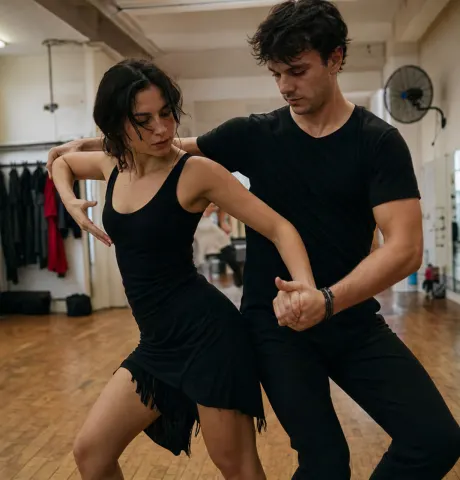 Preparing for your first Samba tournament: Stepping into the spotlightThe step from dance class to the competition floor is exciting and requires a whole new level of preparation. This case study shows how to succeed in your amateur debut.
 Finding a Samba tournament partner: What to look forIf you want to dance Samba successfully in Latin tournament sport, you need the ideal partner. Learn what matters when choosing and how to search systematically.