Competitive dance5 minutes

Samba competition dress: The official dress code rules

By Bernhard De LucaUpdated

In a nutshell
  • The dress code in competitive dance prohibits skin-colored fabrics in the intimate area and requires full coverage of the buttocks.
  • In the children's and junior classes, glitter, rhinestones, heavy makeup, and hairpieces are strictly prohibited.
  • The Samba tournament outfit must be elastic and must not restrict the couple's athletic movement at any time.
  • Violations of the associations' dress code can lead directly to the couple's disqualification from the tournament.

Your path to the competition floor

Whether you are still looking for the perfect dance partner for competitive dancing or searching for a professional dance school for your Latin training: on udansa you will find exactly the contacts that will help you progress in your sport.

Your path to the competition floor

Anyone competing in an official dance tournament must follow strict rules. This is especially true for outfits in the Latin American category, where the line between athletic elegance and a rule violation is razor-thin.

DefinitionDress code in dance sport

In dance sport, the dress code describes the official set of rules from the associations, which defines the permitted fabrics, cuts, colors, and embellishments for competition clothing. It ensures sporting fairness and protects the dignity of the athletes on the floor.

Sports equipment instead of carnival costume

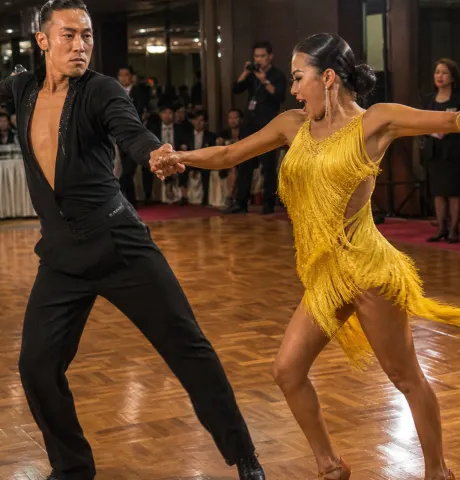
When people think of Samba, they usually immediately picture the colorful, feather-filled costumes of the Rio Carnival. However, in organized competitive dance, completely different laws apply. Here, the outfit is not just a show element, but a strictly regulated piece of sports equipment. National and international dance sport associations, such as the German Dance Sport Association (DTV) or the World DanceSport Federation (WDSF), have issued a detailed dress code. These rules are intended to ensure fair conditions, emphasize athleticism, and prevent the focus from shifting from dance performance to mere costume show. Anyone who disregards the guidelines risks, in the worst case, disqualification before even entering the floor.

Especially in the field of Latin American dances, to which Samba belongs, the requirements for the regulations for the Samba competition dress must be followed. Every age group and every competition class has its own unchangeable limits. While strict step limitations and a ban on glitter and expensive fabrics prevail in the lower classes, such as the D-class, the regulations open up in the higher classes. But even there, not everything that is pleasing is allowed. A deep understanding of Samba in social and competitive dance necessarily includes precise knowledge of the dress code.

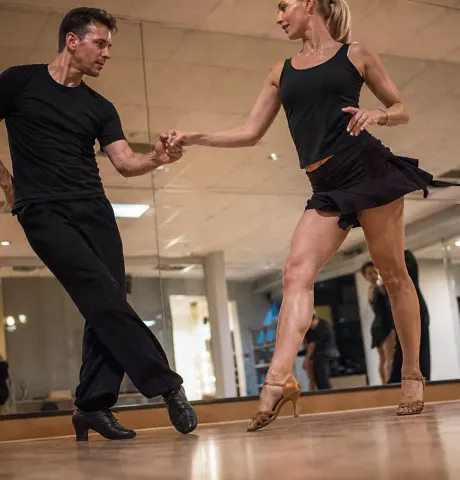
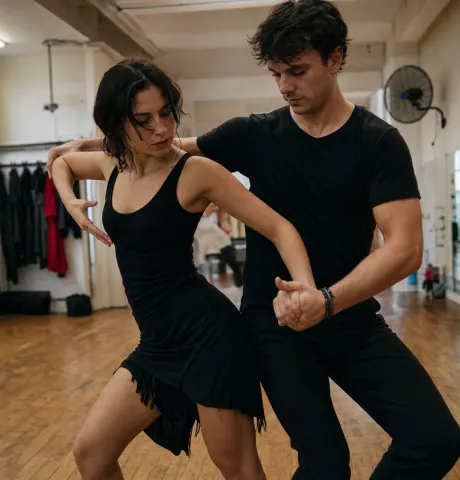
In competitive dance, the right length and elasticity of the dress determine the perfect presentation of fast hip and leg work.

Focus on decency rules and intimate areas

The most important pillar of the dance sport dress code concerns the intimate area and the so-called decency rule. A Samba competition dress must be designed in such a way that all intimate zones remain reliably covered at all times during the dance. The guidelines stipulate that the fabric in the crotch area must have a minimum width and the buttocks must be completely covered. Skin-colored fabric, which is often used to create optical illusions, is strictly prohibited in these sensitive areas. The neckline must also not be arbitrarily deep: a neckline that is too low or an open back that reaches below the waistline inevitably leads to point deductions or warnings from the tournament director.

In addition, the regulations for Latin dresses in the tournament area distinguish very precisely between age groups. For children and juniors, make-up, false eyelashes, hairpieces, and any jewelry are completely forbidden. The dresses must be simple, solid-colored, and made without glittering applications such as rhinestones or sequins. Only from the youth and adult groups onwards can the Samba dress in tournament dancing unfold its full visual effect. Anyone planning the transition from recreational sports to the tournament class should familiarize themselves with the age limits before purchasing to avoid expensive bad buys. A look at the dance course etiquette for beginners, which teaches the basics of respectful conduct in the sport, is also helpful here.

The dress code check for your tournament

Correct

  • Choose opaque fabrics for the intimate area
  • Consider the age group when designing the dress
  • Use fringes and elastic fabrics for dynamics
  • Test the fit of the dress during fast turns

Don'ts

  • Use skin-colored fabrics in intimate areas
  • Wear glitter and rhinestones in beginner classes
  • Risk necklines that are too low or exposed buttocks
  • Lose loose appliqués on the dance floor

A competition dress in dance sport is not just a fashion statement, it must also be highly functional sportswear that complies with the strict rules of the associations.

Dance sport adjudicator

Functionality and dynamics on the dance floor

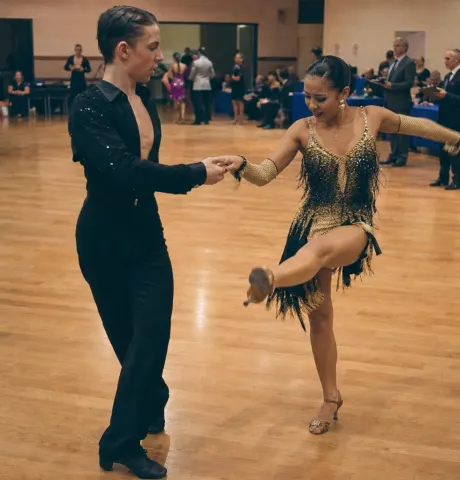
A perfect Samba competition outfit must strike a balance between the strict rules of the Latin dance sport dress code and maximum freedom of movement. Since Samba thrives on fast hip movements, the characteristic bounce, and rapid turns, the dress must support this dynamic rather than hinder it. Designers therefore use highly elastic functional fabrics that wick away sweat and fit the body like a second skin. Fringes, feathers, and light chiffon inserts are extremely popular in adult competition dance because they visually amplify every small pelvic movement and clarify the dynamics of the dance to the judges.

When it comes to design, the rule of thumb is: less is sometimes more, as long as the accents are in the right places. A well-placed detail on the hem or an asymmetrical cut can visually lengthen the legwork. However, it is important that all applications such as rhinestones or fringes are sewn on securely. If dancers lose parts of their dress on the floor during the tournament, this can not only lead to point deductions but also poses a significant slipping hazard for all other couples. Preparing for the first tournament therefore requires not only athletic training but also a careful material check of the entire outfit.

Two worlds of competitive dance

Beginners

The lower classes

Simplicity and focus on technique

In the lower starting classes, such as the D-class, outfits are simple and unadorned. Glitter, rhinestones, feathers, and fringe are prohibited to keep the focus purely on the dance fundamentals.

Professionals

The special classes

Maximum dynamics and elegant details

From the higher competition classes, elaborate designs with rhinestones, fringes, and feathers are permitted. The dresses may visually support the dynamics of Samba movements and set accents.

Frequently Asked Questions

  1. Yes, in lower competition classes such as the D-class, glitter, rhinestones, sequins, and shiny fabrics are prohibited. Such decorations are only permitted in higher classes.

Latin and tournament training near you

Find the right dance school for your athletic training on udansa now.

View all matching courses