Getting started locally5 minutes

Dancing in Bremen: Four ways to get started

By Bernhard De LucaUpdated

Kurz gesagt
  • Beim Tanzen in Bremen führen vier Zugänge zur Orientierung: Unterricht, Tanzstile, gemeinsames Tanzen und Bühnenkultur.
  • Unterricht gibt dir Lernstruktur, während ein Tanzstil deine Vorlieben für Musik und Bewegung anspricht.
  • Gemeinsames Tanzen beginnt mit einer passenden Begegnung und setzt nicht automatisch ein festes Paar voraus.
  • Bremens Tanztheater-Geschichte eröffnet einen Zugang über das Zuschauen, auch ohne eigene Tanzerfahrung.

Wer neu in Bremen ist oder erstmals tanzen möchte, muss nicht sofort einen Stil festlegen. Manchmal gibt ein bestimmtes Lied den Ausschlag, manchmal eine Verabredung, manchmal ein Abend im Zuschauerraum.

DefinitionDance format

Dance format refers to the setting in which dancing takes place, such as a class, open dancing, a workshop, or a stage performance. The same dance style can appear in different formats.

Four ways to follow your first impulse

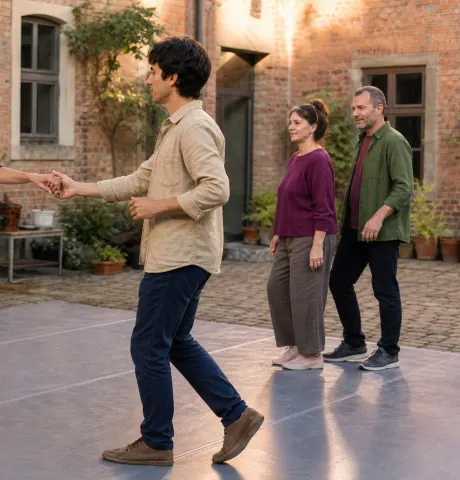
Dancing in Bremen can be sorted according to the impulse you start with. If you want to learn something step by step, lessons take center stage: movements are explained, repeated and paired with feedback. If a song or a type of movement catches your attention first, dance style is your starting point. If you want to spend time on the dance floor with someone, your path begins with dancing together. Stage culture, on the other hand, offers an entry point where you can start by watching.

The stage has its own place in this overview for a local reason. At Theater Bremen, Johann Kresnik took over the dance department in 1968/69. In 1978, Gerhard Bohner and Reinhild Hoffmann became artistic directors; in the early 1980s, the department was named Tanztheater Bremen. Dance is therefore also part of the city’s history as a performing art.

These four approaches are not separate camps. After a performance, you might feel inspired to take lessons; a class can lead to a dance date. This distinction is enough to get your bearings. The guide to the right dance class for adults explores the different ways of learning in more depth.
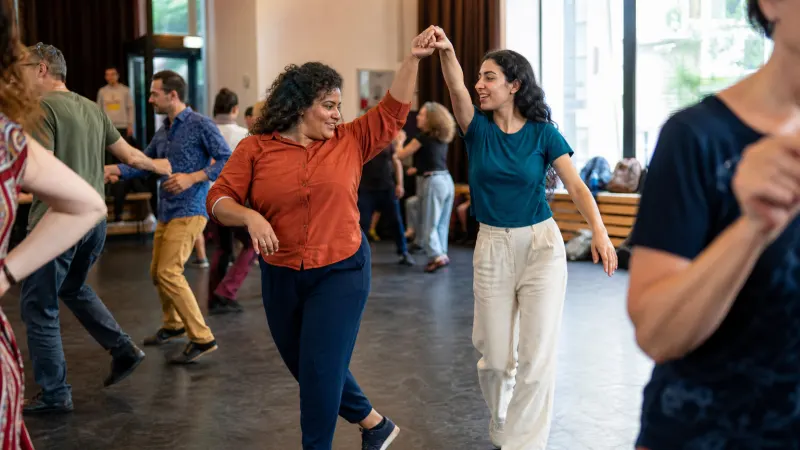
As an audience member, you can follow a movement without having to master it yourself afterward.

A dance style doesn't tell you how the event will unfold

A common misconception arises when you equate a style name with a particular experience. Salsa doesn't automatically mean a dance night, and contemporary dance doesn't automatically mean a stage performance. Classes let you work on movements; a workshop focuses on a topic; at a performance, others have already created the movements. The music alone doesn't explain this difference.

A Bremen example of several formats within one event is Four Days of Dance. The festival by Unusual Symptoms took place over Easter weekend in 2026 at Theater Bremen. The documented program included productions, workshops, audience discussions and a Kiki Ball with Voguing and Ballroom. These were different ways to participate, not four labels for the same format. This doesn't allow us to infer a future date.

Whether to bring someone along also depends on the format. A regular dance partner can be helpful for practicing together, while solo classes don't require a partner. Partner rotation, in turn, means adapting to different people within a guided setting. The guide to dance classes for singles explains this approach to classes in more detail. To help you decide, what matters first is whether you want to practice yourself, dance freely or watch.

Distinguishing Style from Occasion

That's right

  • Classify a course as guided learning
  • See a dance event as an occasion in its own right
  • Experience a performance as a spectator first

Not like this

  • Expecting every class to produce a polished show
  • Assuming there will be lessons at every dance event
  • Using stage moves as the benchmark for getting started

Ein Tanzstil sagt noch nicht, ob du gerade lernen, mit anderen tanzen oder einer Aufführung zusehen wirst.

Redaktion für Tanzratgeber

Bremen's performing arts culture expands your perspective

A performance shows you dance as more than a list of correct steps. Bodies can express closeness, resistance, uncertainty or collaboration. So when you watch, you may notice things that are different from what you notice in class: Who claims space? Who repeats a gesture? How does silence change the effect? You don't need to arrive at a definitive interpretation.

Bremen's dance history offers concrete points of reference. Unusual Symptoms became the dance company of Theater Bremen in 2012. In 2016, steptext dance project, in co-production with Theater Bremen, presented “Two Giraffes Dance Tango, Bremen Steps”. The production combined reconstructed sections of Bohner's piece with a new choreography by Helge Letonja. Here, dance history was explored through movement, not just told.

The Schwankhalle in Neustadt has also been described as a venue for performance, theatre, dance and music theatre, as well as a production space for the independent arts scene. Places like these help you put the stage perspective into context alongside your own dancing. At the same time, it's important to distinguish history from what's on offer today: the Bremen Samba and Mask Carnival ended in February 2025. Its parade from the Marktplatz to the Ostertor is part of past festival culture, not a current events calendar. You can choose from these perspectives as a starting point, without needing to have mastered a particular dance technique.

Two experiences that complement each other

Mitmachen

Den Rhythmus im eigenen Körper spüren

Erfahrung durch Bewegung und Rückmeldung

Beim eigenen Tanzen merkst du, wie sich ein Gewichtswechsel oder eine Pause anfühlt. Du kannst eine kleine Bewegung wiederholen und erleben, wie sie mit Musik anders wirkt.

Watching

Discovering movement in context

Experience through attention and distance

By watching, you can notice relationships, paths through space, and recurring gestures. You don't have to perform any steps, so you have time to observe several people and their changes at the same time.

Frequently Asked Questions

  1. You don't need to make a final decision about a style before your first class. Getting started can help you find out whether you enjoy guided movement, dancing to particular music, or interacting with others. Attending a class doesn't commit you to any future dance choices.

Tanzkurse in Bremen

Auf udansa findest du aktuelle Kurse in Bremen, wenn du aus deiner ersten Orientierung eine Unterrichtsstunde machen möchtest.

Dein Einstieg braucht einen Anlass

Auf udansa findest du Tanzpartner in Bremen für eine erste gemeinsame Kursstunde oder eine Verabredung zum Tanzen. So bekommt deine Orientierung einen konkreten Treffpunkt.

Dein Einstieg braucht einen Anlass