
Find your partner for competitive dance
Here you can find ambitious dance partners and specialized dance courses that will take your Latin tournament technique to the next level.



By Mary De LucaUpdated
Here you can find ambitious dance partners and specialized dance courses that will take your Latin tournament technique to the next level.
If you want to master Samba on the competition floor, you need more than just fast feet. Only through the perfect balance of body tension and elastic contact do two individual dancers become a harmonious unit.
The frame refers to the stable, immobile structure formed by the arms and upper bodies of dance partners in partner dance. It serves to transmit leading signals directly to the partner's body without any effort.
Latin dances in competitive sports demand extreme dynamics, which in no other discipline originate as strongly from the core as in Samba. While relaxed social dance is often performed with plenty of distance, the Samba dance posture with permanent partner contact in competitive sports is based on a precise mechanical connection. This posture is not a static corset, but a highly flexible system of push and pull. The upper body remains proud and upright, while the pelvis works permanently through the typical Samba bounce technique. This separation of the upper and lower body is the absolute prerequisite for presenting a calm, aesthetic topline to the judges despite the fast hip movements.
To achieve this stability, couples in competitive dance use an asymmetrical posture. The gentleman's left hand and the lady's right hand meet at the lady's eye level. The gentleman's right hand lies flat and stable on the lady's left shoulder blade, while she rests her left arm gently on his right upper arm. This solid frame, also called "frame", must not deform during the entire dance. Only in this way is every weight shift of the leader transmitted immediately and without delay to the partner.

The Samba posture becomes particularly demanding during fast turns and expansive promenade runs. This is where it becomes clear whether the Samba posture is suitable for dance sport or collapses at the first acceleration. During promenade runs, the couple opens up slightly, but maintains an elastic connection through the pelvic area and the held hands. Anyone who loses physical contact here risks making the movements appear asynchronous. The challenge is to keep the upper body slightly turned towards the partner despite the forward energy.
During fast turns, such as the dreaded Samba spins, centrifugal force acts massively outwards. This is where the principle of controlled counter-tension comes into play. The partners use their shared center of gravity to stabilize each other. The Samba leading, which is typical for Latin, requires extremely fast responsiveness from the lady to the finest signals in the hand-to-hand connection in these moments. As soon as the body tension in the core subsides, the couple drifts apart, which immediately leads to point deductions in tournament dancing. A stable core is therefore the most important tool for every turn.
Correct
Wrong
In competitive Samba, the quality of the couple's connection determines the entire dynamic on the floor: without a stable frame, the energy of the hip work dissipates ineffectively.
A common misconception in competitive dance is the assumption that close contact must be forced throughout. In reality, physical contact in competitive Samba is a constant breathing of distance. It differs fundamentally from the permanent, close hold in ballroom dance or the completely free movement in street dance. In Samba, the couple switches every second between close face-to-face positioning, side-by-side promenade, and solo passages where only one hand maintains the connection. Anyone who desperately tries to maintain belly-to-belly contact blocks their partner's hip movement.
The high art of Samba couple hold and correct technique lies in not letting the connection break, even over a distance. Even when the partners physically separate from each other, the visual and energetic lead remains. This requires an extremely high level of balance and body control from both sides. To perfectly coordinate these subtleties in couple interaction, targeted training in a club or a specialized workshop, which you can book via udansa, is worthwhile. Only when the hold works without thinking can the couple focus entirely on the music and the charisma.
Full control in a crowded space
The closed position offers maximum stability for stationary figures and fast bounces. The physical contact at the pelvis allows for a direct, lag-free transmission of leading impulses.
Spacious movement across the dance floor
In the open position, as with promenades, the couple opens up in a fan shape. The connection remains elastic through the arms, which allows for maximum dynamics and space gain.
In competitive dancing, the contact is dynamic and adjusted depending on the figure to allow for hip movements. In street carnival, you usually dance solo without a fixed frame and without the strict rules of standard and Latin technique.
The frame remains stable because the muscles in the upper back and shoulders are permanently active. The elbows do not drop, and the hands do not exert pressure, but maintain the position solely through body tension.
Leading in Latin dances always comes from the center and the weight shift of the body. The arms serve only as rigid antennas that transmit this movement directly to the partner without using their own muscle power.
Find the right course on udansa to specifically improve your posture and technique in partner dance.
Couple danceLimbach-Oberfrohna · Germany
PaartanzkreisFriday · 18:15 · Oct 23
Limbach-Oberfrohna
BallroomMeißen · Germany
Tanzkreis | PROFESSIONALTuesday · 20:15 · Oct 27, 2026 - Jan 5, 2027
“Ein Haus für Vieles” - Saal Tanzkurse
Couple danceLimbach-Oberfrohna · Germany
Silberkurs für PaareSunday · 16:15 · Oct 25 - Nov 15
Limbach-Oberfrohna
 Samba in competitive dance: How judges scoreIf you want to impress at Samba competitions, you need to know the judges' strict criteria. This guide explains what really matters in technique, rhythm, and presentation.
 Mastering Samba bounce technique: Step-by-step guideLearn the essential Samba bounce for an elegant look. Our step-by-step guide shows you how to perfectly execute the bounce from your knees and ankles.
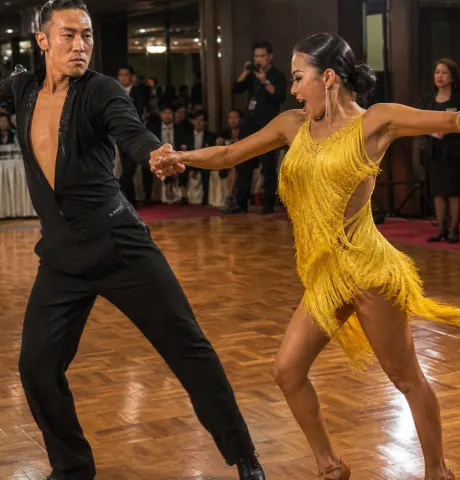 Samba in ballroom and competitive dance: technique & rulesSamba in competitive dance fascinates with its speed and precision. Learn how the Latin American tournament dance differs from the Brazilian social dance.
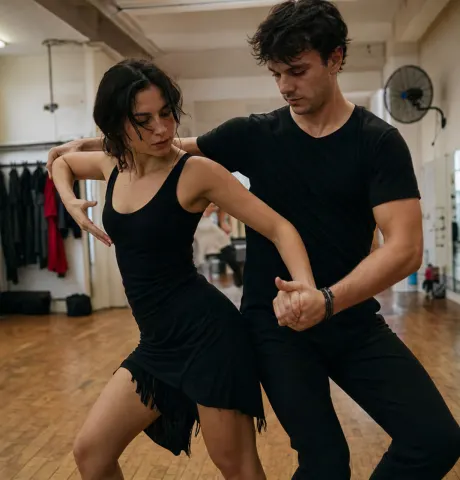 Preparing for your first Samba tournament: Stepping into the spotlightThe step from dance class to the competition floor is exciting and requires a whole new level of preparation. This case study shows how to succeed in your amateur debut.
 Finding a Samba tournament partner: What to look forIf you want to dance Samba successfully in Latin tournament sport, you need the ideal partner. Learn what matters when choosing and how to search systematically.Samba in competitive dance: How judges scoreIf you want to impress at Samba competitions, you need to know the judges' strict criteria. This guide explains what really matters in technique, rhythm, and presentation.Mastering Samba bounce technique: Step-by-step guideLearn the essential Samba bounce for an elegant look. Our step-by-step guide shows you how to perfectly execute the bounce from your knees and ankles.
 Avoiding Samba mistakes: The 7 most common pitfallsDancing Samba is fun, but it requires precise technique. Learn here how to avoid typical mistakes in posture and rhythm when dancing in a ballroom setting.
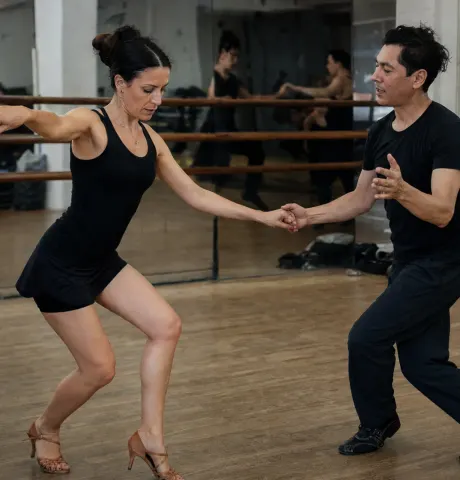 Which Samba competition class suits you? Take the testFind out which Samba competition level, from D-class to S-class, best matches your dance skills with our in-depth self-test.