
Find your Samba dance partner on udansa
Here you can find like-minded people who want to polish their technique with you or simply share the joy of Latin American rhythms.



By Bernhard De LucaUpdated
Here you can find like-minded people who want to polish their technique with you or simply share the joy of Latin American rhythms.
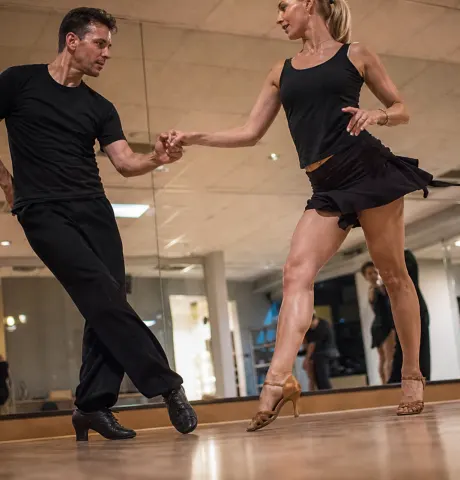
The Samba bounce gives the dance its unmistakable, pulsating character. With the right technique, you spring elegantly to the rhythm without losing your balance or contact with the floor.
The Samba bounce is not wild hopping, but a controlled, fluid movement that comes deep from the muscles. The magic of this bounce lies in the coordination of the ankles and knees. Anyone who tries to create the bounce by pushing off the floor immediately loses their balance and contact with their partner. Instead, the correct Samba bounce is based on the principle of lowering and gently absorbing the weight. The movement goes down, not up.
To anchor this dynamic in your body, a look at the basics helps. If you want to master the Samba as a partner dance in social or competitive dancing, you must master the bounce independently of steps in space. Only when the knee joints work elastically and the ankles roll the weight softly does the typical, almost weightless character of the dance emerge. It is worth training this basis in isolation in front of the mirror before you venture into complex step sequences.
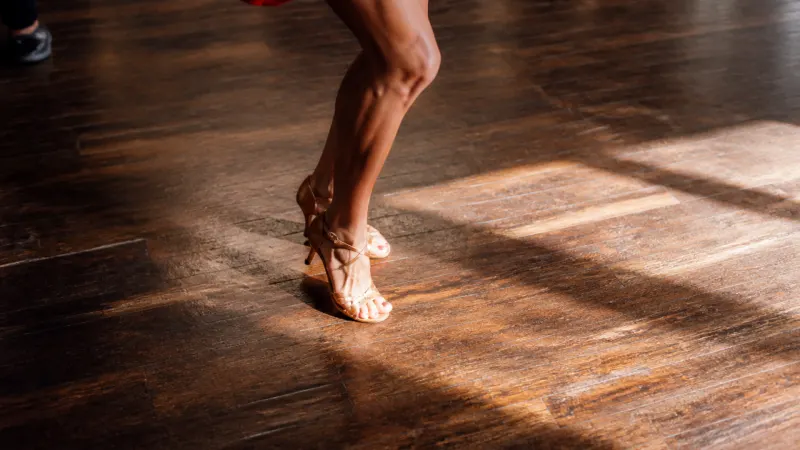
Stand upright with your feet hip-width apart, either barefoot or in flat training shoes. Distribute your weight evenly across both feet, with your center of gravity shifting slightly forward onto the balls of your feet, without the heels losing contact with the floor entirely.
Bend your knees slightly forward and down, while your heels lift gently off the floor. The movement feels as if you are softly bouncing your body weight into the floor.
Stretch your knees almost completely again while letting your heels lower in a controlled manner. Make sure never to lock your knees completely to maintain elasticity for the next bounce.
Combine the bending and stretching into a fluid, wave-like up-and-down movement. The rhythm follows the count 1-and-a-2, with the lowering occurring on the main beat and the lifting on the intermediate beats.
Bouncing correctly
Typical mistakes
Preparation
Arrival
During
The Samba bounce is a rhythmic, vertical springing movement from the knees and ankles. It gives Samba its typical, wave-like character and provides the characteristic dynamics in partner dancing.
The bounce moves primarily downwards. You spring into your knees and absorb the weight softly, instead of actively pushing yourself upwards like when jumping. The upward movement is merely the passive return to the starting position.
Yes, in competitive dancing and advanced social dancing, the bounce is the absolute foundation. However, there are some modern Samba figures and fast promenade runs where the springing is flatter or temporarily omitted.
Find the right dance course now to try out your Samba technique directly on the dance floor.
BallroomMeißen · Germany
Tanzkreis | PROFESSIONALTuesday · 20:15 · Oct 27, 2026 - Jan 5, 2027
“Ein Haus für Vieles” - Saal Tanzkurse
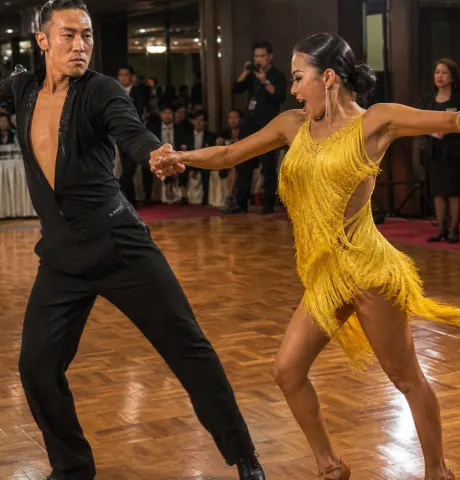 Samba in ballroom and competitive dance: technique & rulesSamba in competitive dance fascinates with its speed and precision. Learn how the Latin American tournament dance differs from the Brazilian social dance.
 Avoiding Samba mistakes: The 7 most common pitfallsDancing Samba is fun, but it requires precise technique. Learn here how to avoid typical mistakes in posture and rhythm when dancing in a ballroom setting.
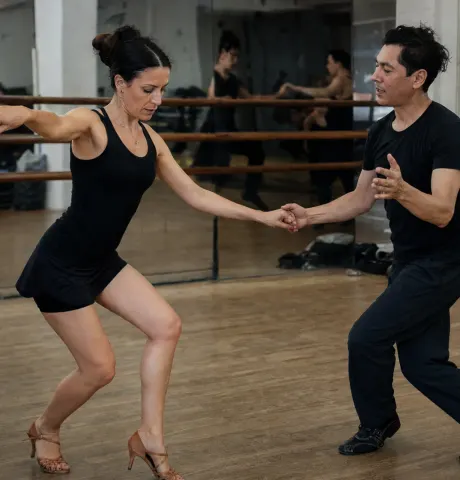 Which Samba competition class suits you? Take the testFind out which Samba competition level, from D-class to S-class, best matches your dance skills with our in-depth self-test.
 Samba competition dress: The official rulesIf you want to shine in Samba competitions, you need to know the associations' strict dress rules. Our guide shows you what matters for the perfect Samba competition dress.
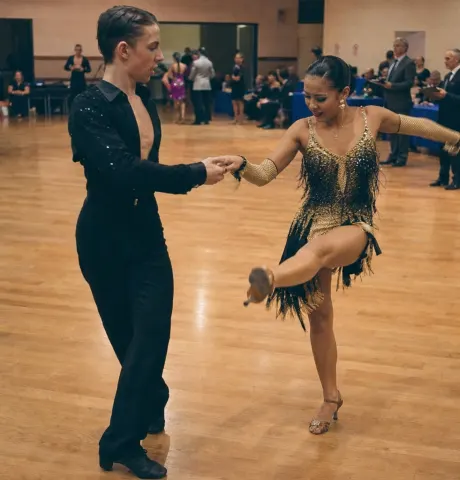 Creating a Samba choreography: A guide for couplesA harmonious Samba choreography is the key to success in the D-class. Learn how to create a secure and expressive routine for the tournament floor.
 Samba Music Trends: Modern Beats in Dance SportExperience the evolution of samba music: modern pop remixes and electronic beats are currently revolutionizing dance schools and competitive sports.
 Samba Step Limits: Allowed Figures in TournamentsLearn everything about the strict step limits in tournament Samba from class D to S and how to design your choreography in compliance with the rules.