
Find your perfect dance partner
On udansa, you will meet like-minded people who want to refine their posture with you or simply glide through the dance school in a relaxed way. Sign up and find your perfect match on the dance floor!



By Mary De LucaUpdated
On udansa, you will meet like-minded people who want to refine their posture with you or simply glide through the dance school in a relaxed way. Sign up and find your perfect match on the dance floor!
Samba brings pure joy to the dance floor, but it also challenges us technically. With a few simple tricks, you can correct typical posture mistakes and find your rhythm again immediately.
Relevance for the social dance scene
All listed errors refer to practical social dancing in recreational sports.
Practical benefits
The tips offer immediately applicable solutions for your weekly training.
Independent selection
No payments or advertising placements were accepted for the creation of this list.

Mistake 1: The banana posture in the upper body
Many beginners collapse at the hips or lean back too far. An upright axis, slightly tilted forward, is crucial to maintain balance and not block your partner.
Mistake 2: Incorrect bouncing from the upper body
Anyone trying to force the characteristic bounce step often bounces with their shoulders. This looks restless and disrupts the lead. The movement belongs exclusively in the legs.
Mistake 3: Heel strike on forward steps
Samba is danced on the balls of the feet. If you land on your heel first, you slow down your own momentum and lose your connection to the fast music.
Error 4: Inaccurate timing during the weight change
Samba has an asymmetrical rhythm. Often the quick intermediate step (the 'a') is omitted or dragged out, which disrupts the entire flow of the dance.
Error 5: Lifeless or stiff arms
If your arms hang limply or are as rigid as concrete, your leading will suffer. The arm connection must be as elastic as a spring to transmit signals smoothly.
Mistake 6: Stationary dancing in the room
Samba is a progressive dance that moves counter-clockwise around the dance floor. If you dance rigidly in one spot, you block other couples and do not use the space.
Mistake 7: Forced hip movements
Instead of letting the hips flow softly, they are often held stiffly or moved in an overly jerky manner. Hip movement is the natural result of correct foot and knee work.
If you want to shine in a social dance setting, you do not need to aim for professional tournament levels. However, typical mistakes quickly creep into recreational dancing when the focus is too much on complicated figures instead of the basics. A common problem is the misunderstanding of the characteristic spring action, the so-called bounce effect. Many couples try to create this momentum through uncontrolled bobbing of the upper body, which disrupts the entire partner connection. To avoid this Samba mistake, the movement must come exclusively from the knees and ankles, while the spine remains stable. Anyone who neglects this foundational work quickly loses balance during turns.
Another stumbling block concerns leading and mutual coordination. Samba is an extremely dynamic dance that thrives on quick changes of direction. Without clear core tension in the upper body, the leader's signals fizzle out. Instead, an unpleasant pulling and tugging on the arms occurs. If you want to correct your Samba posture, you should ensure that the elbows remain stably positioned in front of the body and that the power transmission comes from the core. Only through this elastic, yet firm connection can the rhythmic promenade runs be presented harmoniously and without stumbling on the dance floor.
To avoid rhythm mistakes in Samba, counting along in your head helps. Focus on the typical 'slow-a-slow' pattern and use slow practice music to place the quick intermediate steps precisely on the beat.
The bounce is created by the elastic bending and stretching of the knees and ankles. The upper body remains at a stable height and does not absorb the movement through restless bobbing up and down.
Yes, on the udansa platform you can specifically search for dance partners who share your interest in Latin dances. A descriptive profile helps you to quickly find the right match for your dance class.
Find the right course to improve your technique directly on the dance floor.
Couple danceLimbach-Oberfrohna · Germany
PaartanzkreisFriday · 18:15 · Oct 23
Limbach-Oberfrohna
BallroomMeißen · Germany
Tanzkreis | PROFESSIONALTuesday · 20:15 · Oct 27, 2026 - Jan 5, 2027
“Ein Haus für Vieles” - Saal Tanzkurse
Couple danceLimbach-Oberfrohna · Germany
Silberkurs für PaareSunday · 16:15 · Oct 25 - Nov 15
Limbach-Oberfrohna
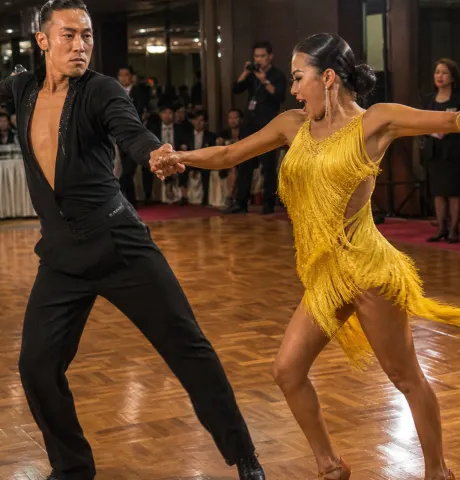 Samba in ballroom and competitive dance: technique & rulesSamba in competitive dance fascinates with its speed and precision. Learn how the Latin American tournament dance differs from the Brazilian social dance.
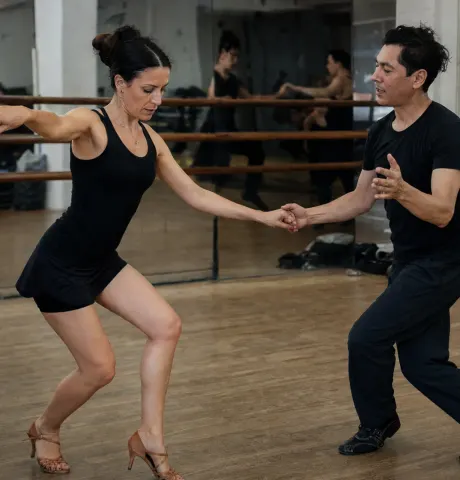 Which Samba competition class suits you? Take the testFind out which Samba competition level, from D-class to S-class, best matches your dance skills with our in-depth self-test.
 Samba competition dress: The official rulesIf you want to shine in Samba competitions, you need to know the associations' strict dress rules. Our guide shows you what matters for the perfect Samba competition dress.
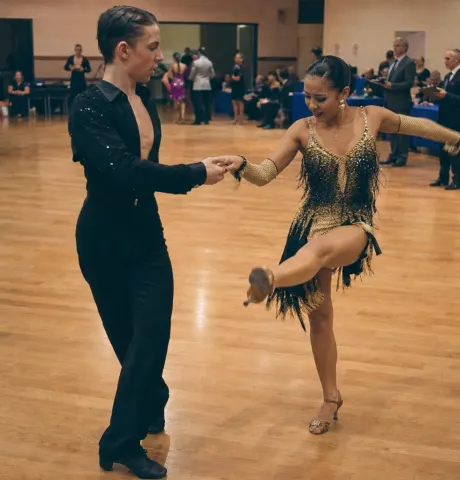 Creating a Samba choreography: A guide for couplesA harmonious Samba choreography is the key to success in the D-class. Learn how to create a secure and expressive routine for the tournament floor.
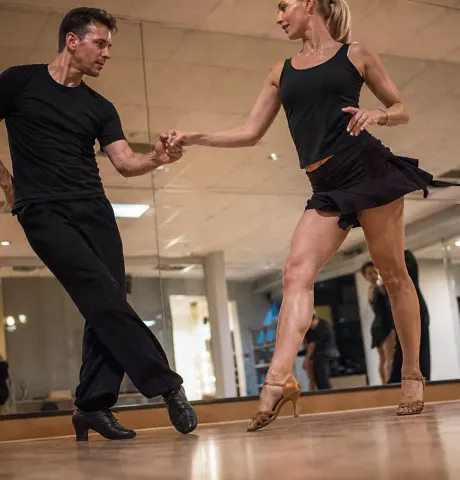 Samba Music Trends: Modern Beats in Dance SportExperience the evolution of samba music: modern pop remixes and electronic beats are currently revolutionizing dance schools and competitive sports.
 Samba Step Limits: Allowed Figures in TournamentsLearn everything about the strict step limits in tournament Samba from class D to S and how to design your choreography in compliance with the rules.
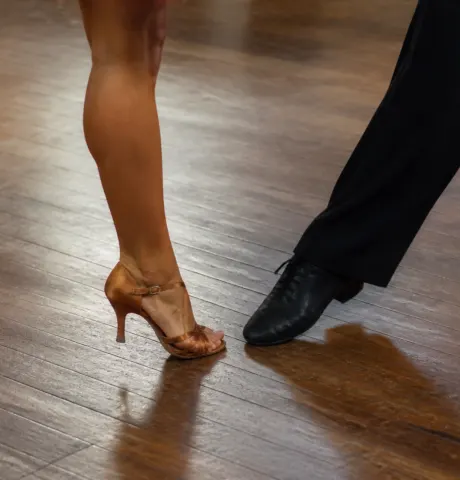 Improve Samba footwork: 5 exercises for fast feetFast feet and precise footwork are the key to success in competition Samba. These five field-tested exercises will take your dance technique to the next level.