
Find your partner for the competition
Whether you are looking for the right partner for joint competition training or seeking a new sporting challenge: on udansa you will find like-minded people for your journey onto the dance floor.



By Bernhard De LucaUpdated
Whether you are looking for the right partner for joint competition training or seeking a new sporting challenge: on udansa you will find like-minded people for your journey onto the dance floor.
The path in Latin American tournament dancing is strictly regulated. If you want to be successful at tournaments, you must know the exact limits of the permitted figures from D-class to S-class.
Samba step limit refers to the official requirements of dance sport associations, which determine which figures and step sequences may be danced in the respective competition classes at tournaments.
Anyone venturing into Latin American competitive dance will quickly encounter a strict set of rules. In German competitive dance, the Tournament Sports Regulations (TSO) precisely govern which figures may be shown in the lower classes. The Samba step limitation in tournaments primarily serves to protect the couples: it ensures that beginners first build a solid foundation of rhythm, balance, and clean footwork instead of overwhelming themselves with complex choreographies. In the D-class, the selection is therefore limited to basic actions.
For the Latin American dances, the official samba competitive dance figure catalog applies here. In the D-class, only figures from this list are permitted. These include the classic basic steps, simple Promenade Runs, the Samba Whisper, and simple Voltas. Anyone who ignores these restrictions and shows unauthorized poses or complex wrapping figures risks a warning or even subsequent disqualification by the panel of judges. Only in the higher classes does the spectrum gradually open up.

With the promotion to C-class, the samba step restrictions latin loosen noticeably. While strict prohibitions on demanding shadow actions or free turns still apply in D-class, couples in C-class are already allowed to present more complex rhythms and more challenging changes of direction. Nevertheless, a fixed framework remains here as well: acrobatic lifts, floor-level poses, or long solo passages without partner contact remain taboo. The main focus is on the correct technical execution of the expanded figures.
In B-class, the classic step restriction finally disappears completely. From this level onwards, couples may design their choreographies freely and also dance figures that are not listed in the standard catalog. However, this freedom does not mean lack of restraint. Even in A-class and S-class, the typical characteristics of Samba must be maintained. Anyone who only strings together show effects and loses the actual character of the dance will be penalized accordingly by the judges at the tournament.
Training correctly
Avoid mistakes
The step limitation in competitive dance is not a form of harassment, but the foundation for a clean technical education, from which couples benefit all the way up to the S-class.
Adhering to step limits often presents couples and coaches with logistical challenges when designing a new choreography. Every single sequence must be precisely cross-referenced with the rulebook. Transitions are particularly tricky, as they can lead to unintentional prohibited hand positions or degrees of rotation. A thorough study of the current TSO guidelines is therefore essential for every ambitious tournament couple to avoid nasty surprises on the day of the competition.
If you want to shine on the dance floor, you should look for a training partner early on who pursues the same sporting goals and brings the discipline required for precise technical training. Harmonious interaction is the key to success in tournament sports. If you are still looking for the right addition to your Latin training, a targeted look at specialized portals like udansa will help you contact ambitious dancers in your area.
Focus on D and C class
In the lower classes, the focus is entirely on the clean technical execution of the basic steps. Couples must strictly adhere to the specified figure syllabus to avoid disqualification.
Freedom starting from B-class
From B-class onwards, the tabular restrictions no longer apply. Couples can let their creativity run wild and develop individual, highly dynamic choreographies for the adjudicators.
In the D-class, only basic figures such as basic steps, promenade runs, whisper, and simple voltas are allowed. Complex wrapping figures or solo turns are strictly prohibited.
The step restriction is officially lifted upon promotion to the B-class. From this level, couples may design their choreographies completely freely and without restrictions from the standard catalog.
In the event of violations of the step restriction, the couple faces a deduction of points or, in the worst case, direct disqualification by the tournament director or the judging panel.
Find the right course now to take your technique to the next level for your next competition.
Couple danceLimbach-Oberfrohna · Germany
PaartanzkreisFriday · 18:15 · Oct 23
Limbach-Oberfrohna
BallroomMeißen · Germany
Tanzkreis | PROFESSIONALTuesday · 20:15 · Oct 27, 2026 - Jan 5, 2027
“Ein Haus für Vieles” - Saal Tanzkurse
Couple danceLimbach-Oberfrohna · Germany
Silberkurs für PaareSunday · 16:15 · Oct 25 - Nov 15
Limbach-Oberfrohna
 Samba in competitive dance: How judges scoreIf you want to impress at Samba competitions, you need to know the judges' strict criteria. This guide explains what really matters in technique, rhythm, and presentation.
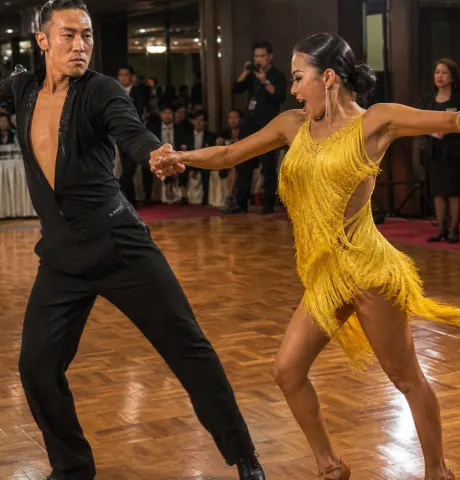 Samba in ballroom and competitive dance: technique & rulesSamba in competitive dance fascinates with its speed and precision. Learn how the Latin American tournament dance differs from the Brazilian social dance.Samba in ballroom and competitive dance: technique & rulesSamba in competitive dance fascinates with its speed and precision. Learn how the Latin American tournament dance differs from the Brazilian social dance.
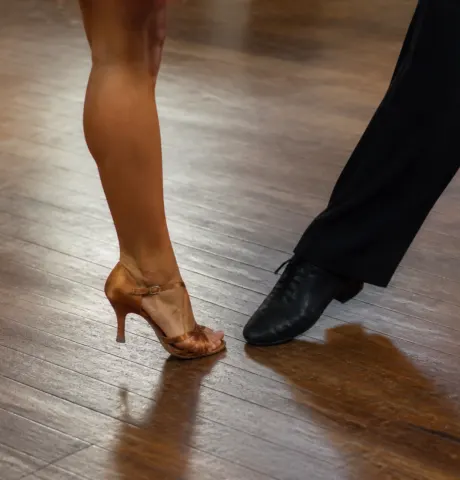 Improve Samba footwork: 5 exercises for fast feetFast feet and precise footwork are the key to success in competition Samba. These five field-tested exercises will take your dance technique to the next level.
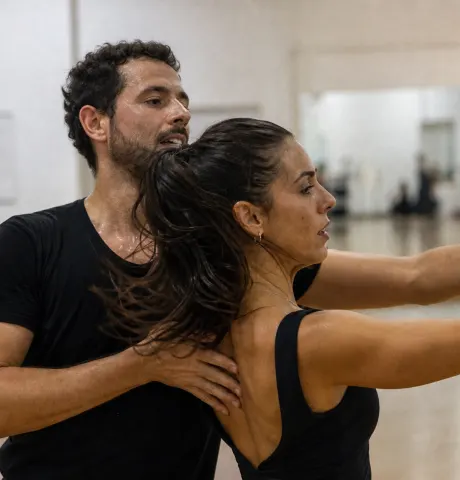 Samba Dance Hold: Perfect Partner Contact in CompetitionThe perfect Samba dance hold in competition requires a delicate balance of stability and dynamics. Learn how to maintain flawless partner contact during fast turns and promenades.
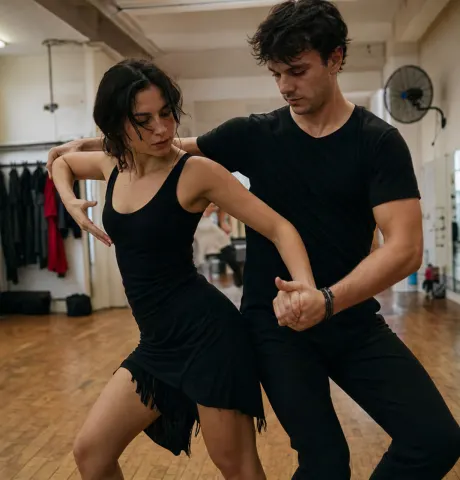 Preparing for your first Samba tournament: Stepping into the spotlightThe step from dance class to the competition floor is exciting and requires a whole new level of preparation. This case study shows how to succeed in your amateur debut.
 Finding a Samba tournament partner: What to look forIf you want to dance Samba successfully in Latin tournament sport, you need the ideal partner. Learn what matters when choosing and how to search systematically.Samba in competitive dance: How judges scoreIf you want to impress at Samba competitions, you need to know the judges' strict criteria. This guide explains what really matters in technique, rhythm, and presentation.
 Mastering Samba bounce technique: Step-by-step guideLearn the essential Samba bounce for an elegant look. Our step-by-step guide shows you how to perfectly execute the bounce from your knees and ankles.