
Find the perfect partner for the competition floor
Whether you are taking your first steps or looking to enter competitive dancing: on udansa you will meet ambitious dancers who share your passion.



By Mary De LucaUpdated
Whether you are taking your first steps or looking to enter competitive dancing: on udansa you will meet ambitious dancers who share your passion.
The leap from the dance school floor to the competitive level is exciting and demanding. If you understand the jury's criteria, you can work specifically on the details that make the difference between the middle of the pack and a podium finish.
Bounce refers to the continuous, elastic upward and downward movement in partner dance, which is created by the rhythmic interplay of the knees and ankles. This technique is the fundamental characteristic of Samba.
Anyone attending a Latin dance competition will experience the Samba as a true firework of energy, rhythm, and dynamics. Yet, behind the seemingly effortless show on the dance floor lies a highly complex set of rules. A Latin dance judge looks through the glittering spotlights with a trained eye and filters out the pure facts in a matter of seconds. Among the five Latin American dances, the Samba is considered particularly technically demanding, as it combines various movement principles at an extremely high tempo. To succeed in a competition, couples must show far more than just a flawless choreography.
The scoring system in competitive dance is based on clearly defined pillars. The most important foundation for any positive score is the beat. Anyone who does not dance precisely to the music will inevitably fall behind on the score sheet. Only once this foundation is solid do the judges turn their attention to deeper technical aspects. For beginners venturing from recreational dance, this knowledge is essential. Anyone who wants to understand the difference between pure enjoyment and competitive scoring will find valuable insights in the comparison Ballroom dance vs. Social Dance.
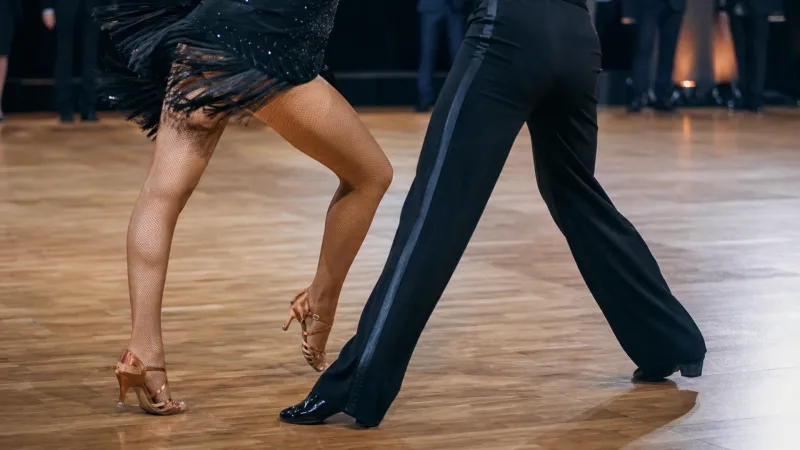
At the center of the Samba competition dance judging criteria is the characteristic body action. Samba thrives on two contrasting forms of movement: the bounce and pelvic activity. While the bounce represents a rhythmic spring from the knees and ankles, other figures require a flat, soft hip movement without vertical rising and falling. A common mistake is to mix both actions or to perform the bounce in an overly stiff manner. Judges pay meticulous attention to whether the couple cleanly separates the respective technique according to the figure being danced.
Another key criterion for Samba evaluation in competition is footwork. Every step must be placed in a controlled manner over the ball of the foot and rolled through cleanly. Since Samba has a high degree of progressiveness, meaning it requires strong movement along the line of dance, the pressure point to the floor is decisive. Only those who push off powerfully from the standing leg achieve the required dynamics and spatial effect. Sloppy transitions or heels placed flat lead to immediate point deductions, as they disturb the flow of movement and endanger balance.
Correct
Error
A good couple is defined by the fact that you not only hear the music, but see it in every muscle fiber of their body. Technique is the tool for this, not an end in itself.
Beyond the purely mechanical execution of the steps, the judges evaluate the visual unity of the couple. The Samba technique in Latin American dances requires a constant balance between maximum body tension and elastic flexibility. The arms must not hang uncontrollably in the air, but must harmoniously extend every movement of the body. A stable, yet adaptable dance posture ensures that leading signals are transmitted without delay. If the connection between the partners breaks, the synchronous presentation suffers immediately.
In addition, musicality and so-called "floorcraft" are included in the scoring. Floorcraft refers to the couple's ability to move skillfully through the space despite a crowded dance floor, avoid collisions, and flexibly adapt their own choreography. Those who keep their cool despite oncoming traffic and present the Samba with the typical, proud charisma secure important points. If you want to optimally prepare for your dance development and avoid typical stumbling blocks from the start, a look at the dance course etiquette will help you.
The rhythmic bouncing in two-four time
The vertical bounce is created by the rhythmic bending and stretching of the knees and ankles. It gives the Samba its typical, pulsating lightness on the dance floor.
Smooth pelvic action without vertical movement
In stationary figures, the bounce gives way to a fluid, horizontal hip movement. Here, the body's height remains constant while the pelvis interprets the music.
Rhythm has absolute priority. Anyone who does not dance exactly to the beat of the music loses any chance of a good placement, as the technical execution is worthless without rhythm.
The jury evaluates footwork based on the clean placement of the feet. Every step must be actively placed on the ball of the foot and rolled through in a controlled manner to guarantee stability.
Floorcraft refers to the skillful navigation of a crowded dance floor. Couples must be able to adapt their choreography spontaneously to elegantly avoid collisions.
Find the right training to take your technique to the next level.
Couple danceLimbach-Oberfrohna · Germany
PaartanzkreisFriday · 18:15 · Oct 23
Limbach-Oberfrohna
BallroomMeißen · Germany
Tanzkreis | PROFESSIONALTuesday · 20:15 · Oct 27, 2026 - Jan 5, 2027
“Ein Haus für Vieles” - Saal Tanzkurse
Couple danceLimbach-Oberfrohna · Germany
Silberkurs für PaareSunday · 16:15 · Oct 25 - Nov 15
Limbach-Oberfrohna
 Ballroom vs. Social Dance: A ComparisonBallroom or Social Dance? Our guide compares the worlds of the classic ballroom and the modern dance scene regarding atmosphere and rules.
 Dancing Samba: From Samba no Pé to competitive danceDancing Samba is pure joy of life. Learn everything about the fiery rhythm, the first steps, and how to get started successfully in our beginner's guide.
 Dance Class Etiquette: The 10 Essential Rules for BeginnersFeel confident and relaxed during your first dance lesson: With our dance class etiquette for beginners, you will avoid common pitfalls and start your journey on the dance floor with ease.
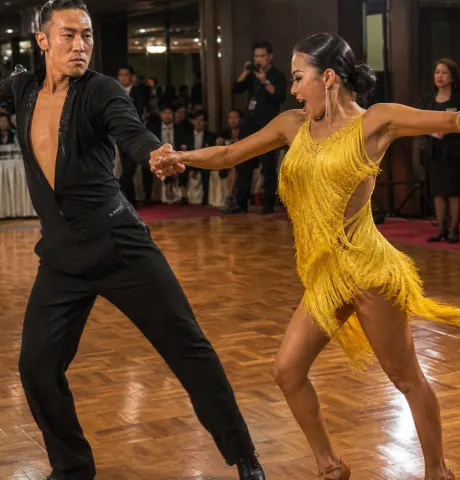 Samba in ballroom and competitive dance: technique & rulesSamba in competitive dance fascinates with its speed and precision. Learn how the Latin American tournament dance differs from the Brazilian social dance.
 Mastering Samba bounce technique: Step-by-step guideLearn the essential Samba bounce for an elegant look. Our step-by-step guide shows you how to perfectly execute the bounce from your knees and ankles.
 Avoiding Samba mistakes: The 7 most common pitfallsDancing Samba is fun, but it requires precise technique. Learn here how to avoid typical mistakes in posture and rhythm when dancing in a ballroom setting.
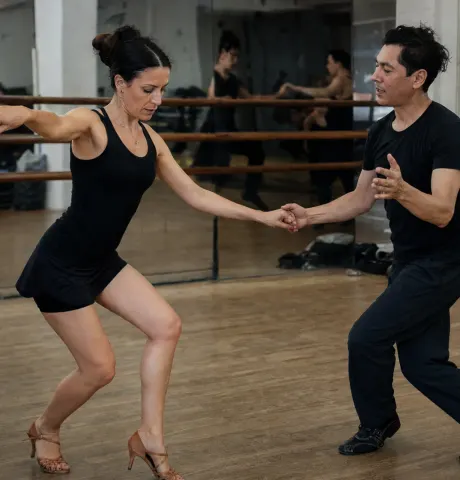 Which Samba competition class suits you? Take the testFind out which Samba competition level, from D-class to S-class, best matches your dance skills with our in-depth self-test.
 Samba competition dress: The official rulesIf you want to shine in Samba competitions, you need to know the associations' strict dress rules. Our guide shows you what matters for the perfect Samba competition dress.
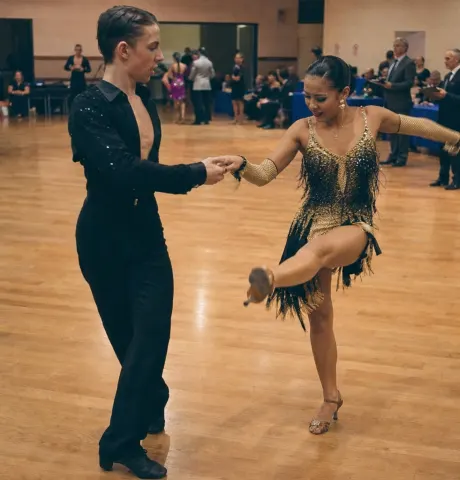 Creating a Samba choreography: A guide for couplesA harmonious Samba choreography is the key to success in the D-class. Learn how to create a secure and expressive routine for the tournament floor.
 Samba Music Trends: Modern Beats in Dance SportExperience the evolution of samba music: modern pop remixes and electronic beats are currently revolutionizing dance schools and competitive sports.