
Find your partner for every dance floor
On udansa, you can find like-minded people for every dance floor. Search specifically for people who share your passion for formal balls or relaxed dance parties.



By Bernhard De LucaUpdated
On udansa, you can find like-minded people for every dance floor. Search specifically for people who share your passion for formal balls or relaxed dance parties.
Whether it is a festive ballroom or a club atmosphere: the choice between ballroom dancing and social dance determines how you experience music and connect with other people on the dance floor.
Social dance refers to dance styles that are primarily danced for social interaction, conviviality, and free improvisation at parties. The focus is on spontaneous communication between the leader and the follower without fixed choreographies.
Anyone looking into partner dance for the first time will quickly come across two terms that often seem like opposites: ballroom dance and social dance. The fundamental difference between ballroom and social dance lies primarily in the structure and the setting in which the dancers move. In classic ballroom dance, as it is traditionally taught in a dance school, the focus is on learning a fixed repertoire together. This includes the standard and Latin dances of the world dance program, which couples usually move through the room in a fixed dance hold. The atmosphere is often characterized by a certain formality, which gives the dances an elegant, festive character.
In contrast, the modern social dance scene with styles like Salsa, Bachata, or West Coast Swing has created a completely different world. Here, it is less about exactly following a prescribed direction of dance or reeling off learned choreographies, but rather about spontaneous communication in the moment. If you are facing the decision of whether to choose a classic dance school or a dance party, you should ask yourself what feeling you are looking for on the dance floor. In social dance, changing partners after every song is absolutely common, which makes the scene extremely dynamic and approachable.
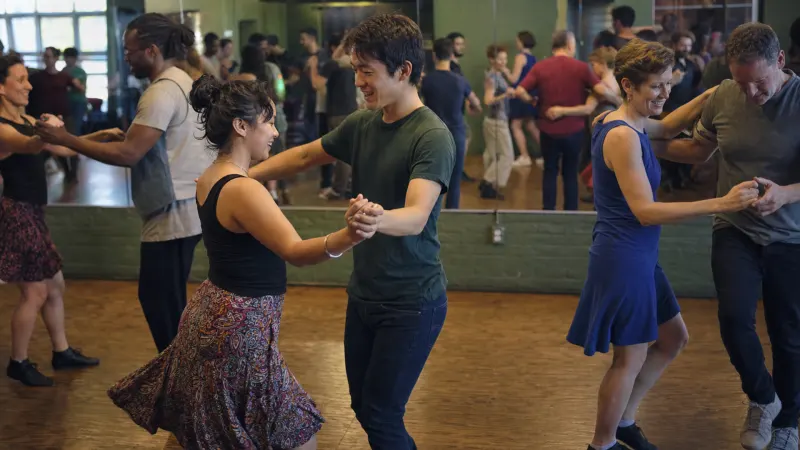
The different dynamics are particularly evident in a direct comparison: ballroom vs social dance. In the ballroom, couples generally move counter-clockwise along the dance floor. There is a clear spatial layout that prevents collisions and creates a harmonious overall picture. This structure provides security, but also requires discipline and mutual consideration. If you are wondering how to find the perfect start, our guide Finding a dance course for beginners: How to get started easily will help you take your first steps in a protected environment.
Modern social dances break these strict lines. At a social dance party, every couple dances on the spot or uses the space completely freely. The music is often more modern, the rhythms are more syncopated, and the connection between the dancers is based on a constant, sensitive shift of weight. To find out which of these forms of movement suits your personality better, you can take the Which dance style suits me? The big personality test, which analyzes your preferences precisely.
Correct
Wrong
In the ballroom, you dance with each other for the bigger picture, while in social dance, you celebrate the connection as a couple and the music in the very same moment.
Whether traditional partner dance or modern partner dance is the better choice for you depends entirely on your personal goals. Ballroom dance prepares you perfectly for formal occasions where etiquette and a stylish appearance are required. You learn to move elegantly and adapt to social conventions. Social dance, on the other hand, trains your ability to improvise and your flexibility in dealing with constantly changing partners. It takes away your fear of making mistakes, because there are basically no wrong steps as long as the connection within the pair is right.
However, the following applies to both worlds: dancing opens doors to new communities. If you are still unsure which role suits you better on the dance floor, take a look at our article on the dynamics of Lead or Follow: Which lead or follow dance partner suits you?. In the end, one does not exclude the other: many dancers enjoy the variety and appreciate the precise technique of ballroom dance just as much as the playful freedom of social dance.
Classic partner dance in the ballroom
Here, clear lines, fixed dance postures, and moving together in the flow of the line of dance dominate. The focus is on aesthetics, technical precision, and the stylish mastery of traditional rhythms.
Modern club dance styles
Improvisation, eye contact, and playing with the music are at the heart of it. Through constant partner switching, non-verbal communication is sharpened, and the dance is created entirely in the moment.
The main difference lies in the structure. Ballroom dancing follows fixed rules and a specific direction of movement around the room, while social dance is based on free improvisation and spontaneous leading.
No, prior knowledge is not required. Both worlds offer special beginner courses that teach the basics of posture, steps, and leading in an understandable way.
Yes, changing partners is actually encouraged in social dance. It helps you adapt your leading and following skills flexibly to different dance styles.
That depends on your preference. If you are looking for structure and traditional elegance, a dance school is ideal, but if you are looking for casual parties and quick social connections, the social dance scene is a better fit.
Find the right course and start your dance adventure.
Couple danceLimbach-Oberfrohna · Germany
PaartanzkreisFriday · 18:15 · Oct 23
Limbach-Oberfrohna
Couple danceLimbach-Oberfrohna · Germany
Silberkurs für PaareSunday · 16:15 · Oct 25 - Nov 15
Limbach-Oberfrohna
 Viennese Waltz vs. Slow Waltz: The differences explainedViennese Waltz or Slow Waltz? Our comparison shows you the differences in tempo, movement, and difficulty to help you get started perfectly.
 Which partner dance suits you? The ultimate self-testWhich partner dance is really for you? Take our quick self-test and find out if you are the elegant Waltz type, the fiery Salsa fan, or the sensual Tango improviser.
 Finding a dance class for beginners: How to get started easilyGetting started is easy: With our guide, you will find the right dance class for beginners and prepare perfectly for your very first dance lesson.
 Comparing partner dance styles: Which one suits you?Which partner dance is the perfect fit for you? Our comprehensive style comparison highlights the differences between ballroom, Latin, and modern social dance styles.Viennese Waltz vs. Slow Waltz: The differences explainedViennese Waltz or Slow Waltz? Our comparison shows you the differences in tempo, movement, and difficulty to help you get started perfectly.Which partner dance suits you? The ultimate self-testWhich partner dance is really for you? Take our quick self-test and find out if you are the elegant Waltz type, the fiery Salsa fan, or the sensual Tango improviser.
 Standard vs. Latin: What is the difference?The difference between Standard and Latin dances defines the entire ballroom dance program. Learn how posture, movement, and rhythm shape both styles.
 The 5 Easiest Partner Dances for BeginnersEvery beginning is easy: We introduce you to the 5 easiest partner dances for beginners, with which you will look great on the dance floor immediately, even without prior experience.
 5 steps to finding your shared dance styleLearning to dance together strengthens your relationship. With this simple step-by-step guide, couples can find the perfect dance style that you both enjoy without any arguments.
 Limited space? The best partner dances for crowded floorsIf you want to dance at parties or weddings, you often have very little room. We show you the best space-saving partner dances that help you look great even in the tightest spots.