
Find your partner for the Waltz
On udansa you can find like-minded people who want to conquer the three-quarter time with you. Discover suitable dance courses in your region and meet your perfect dance partner for the next ball night.


By Mary De LucaUpdated
On udansa you can find like-minded people who want to conquer the three-quarter time with you. Discover suitable dance courses in your region and meet your perfect dance partner for the next ball night.
Two dances in the same time signature, yet they differ like night and day. We show you how the Viennese Waltz and the Slow Waltz feel on the dance floor and which style is perfect for your start with udansa.
Three-quarter time is the rhythmic foundation of both waltz styles and is characterized by three even beats per measure, with the first beat being accented.
Anyone starting out with partner dance will quickly come across the term Waltz. But not all Waltzes are the same. The two best-known variations, the Viennese Waltz and the Slow Waltz, differ fundamentally in their dynamics. The difference between Viennese Waltz and Slow Waltz is most evident in their speed. While the Viennese Waltz sweeps across the dance floor at around 60 bars per minute, the Slow Waltz comes in at half that tempo with about 30 bars per minute. This difference in tempo shapes not only the feeling while dancing, but also the entire movement in the room.
For beginners looking for a dance style for beginners, this difference is crucial. The high tempo of the Viennese Waltz requires quick reactions and precise turning technique. The Slow Waltz, on the other hand, gives you plenty of time to find your balance and execute the movement consciously. It is therefore often perceived as the harmonic, flowing variation where couples glide elegantly through the room without breaking a sweat.

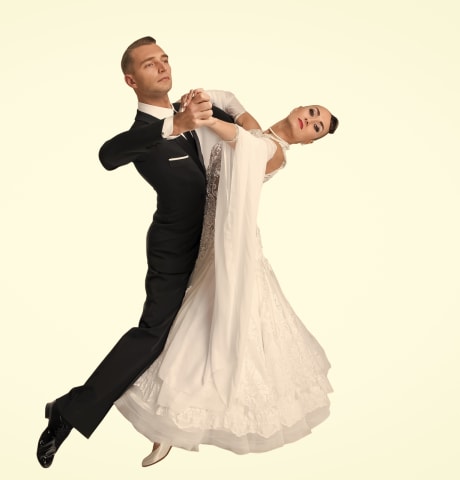
Another essential aspect of the differences between the waltzes lies in the use of the dance floor. The Slow Waltz thrives on wide, space-consuming steps. Since the music is slow, the dancers have time to sink deep into their knees and push off powerfully. The movement resembles a gentle wave that continues through the room. It is a constant rising and falling that gives the dance its typical, floating elegance.
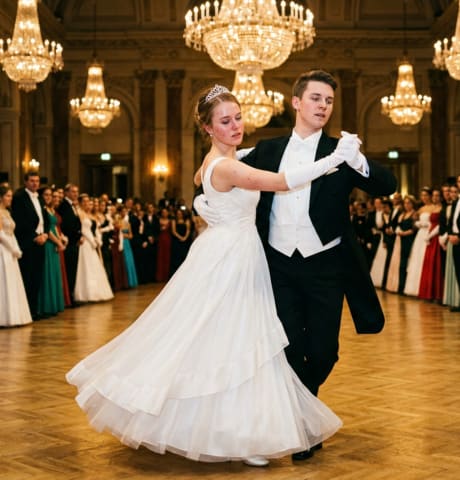
In the Viennese Waltz, the space allocation is completely different. Due to the high Viennese Waltz tempo, there is hardly any time for deep knee bends or expansive steps. Instead, the couple moves in fast, rotating turns along the line of dance. The focus here is on centrifugal force and shared momentum. On crowded dance floors, as experienced at a large ball, the Viennese Waltz therefore requires excellent orientation to avoid collisions. If you want to navigate in a relaxed manner here, you might sometimes prefer to fall back on the Foxtrot as a savior in the crowd at large events.
Correct
Wrong
The Slow Waltz is like a calm river you glide along, while the Viennese Waltz is like a wild whirlwind that sweeps you away.
When it comes to learning one of the two dances as a beginner, the question of difficulty often arises. When it comes to learning waltz for beginners, the Slow Waltz usually has the edge. Its basic steps are logically structured and the slow tempo is forgiving of small hesitations. You can focus entirely on your posture and the interaction with your partner. The first slow waltz steps usually feel secure and elegant very quickly.
The Viennese Waltz, on the other hand, presents beginners with a physical challenge. The fast turns can initially lead to dizziness, and coordinating your feet at high speed requires a lot of practice. Nevertheless, the fast waltz also has an unbeatable advantage: it has significantly fewer complex figures than its slower brother. Once you have mastered the turn, the Viennese Waltz runs almost by itself. If you want to prepare for festive occasions, you can find out which preparation path best suits your plans in the dance course test for the ball on udansa.
Fast-paced and lively, spinning around
The Viennese Waltz captivates with its fast-paced dynamics. With quick, continuous turns, you move in circles across the dance floor, which requires good stamina and a head for heights.
Gently gliding with plenty of room for posture
The Slow Waltz focuses on controlled elegance. The slow music allows for wide, flowing steps with soft rise and fall movements, which give the dance a floating character.
The Slow Waltz is usually easier to learn for beginners. The calm tempo gives you enough time to coordinate steps, posture, and the typical rise and fall movement without stress.
The Viennese Waltz is played at about 58 to 60 bars per minute. This corresponds to around 180 steps per minute, making it one of the fastest and most physically demanding ballroom dances.
No, the basic steps differ significantly. The Viennese Waltz consists almost exclusively of fast right and left turns, while the Slow Waltz features a variety of figures such as promenades, pivots, and weaves.
Prepare for your next dance event with the right course.
Couple danceLimbach-Oberfrohna · Germany
PaartanzkreisMonday · 19:30 · Oct 12
Limbach-Oberfrohna
BallroomMeißen · Germany
Tanzkreis | PROFESSIONALTuesday · 20:15 · Oct 27, 2026 - Jan 5, 2027
“Ein Haus für Vieles” - Saal Tanzkurse
Couple danceLimbach-Oberfrohna · Germany
PaartanzkreisFriday · 18:15 · Oct 23
Limbach-Oberfrohna
 Which dance style suits me? The ultimate guide for beginnersYou want to start dancing but don't know which style suits you best? Our comprehensive guide gives you the perfect orientation for your start on the dance floor.
 Foxtrot at the ball: Your reliable savior in the crowdFoxtrot is the secret hero of every ball night. Learn how this uncomplicated dance saves your evening when the floor is crowded and the music is unclear.
 Which dance course for the ball? Take the self-testIs the ball season just around the corner and you are not sure which course will best prepare you for the dance floor? Our self-test shows you the ideal path for your time budget.
 Comparing partner dance styles: Which one suits you?Which partner dance is the perfect fit for you? Our comprehensive style comparison highlights the differences between ballroom, Latin, and modern social dance styles.
 Which partner dance suits you? The ultimate self-testWhich partner dance is really for you? Take our quick self-test and find out if you are the elegant Waltz type, the fiery Salsa fan, or the sensual Tango improviser.
 Standard vs. Latin: What is the difference?The difference between Standard and Latin dances defines the entire ballroom dance program. Learn how posture, movement, and rhythm shape both styles.
 The 5 Easiest Partner Dances for BeginnersEvery beginning is easy: We introduce you to the 5 easiest partner dances for beginners, with which you will look great on the dance floor immediately, even without prior experience.
 5 steps to finding your shared dance styleLearning to dance together strengthens your relationship. With this simple step-by-step guide, couples can find the perfect dance style that you both enjoy without any arguments.
 Limited space? The best partner dances for crowded floorsIf you want to dance at parties or weddings, you often have very little room. We show you the best space-saving partner dances that help you look great even in the tightest spots.
 Bachata vs. Kizomba: A comparison of sensual partner dancesAre you looking for the perfect blend of rhythm, elegance, and connection? Our guide shows you the subtle differences between Bachata and Kizomba.