

Find your Bachata partner on udansa
On udansa you will find like-minded people in your city who want to practice the first basic step with you or hit the next Latin party. Sign up and discover suitable courses and dance partners in your area.
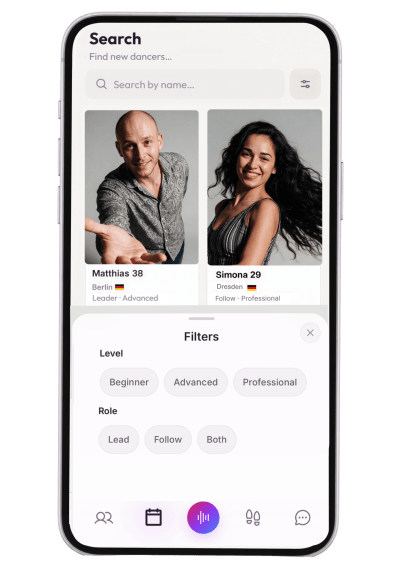

Bachata is taking dance schools and clubs by storm worldwide. With its catchy rhythms and warm community, this dance is the perfect starting point for anyone looking for joy on the dance floor.
The tap refers to the rhythmic tapping of the floor with the unweighted foot on the fourth and eighth beat in the Bachata rhythm. It completes the sequence of steps and prepares for a change of direction.
Anyone starting to dance is often looking for an entry point that is fun quickly and does not require years of theory. This is exactly where Caribbean partner dance comes in. If you want to learn to dance Bachata, you are entering a global community known for its openness and zest for life. The dance originally comes from the Dominican Republic and has developed from a melancholic street dance into a global phenomenon. A big advantage for getting started: the basics are surprisingly uncomplicated compared to other dances like Salsa or Tango.
A structured Bachata dance course takes away the fear of the first steps. In a group of like-minded people, you will not only learn the movement sequences, but also the interaction between leading and following. By the way, you do not need any prior knowledge for the beginning and often not even a fixed partner, as partners are regularly rotated in the courses. This way, you learn from the very first second to adapt flexibly to different dance partners, which will help you enormously later at parties.
Before you venture onto the dance floor, a look at the musical structure helps. The music is based on a clear four-four time. Anyone who understands the basic rhythm structure of Bachata music will never lose their orientation. You count in the classic scheme from one to eight. The actual basic step extends over four beats: three steps lead to the side or forward and back, followed by a so-called tap on the fourth beat. This tap is a light touch of the floor with the ball of the foot, often accompanied by a gentle, characteristic hip movement.
This guide to the Bachata basic step forms the foundation for all further figures. Once you have internalized this pattern, you can venture onto the dance floor almost anywhere in the world. Over time, however, different trends have developed. The most important differences in Bachata styles are shown in the range of movement: while traditional Bachata Dominicana is danced very playfully and with fast footwork, the modern style emphasizes soft, flowing body waves. Anyone starting in the Bavaria region, for example, will find a particularly popular, modern variant of the dance with Bachata Sensual in Munich.
Feel free to count the music quietly in your head at the beginning: one, two, three, tap. This strengthens your sense of rhythm extremely quickly, until it happens all by itself.
Bachata is not about spinning as many complicated figures as possible, but about feeling the music together with your partner in the same rhythm.
The true magic of dance unfolds outside the classroom. A Bachata social party is a casual event where dancers of all levels come together to try out what they have learned in a relaxed atmosphere. It is not about perfection or flawless choreography here, but about the connection to the music and your partner. It is completely normal, and even encouraged, to ask other dancers for a dance even as a beginner.
To make the transition from the classroom to the social dance floor easier, good preparation helps. If you are still looking for the right companion for your first class, you can look for a dedicated Salsa and Bachata partner in Munich or other cities. Starting together takes away the nervousness. At the party itself, the rule is: focus on simple Bachata steps in partner dance and enjoy the music. The community is known worldwide for its mutual support, so even small mistakes are usually laughed off with a smile.
The rhythmic origin
The traditional style from the Dominican Republic captivates with fast footwork, an open dance position and a playful, rhythmic interaction with the beat of the instruments.
The modern evolution
This modern style focuses on close body leading, fluid movements, and gentle body waves that fit particularly well with modern, pop-oriented songs.
Bachata is ideally suited for absolute beginners. The basic step is very easy to learn compared to Salsa or Tango, so you can dance simple figures after just the first lesson.
Find the right course and start your journey into the world of Bachata.
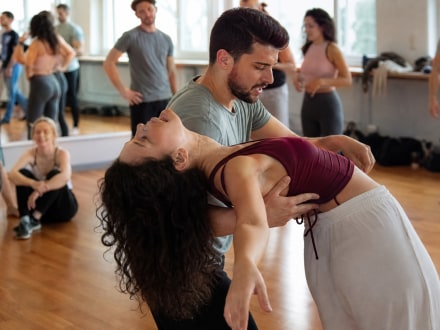 Bachata Sensual in Munich: A dance style booming by the IsarThe Bachata Sensual scene in Munich is growing rapidly. In our case study, learn how this fluid dance style has conquered the city and how you can become part of the community.
 Salsa and Bachata: The best communities in MunichAre you looking to connect with the Munich Salsa and Bachata scene? We introduce you to the most active communities where you can start dancing right away, even without a fixed partner.
 Bachata styles and history comparedDiscover the fascinating history of Bachata and learn the differences between the traditional Dominican style and modern variations like Bachata Sensual.
 Bachata Basic Step and Dance Technique for BeginnersGetting started is easy: With our simple guide to the Bachata basic step and proper hip technique, you will master your first steps in partner dancing effortlessly.
 Mastering Bachata rhythm and musicDiscover how the musical structure of Bachata is built and how to use the instruments to hear and dance to the beat without missing a step.
 Bachata Social Dance: Your Guide to Classes and PartiesEntering the world of Bachata social dance opens doors to a passionate community. Learn how to prepare perfectly and shine at parties.