Dance culture6 minutes

Dancing in Bonn: Classes, Connection and the Stage

By Mary De LucaUpdated

Kurz gesagt
  • Tanzen in Bonn umfasst Unterricht, gemeinsames Tanzen und den Besuch von Bühnenaufführungen.
  • Im Unterricht lernst du Technik, während du beim freien Tanzen auf Musik und andere Menschen reagierst.
  • Zur Bonner Tanzgeschichte gehören internationale Gastspiele, die freie Szene und Tanzauftritte im Karneval.
  • Für Unterricht und Tanzabende in Bonn findest du passende Angebote und Tanzkontakte auf udansa.

A dance class, a performance, and a dance meetup can spark the same enthusiasm, but each calls for a different kind of attention. If you're moving to Bonn or looking for a new way to get involved there, you don't have to pit these experiences against each other.

DefinitionSocial Dance

Social Dance bezeichnet gemeinsames Tanzen in einem geselligen Rahmen, ohne dass eine Aufführung oder ein Wettbewerb im Mittelpunkt steht. Dabei können Paare wechseln oder Menschen gemeinsam in einer Gruppe tanzen.

Unterricht gibt deiner Bewegung eine Grundlage

Wenn du Tanzen in Bonn zunächst als Unterricht kennenlernen möchtest, hilft eine Unterscheidung: Ein Tanzstil beschreibt eine Bewegungssprache, ein Kursformat beschreibt, wie du sie lernst. Im Paartanz gehört die Abstimmung mit einer anderen Person dazu. Bei einer Solochoreografie arbeitest du an einer festen Folge, in improvisationsorientierten Formaten an Entscheidungen ohne vorgegebene Schrittfolge. Keiner dieser Zugänge setzt voraus, dass du bereits auftreten möchtest.

Eine erste Unterrichtsstunde besteht deshalb nicht nur aus Schritten. Du lernst, Gewicht von einem Fuß auf den anderen zu übertragen, einen musikalischen Puls zu hören und Bewegungen zu dosieren. Im Paartanz kommt hinzu, dass ein Signal rechtzeitig und ohne Ziehen ankommen muss. Eine Figur gilt nicht schon deshalb als verstanden, weil du ihre Reihenfolge kennst. Sie braucht einen stabilen Stand und ein passendes Timing.

Wiederholungen sind dabei Arbeitszeit: Die Aufmerksamkeit wandert von den Füßen zur Musik und schließlich zum gemeinsamen Bewegungsgefühl. Eine Orientierung zu den Lernformen bietet der Ratgeber zu Tanzkursen für Erwachsene. Für deinen Einstieg ist damit zunächst die Art des Lernens wichtiger als eine möglichst lange Liste von Tänzen.
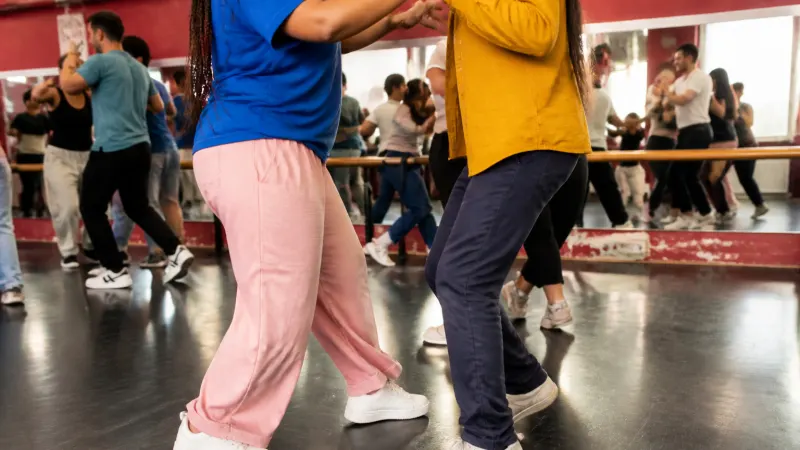
When watching, you can also pay attention to pauses: movement is shaped by what happens between movements.

Dancing together does not require a committed partnership

Between lessons and public performances lies social dancing. A social dance can be based on familiar basic steps and still look different every time: the music changes, the space shifts, and your partner adds different accents. Here, a practiced movement becomes spontaneous communication. A small step that works for both of you is often better than a big figure that only one person knows.

Dance partners can therefore play different roles in your everyday life. A regular practice partner makes it possible to repeat things consistently. Dancing with different people lets you experience how the same lead or rhythm is interpreted differently. Both are worthwhile, as long as your expectations align. Dancing together does not commit you to more dances or a private date.

Invitations can be brief, and so can refusals. On a crowded floor, make your steps smaller and leave out risky moves. Unsolicited corrections have no place in a social dance. If you're looking for lessons without a regular partner, the guide to dance classes for singles explains this option in more detail. If you're looking for a dance partner in Bonn, you can use udansa to say which style you dance and whether you'd like to practice or go out.

Classifying different formats correctly

Yes, like that

  • Repeat a movement in class and take in corrections
  • At a dance evening, adapt the movement you do together to the space
  • At performances, also pay attention to pathways through the space and group formations

Not like this

  • Dismiss every repetition in class as a lack of variety
  • Force large figures from class into a cramped space at a dance night
  • Judge every performance only by whether its steps can be copied

A class gives you time to review, a dance evening calls for decisions in the moment, a performance changes your perspective on movement.

Dance guide editorial team

Bonn's dance history spans guest performances and Carnival

Stage dance has a different framework from classes: movements are designed for an audience to watch. This can create a recognizable story, but it can also explore bodies, sound and space. In Bonn, this range can be traced through the city's dance history. The Theater Bonn's in-house dance department closed at the end of the 2007/2008 season. After that, the guest performance series “Highlights of International Dance” presented classical ballet and contemporary dance at the opera house, with a focus on German premieres.

The independent scene includes the CocoonDance group, founded in 2000. It took over the direction and artistic programming of the dance department at Theater im Ballsaal in Endenich. This history shows another approach: dance is created not only in large theater companies, but also in venues shaped by the work of producing artists. “Independent” describes the production structure here, not movement without technique.

Another tradition connects dance with Bonn Carnival, whose organized history goes back to a society founded in 1826. Dance groups performed at the Bonn Carnival Festival on Münsterplatz on February 7, 2026. Such routines involve group formations and coordinated accents. Historical series and past performances are not event announcements, however: they explain the different contexts in which dance has become visible in Bonn.

Two ways to experience a dance

Join in

You feel the movement for yourself

Weight, rhythm and connection become physical

When you dance, you notice when a step feels stable and when you set off too soon. You don't need a big repertoire of moves to shape the music together. Small movements give you time to respond to others.

Watching

You see relationships emerge

Distances, repetitions and contrasts become visible

As a spectator, you can follow how an ensemble separates and comes together again. You don't need to master the movements yourself. Even a quiet moment can make it clear how tension arises between people.

Frequently Asked Questions

  1. Yes, you can get started without a regular dance partner, for example with a solo format or a class format where partners rotate. Solo does not automatically mean dancing alone: a group can learn the same choreography. On udansa, you can also find dance partners in Bonn to practise together.

Dance classes in Bonn

On udansa, you can find classes in Bonn if you want to turn your exploration into regular practice.

Your access starts with connection

On udansa, you’ll find dance partners in Bonn to practice with or join for a dance night. Describe whether you’re currently learning the basics or already want to dance together to the music.

Your access starts with connection