Your Dance connection in Paris
On udansa connect, you can find people in Paris to practice with or enjoy a dance night. Your profile shows which dance you'd like to discover and what experience you bring.

By Bernhard De LucaUpdated
On udansa connect, you can find people in Paris to practice with or enjoy a dance night. Your profile shows which dance you'd like to discover and what experience you bring.
If you live in Paris or are just moving here, an evening in the audience can be just as much a part of it as an hour on the dance floor. What matters is which role you want to take on.
Social dance means dancing together to music without a stage performance or competition judging. A social is a dance event where you can freely use moves you've already learned.
When dancing in Paris, it helps to start by distinguishing your role: Are you learning, dancing freely, or watching? A style name alone doesn't answer that. The same dance can appear as a beginner class, social dancing, or stage choreography. The music may sound similar, but the format asks something different of you.
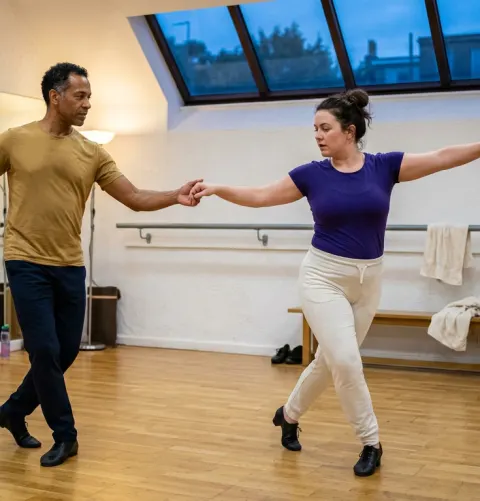
In class, movements are broken down and repeated. For example, you learn to transfer your body weight fully from one foot to the other. Only then is your free foot ready for the next step. Arms and turns are added to this foundation. The article on common mistakes when copying dance movements explains why simply copying the visible form isn't enough.
On an open dance floor, the music keeps playing even if you briefly lose the rhythm. On stage, the beginning, pathways across the space, and ending are often choreographed. The type of event tells you as much about what to expect as the dance style does. A class is a learning environment, a dance evening is a place to put what you've learned into practice, and a performance is an experience for an audience. These differences apply even when all three use the same musical material.
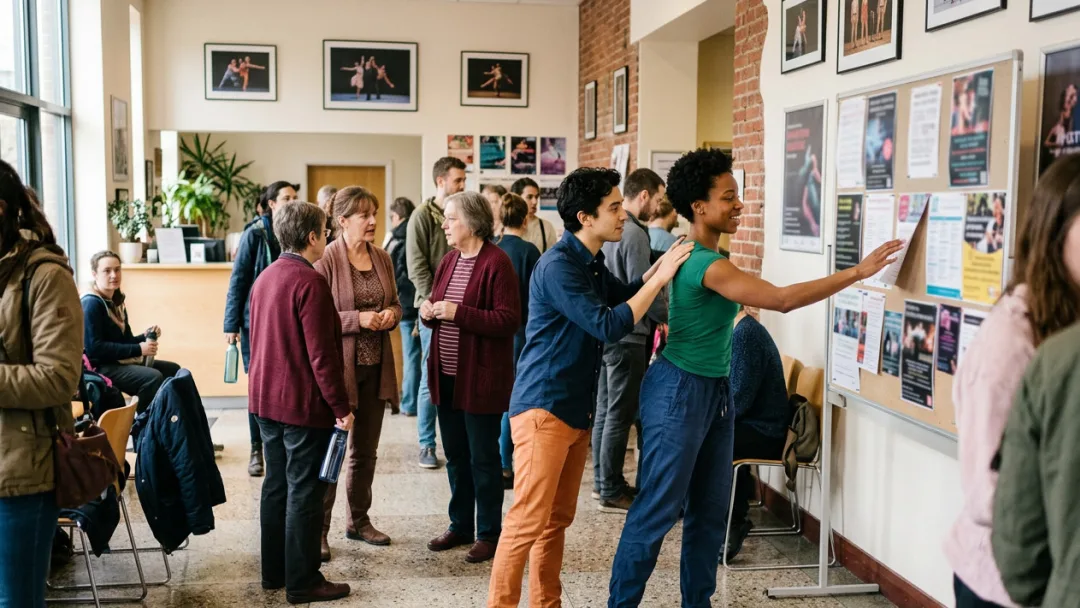
Paris's dance culture cannot be reduced to a single image. The Paris Opera Ballet names 1661 as its founding year; in 1875, the Palais Garnier became its home. At the Moulin Rouge, which opened in 1889, the Cancan developed into a revue number in its own right. Both stories belong to the stage, even though the Cancan was danced in public dance halls before that.
The Bal musette offers a different perspective. It became popular in Paris in the 1880s. The accordion, brought by Italian musicians, was later added to the cabrette, a type of bagpipe. In the 1930s, Rue de Lappe was known for its musette dance halls. Here, the historical account focuses on dancing together, not on watching a fully staged number.
Contemporary dance is also part of this perspective: in 2008, the Théâtre national de Chaillot received a focus in its funding. Historical strands like these explain why you can connect Paris with very different forms of movement. However, they do not prove that there are course spots available today or open dance floors at these venues. Nor can you infer a distinct style from a spectacular show, as the explanation of the difference between freestyle, style mix and choreography shows.
Yes, like this
What not to do
On udansa, you'll find the latest classes in Paris and can get started with lessons.
A figure is only understood once you know which foot your weight is on afterward.
For your own dancing, the most important distinction is physical: Would you like to perform movements on your own, coordinate with a partner, or create something together in a group? Solo does not automatically mean free improvisation. You can learn a set choreography on your own, too. Partner dancing, in turn, does not mean that every movement is agreed on beforehand: leading and following make it possible to communicate while the music plays.
In a group dance, shared counts and directions of movement can create a sense of connection. Partner dancing adds signals through contact, posture, and movement. If you just watch at first, you can spot both principles: Is everyone moving through the same sequence, or do different combinations emerge within a shared rhythm? This observation makes the differences tangible, without requiring you to name a step yet.
For your everyday life in Paris, it's also worth separating two wishes: learning something and meeting someone to dance with. Classes can offer both, but they don't guarantee a private practice partner. A dance connection, in turn, is no substitute for instruction. On udansa, you'll find current class listings and registered events in Paris; with udansa connect, you can make your wish to dance together visible. This keeps an interest in culture, learning, and social connection linked, without expecting one single offering to provide everything.
You observe choices on stage
As an audience member, you can pay attention to repetitions, pathways through space, and the interplay with the music. You don’t have to master the movements yourself to notice tension, calm, or an unexpected change.
You experience rhythm through shifts in weight
When you dance along, you notice how timing, balance, and the size of your steps are connected. A simple movement can demand a lot of attention, even if it looks unremarkable to the audience.
Perfect French is not a requirement, but the language of instruction affects how well you understand explanations. Demonstrations show you steps and movements, but they do not replace guidance on exertion or partner contact. Terms for right, left, weight, and repetition make it easier to follow along, especially when a sequence moves on quickly.
Yes, you can start without a regular dance partner, especially with solo dances or partner dance classes specifically designed for this. You do not need a partner for individual movement training. With partner dance, however, practicing together depends on the class format. Partner rotation is one possible teaching practice, but it is not a feature of every class.
You do not need a large repertoire of figures, but knowing a few reliable basic movements in the right rhythm is helpful. On an open dance floor, no one will automatically explain every step. A limited range of movements lets you focus on the music and other people, while lots of half-remembered figures can make your dancing feel unsettled.
No, a show and a dance night can feature the same style, but they have different goals. A show choreographs movement for an audience and may include set patterns or effects. When dancing together, movements need to suit the available space and, if relevant, communication with your partner.