
Find your perfect Salsa dance partner
On udansa you can find dance enthusiasts in your area who share your passion for the rhythm. Sign up and discover suitable Salsa courses and events in your city.



By Bernhard De LucaUpdated
On udansa you can find dance enthusiasts in your area who share your passion for the rhythm. Sign up and discover suitable Salsa courses and events in your city.
Entering the world of Salsa is the start of a journey full of joy and movement. Leave your doubts behind and discover how easily you can master your first steps on the dance floor.
The Salsa basic step is based on an eight-beat rhythm, where a step is taken on counts one, two, three and five, six, seven, while counts four and eight serve as short pauses.
Salsa is much more than a sequence of steps, it is a vibrant way of life that connects people worldwide. Anyone who starts learning to dance Salsa enters a space full of energy, rhythm, and social interaction. The roots of this dance lie in a fascinating mix of Afro-Cuban rhythms like Son and Western influences, which primarily formed in New York during the 1960s and 1970s. This historical diversity has led to the fact that Salsa is not a rigid dance today, but is lived in various styles. Whether the circular Cuban style (Salsa Cubana) or the linear-based styles like the New York Style, the basics are based on a common rhythmic foundation that is learnable for every beginner.
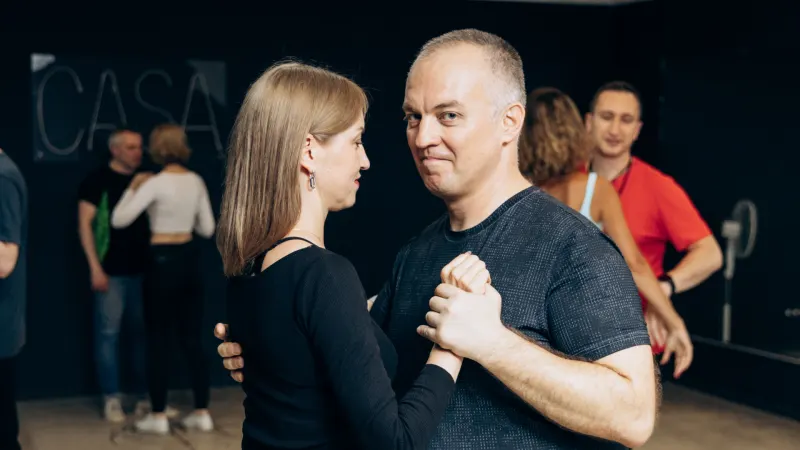
A common misconception among beginners is the belief that you have to be highly talented or extremely flexible to learn Salsa. Many delay visiting a dance school because they fear not understanding the complex rhythm immediately or embarrassing themselves in front of others. The concern of showing up to a Salsa dance course without a fixed partner also holds many back. In reality, however, Salsa is a deeply social dance where partners are constantly rotated during classes. This not only trains adaptability in leading and following, but also removes the pressure of having to harmonize perfectly from the start. The musical foundations can be systematically decoded, so that a sense of rhythm grows quite naturally over time.
Correct
Wrong
If you can walk, you can learn Salsa. It is not about perfection, but about the joy of movement and the connection to the music.
Anyone who overcomes the first hurdles and gets involved in the world of Salsa will quickly experience a noticeable enrichment in their everyday life. Salsa trains coordination, strengthens core muscles, and improves your posture. Beyond the physical aspect, a worldwide community opens up. At so-called socials, which are open dance evenings, people of the most diverse backgrounds come together. To make this transition from the classroom to the dance floor easier, it helps to connect with like-minded people early on. A suitable Salsa dance partner on udansa can be the key to overcoming inhibitions together, consolidating what you have learned in a safe environment, and finally conquering local dance floors with confidence.
The art of clear signals in partner dance
Leading is about giving your partner clear, gentle impulses through body tension. The leader plans the next step in advance and guides the movement safely through the room, without applying pressure.
The art of sensitive reaction
Following is about active attention and sensing the signals. The follower reacts to the leader's cues, maintains their own body tension, and fills the movement with individual styling.
For your first Salsa class, comfortable casual clothing that allows you to move freely is ideal. Your shoes should have clean, relatively smooth soles so that turns do not put strain on your knee joints.
No, a fixed partner is generally not necessary. In almost all dance schools and workshops, partners are rotated regularly during class, which actually accelerates the learning process.
Salsa music is usually based on a 4/4 time signature with a characteristic clave structure. The best way to find the count of one for your starting step is to listen for the heavy bass or the percussion.
Salsa Cubana is danced in a circular motion and is very playful, while linear styles like New York or LA Style are based on an imaginary straight line with fast turns.
Find the right start and learn the basics at a dance school in your area.
Couple danceLimbach-Oberfrohna · Germany
PaartanzkreisFriday · 18:15 · Oct 23
Limbach-Oberfrohna
Couple danceLimbach-Oberfrohna · Germany
Silberkurs für PaareSunday · 16:15 · Oct 25 - Nov 15
Limbach-Oberfrohna
 Learning Mambo: The 7 most common rhythm and step mistakesLearn Mambo without the frustration: We show you the typical rhythm and weight shift mistakes and how to avoid them from the very beginning.
 Find a K-Pop dance partner: Dance covers togetherDon't want to dance the choreographies of your favorite idols alone anymore? Our guide shows you how to easily find the perfect K-Pop dance partner for training and cover projects.
 Salsa dance styles: A comparison of stepsFind out which Salsa style suits you best. We compare Cuban Salsa with the linear styles from New York and Los Angeles.
 Learn Salsa rhythm: Beat and music theory for dancersDo you want to learn Salsa rhythm and finally dance on beat with confidence? Our guide explains the music structure, the key instruments, and how to find the beat effortlessly.
 Salsa leading and following: The art of subtle connectionDiscover how the subtle interplay of leading and following works in Salsa and how to elegantly improve your posture and styling.
 Salsa parties and socials: Etiquette, scene, and your first nightsSalsa social dance is your key to the global community. With our guide to etiquette and parties, you will feel right at home on any dance floor.