
Find your perfect match on udansa
On udansa you will find like-minded people to work on your posture with, as well as suitable dance schools in your area for your next workshop.



By Bernhard De LucaUpdated
On udansa you will find like-minded people to work on your posture with, as well as suitable dance schools in your area for your next workshop.
Salsa thrives on the tangible connection between partners and the shared flow on the dance floor. It is only through the subtle interplay of precise leading and expressive styling that simple steps turn into a real, vibrant dialogue.
Salsa leading and following describes the non-verbal communication system in partner dance, where one person initiates movement data and the other actively interprets it. This dynamic allows for free improvisation on the dance floor without fixed choreography.
Salsa is far more than just reeling off memorized step combinations. It is only through the fine-tuned coordination between dancers that the dynamic which makes this dance so fascinating worldwide emerges. The foundation for this is the physical connection within the pair, which functions via the principle of push and pull. The leading person does not give rigid commands, but rather invites movement through subtle weight shifts and gentle impulses in the upper body. The following person, in turn, does not react with a delay, but keeps the connection active to translate every impulse immediately into fluid steps.
A stable Salsa posture is the absolute prerequisite for this interaction. Without activated core muscles, the so-called core tension, the signals dissipate into thin air or arrive at the partner as an unpleasant tugging. The arms merely act as elastic antennas that transmit the impulse from the center of the body. Anyone who tries to lead only with their hands and arms will tire quickly and risks painful tension in the shoulder area.

As soon as the basic connection in the pair works stably, the space for individual aesthetics opens up. This is where styling elements come into play, which give the dance a personal touch. Salsa Lady Styling is by no means about forcing complicated solo show effects into partnerwork. Rather, it is about the art of using free moments in the flow of the dance to set accents with elegant hand movements, targeted hip action, or a proud head posture, without losing the connection to the partner.
The same applies to Salsa Men Styling, which is often mistakenly seen as secondary. A confident leader does not shine through wild arm movements, but through a present, grounded posture, precise footwork, and rhythmic accents in the upper body. When both dancers master their individual styling and integrate it harmoniously into Salsa Partnerwork, the dance becomes a true dialogue in which both give each other space for creativity.
Correct
Wrong
Good leading never feels like a command, but rather like a logical invitation that you simply cannot help but follow.
A particularly critical area where leading technique and styling meet directly is Salsa turning technique. Many couples fail at fast turns because they try to force the movement with strength. However, a perfect turn is based on physical principles such as axis stability and so-called spotting, the fixed gaze on a point that prevents dizziness. The leader prepares the turn with a clear prepping, a slight counter-movement to build momentum, and then only provides the impulse and the axis guidance.
The following person uses this impulse, maintains their own body tension, and turns independently on the ball of the foot without leaning on the partner. Once you have internalized this fine balance, you will experience a feeling of absolute lightness in partner dancing. If you would like to deepen your skills in social dance, it is also worth taking a look at related techniques, as described in the article on Mambo leading and following, to further sharpen your understanding of axes and weight shifts.
Providing security and shaping the space
The leading role determines the direction, the timing, and the framework of the dance. A good leader acts with foresight, offers their partner maximum security, and uses the upper body instead of pure arm strength for clear, comfortable signals.
Absorbing impulses and actively shaping the dance
The following role actively absorbs impulses and translates them into movement. Following is not a passive act of letting things happen, but requires a high level of muscle tone, attention, and the willingness to let the offered energy flow.
You can achieve good body tension in Salsa by activating your deep abdominal and back muscles. Keep your shoulders low and relaxed, while your arms maintain a light, springy basic tension to transmit signals directly.
When leading with too much force, the dance loses its lightness and there is a risk of injury. Try to give your impulses exclusively through the weight transfer of your own body, instead of pulling on your partner's arms.
It is best to integrate styling elements in moments when the lead gives you space, such as during open solos or simple basic steps. Make sure that your arm movements never block or break the connection with your partner.
Find the right dance school to take your lead technique and styling in partner dance to the next level.
Couple danceLimbach-Oberfrohna · Germany
PaartanzkreisFriday · 18:15 · Oct 23
Limbach-Oberfrohna
Couple danceLimbach-Oberfrohna · Germany
Silberkurs für PaareSunday · 16:15 · Oct 25 - Nov 15
Limbach-Oberfrohna
 First lead signals in Salsa: Creating connectionDiscover the physical and anatomical foundations of tension and compression in Salsa leading. Learn how to build a perfect connection with your partner.
 Leading Salsa correctly: A step-by-step guideLeading Salsa correctly is not a matter of strength, but of technique. In this guide, learn how to give clear signals from your core and lead your partner with ease.
 Following in Salsa: Reacting actively and sensitivelyFollowing in Salsa is not about being passive, it is a highly active process. With the right body tension and balance, you react lightning-fast to every impulse from your partner.
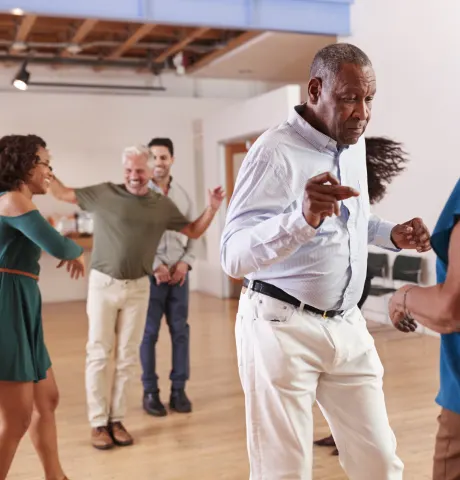 Holding your Salsa frame: Stability in a coupleThe Salsa frame is the foundation for subtle leading and harmonious dancing. Learn how to create stability as a couple with the right body tension and arm positioning.
 Salsa leading style test: Do you lead or follow too firmly?Find out with our Salsa leading style test whether you grip too firmly or act too softly while dancing. Optimize your connection for a harmonious dance experience.
 Salsa Arm Styling for Ladies: Elegant Movements for FollowersElegant arm styling adds a personal touch to your Salsa dancing. Learn how to move your arms and hands expressively without losing the connection with your partner.
 Salsa styling for men: dance with confidenceSalsa styling for men adds that special touch to your dance. Learn how to impress on the dance floor with the right posture and masculine body movement.
 Salsa leading: The 7 most common mistakes in a coupleIf you are looking for a subtle connection in Salsa, you often stumble over typical leading mistakes. Learn how to avoid gripping, pulling, and incorrect tension in your dance partnership.
 Leading Salsa turns: Technique for stable partner spinsSalsa turns in a partnership require precision and sensitivity. Learn how to lead stable turns as a leader without throwing your partner off balance.
 Salsa styling in partnerwork: timing and flowDiscover how to use Salsa styling elegantly in partnerwork. This guide shows you how to dance flourishes without interrupting your partner's lead.
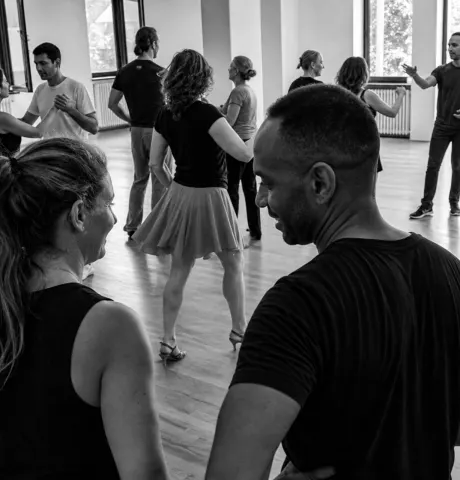 Salsa Styling Trends 2026: The Latest MovesLearn all about the Salsa styling trends 2026 and how to elegantly integrate modern body waves and urban isolations into your dance.
 Practicing Salsa leading at home: The training guideDo you want to noticeably improve your Salsa connection? With this practical guide for training at home, you will master leading and following in no time.